One is Two: A double die from a single squeeze?
Goto page Previous 1, 2 |
  |
| Author |
Message |
wavysteps2003Expert Member
Posts: 1344
Joined: 25 Feb 2005
|
|
 Posted: Sat Nov 03, 2007 11:59 am Posted: Sat Nov 03, 2007 11:59 am |
 |
|
Daggit - you are not out of your league on this forum or in fact any other forum that deals with error and variety coins.
People like Bob P., Chuck Daughtrey, Mike Diamond, James Wiles, myself, just to name a few are here to help people that do not have a full understanding of what is going on and do want to learn.
This is a very interesting hobby and the degree of knoweledge that one obtains from the information that is out there concerning what is going on about dies, planchets, presses, the MINT and such is up to the person and how far he or she wants to study it. Some of us get very deep into what is occurring, for it is our nature to want to know exactly what is happening. Others take less of an involvment in learning all the ins and outs, however, their importance in this hobby is not deminshed by this.
At times, we forget that this is a hobby and it is supposed to be fun. The degree that you want to participate in collecting coins is set by that individual and no one determines the amount of knoweledge that should be learned in order to do that.
So, basically, still ask questions and learn from what others say. When you have reached that level of knoweledge that you are comfortable with, stop asking questions. It is a simple as that.
In my case, I'm insatiably curious, so I will probably never stop asking questions (LOL).
BJ Neff
_________________
Member of: Coppercoins, ANA, CFCC (VP), CONECA, FUN, NCADD (Editor), NLG, LCR, traildies.com. and MADdieclashes.com
The opinions that I express do not necessarily reflect the policies of the organizations that I am a member of.
Last edited by wavysteps2003 on Sun Nov 04, 2007 10:06 pm; edited 1 time in total
|
|
|
|
|
 |
 DickExpert Member DickExpert Member
Posts: 5780
Joined: 21 Sep 2006
Location: Rialto, CA.
|
|
| Posted: Sat Nov 03, 2007 12:10 pm |
|
|
Daggit, dou are not alone!
I'll state that the mintage of coins is NOT the samr thought process, as applies to making love. In minting, it is not what you get that counts so mush, as the wat you do it.
In making love, it isn't wWHAT you do, but how you do it!
Dick
_________________
" Deja Moo: The feeling that you've heard this bull before".
|
|
|
|
|
|
 eagamesExpert Member eagamesExpert Member
Posts: 3013
Joined: 15 Nov 2005
|
|
| Posted: Sat Nov 03, 2007 3:33 pm |
|
|
It will be great to get some of the theories out to get the ideas to be looked at. For me some of the most confusion comes from single squeezed varieties.
It's hard to draw the line between things we call design extensions and what we call a hub doubled die.
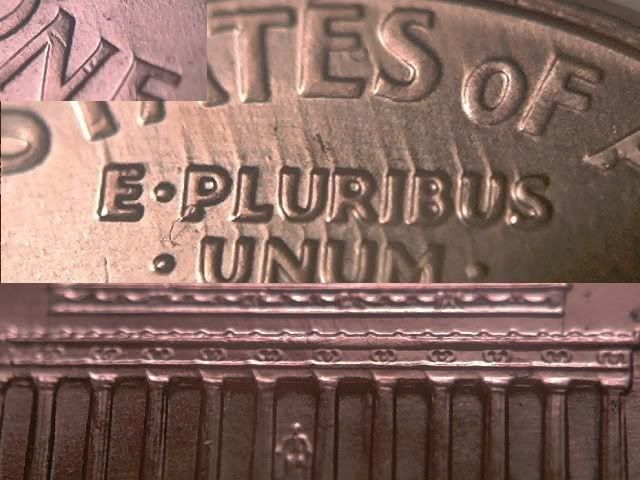
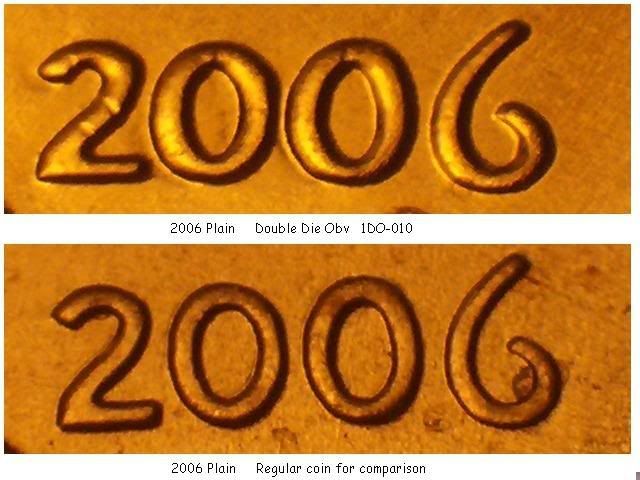
When I look at a coin like 1999 1DTR-004 and see those column tops I wonder what's different about that and the 2006 and 2007 cents with elongated dates. Part of me wants to conclude they are the same or very similar in nature. Maybe they are the same mystery class of single squeezed hub doubling, we know they are single squeezed and we know they are varieties (not strike related in any way) and they show as extensions of the design. Just out of my own discoveries I think these 2 show the similarities very well:
1999 1DTR-004 (see the column tops)
2006 Plain 1DO-010 (see the date)
_________________
Ed
|
|
|
|
|
|
eagamesExpert Member
Posts: 3013
Joined: 15 Nov 2005
|
|
| Posted: Sat Nov 03, 2007 3:46 pm |
|
|
The analogy is...
A single squeezed class 9 like 2006 1DO-010:
You make 1 handprint (hub) into a cake of mud (die) but wiggle your hand in the mud.
A coin with design extensions like 1999 1DTR-004:
You make 1 handprint (hub) into a cake of mud (die) but slide along the mud before sinking in so there's trails of each finger in the mud.
_________________
Ed
|
|
|
|
|
|
DickExpert Member
Posts: 5780
Joined: 21 Sep 2006
Location: Rialto, CA.
|
|
| Posted: Sat Nov 03, 2007 4:24 pm |
|
|
Ed, you have very clearly described my theory on how these "trails" are made. It also gives me an idea as to why/how this occurs: The spacing between the dies is actually closer than ut should be, and as the hammer comes down, the planchet is still in motion, entering the chamber, and is "scraped". Maybe "rubbed" would be a better word, thus making the trails. BJ?
Dick
_________________
" Deja Moo: The feeling that you've heard this bull before".
|
|
|
|
|
|
eagamesExpert Member
Posts: 3013
Joined: 15 Nov 2005
|
|
| Posted: Sat Nov 03, 2007 4:37 pm |
|
|
Dick,
Same basic thing but trails and class 9 DDOs are things that happen at die making so it happens when the hub is squeezed into the die.
There is no planchet or hammer or anvil used in die making just the hub squeezed into the die blank when making dies.
It's known fact that trails and class 9 DDOs are die varieties made from dies with these defects. This is why they can be listed as varieties since they are not unique and each variety has markers linking it to a specific die. What you are describing with planchets and anvils are strike errors not varieties but trails and class 9 DDOs are varieties made by dies that were made with defects causing the trails or design extensions.
But it may be similar to what you described about scrapping but it happens at the die making stage not the coin striking stage. Makes sense?

_________________
Ed
|
|
|
|
|
|
DickExpert Member
Posts: 5780
Joined: 21 Sep 2006
Location: Rialto, CA.
|
|
| Posted: Sat Nov 03, 2007 5:00 pm |
|
|
ED, In answer to you last question: yes, and no.In other words the dies would have to be moving laterally, in any cardiinal direction for my theory to work, which would say that it CAN'T happen as a result of the striking process. It would indicate that the trails would have tobe much more prevalent than they are. back to square one!
Dick
_________________
" Deja Moo: The feeling that you've heard this bull before".
|
|
|
|
|
|
eagamesExpert Member
Posts: 3013
Joined: 15 Nov 2005
|
|
| Posted: Sat Nov 03, 2007 5:21 pm |
|
|
Dick,
Well not back to square one, just back to it happens at die making not coin striking. This is already known because each class 9 variety and each trail variety has specific markers that link them to specific dies.
It will be interesting when some of the experts start to publish their ideas and explain it and other experts give their inputs.
Who knows maybe they will list several new classes of doubled dies specific to single squeeze or they will say they are all classes of design extensions (not doubled dies).
_________________
Ed
|
|
|
|
|
|
DickExpert Member
Posts: 5780
Joined: 21 Sep 2006
Location: Rialto, CA.
|
|
| Posted: Sat Nov 03, 2007 5:55 pm |
|
|
ED, it will prpbably come down to something so simple, that everyone will be asking < "why didn't I think of that"! Until then, the search continues. Thw ay the trails "seem" to be caused, sic, made, would indicate a movement, at the time of impact, be it the hubbing process, or some other action. At ant rate, it is a mystery. I hope BJ is another Scotland Yard type sleuth, that eventually come up with the correct solution! He has spent enough time, trying to find out. I am going thru a tube of 1998-D, in hopes of finding one, but I woulsn't put any money on the success of the search!
Dick
_________________
" Deja Moo: The feeling that you've heard this bull before".
|
|
|
|
|
|
wavysteps2003Expert Member
Posts: 1344
Joined: 25 Feb 2005
|
|
| Posted: Sat Nov 03, 2007 6:14 pm |
|
|
Hi Ed - I really like your analogy concerning the hand print in the mud. You do have the concept down on how trails/wavy steps are formed. Because of the action that you described, you can see the difference why these are not doubled dies. These anomalies are made differently.
What is really interesting and this just occurred to me tonight, is the fact that both the Denver die shop and the Philadelphia die shop are producing trails and wavy steps, from the same type of hubbing process, the single squeeze. It may not sound important, however, it does tie a lot together; wavy steps and trails are a function of the single squeeze process and the fact that dies have been seen from both MINT die shops adequately proves that point.
One thing though, you are using the old style numbering system when refering to a particular die. This has been changed to DEO (for the obverse) and DER (for the reverse). This has been reflected on Frank Leone's web site that has these files.
http://www.1793.com/resources/traildies/traildies.htm
For those of you who have a yen for collecting this type anomaly, some time in January of 2008, the files complied from 2007 (over a 100 new ones) will be added to that site.
Okay Dick - wavy steps and trails are not caused by striking of the planchet. These anomalies are strictly die related. All possible causes involving the striking of a coin have been ruled out as either being random in nature or not physically possible.
As I have pointed out before, we have a lot to learn concerning this siingle squeze hubbing process, for it is definitely not like the multiple hubbing system of old.
BJ Neff
_________________
Member of: Coppercoins, ANA, CFCC (VP), CONECA, FUN, NCADD (Editor), NLG, LCR, traildies.com. and MADdieclashes.com
The opinions that I express do not necessarily reflect the policies of the organizations that I am a member of.
|
|
|
|
|
|
daggitSenior Member
Posts: 560
Joined: 26 Oct 2007
Location: Canada
|
|
| Posted: Sat Nov 03, 2007 6:30 pm |
|
|
I'm absolutely overwhelmed at the knowledge base on this forum, people post coins and make reference to a number and letter combination that refers to what it is. Then I come on here and post "is this it?" LOL, oh well thats ok some of it will sink in I'm sure but till then there may be some redundant posts under my name  I can't deny my facination in the hunt for something worthy and being a newbie I'll just have to park my modesty at the door and jump in with what I've got...useless or not. I'm trying to improve my photo's so that you all can at least visualize what I'm questioning, then I'll post the big one I can't deny my facination in the hunt for something worthy and being a newbie I'll just have to park my modesty at the door and jump in with what I've got...useless or not. I'm trying to improve my photo's so that you all can at least visualize what I'm questioning, then I'll post the big one  Gotta get me a Cherry Pickers book thats for sure! Gotta get me a Cherry Pickers book thats for sure!
|
|
|
|
|
|
 notabotAdvanced Member notabotAdvanced Member
Posts: 118
Joined: 23 May 2007
|
|
| Posted: Sun Nov 04, 2007 1:25 am |
|
|
As I understand it, the scribing process for the dies is a reduction from the engraver's work, and it is mechanically reduced by a mechanism that functions as an autopen. If that device wears in the horizontal and perpendicular apparatus which are guiding the lathe tip, VOILA, you get wavy steps, letters that appear to run, are in the likeness of someone smudging the clay die with a sponge, and the like.
Wear on the lathe guide arms, that simple. The tolerances involved in the actual coin may be tight, but them thar old machines, well folks, we don't even have the steel mills that used to make the steel in the guts of those machines, much less the replacement parts.
On a tangental note, Katrina demonstrated how vulnerable we are technonogically, as the parts for the water pumps which failed were no longer made anywhere. The metal craft process the old guys knew will be lost in time as they die off, and we will need to look to foreigners for expertise if we do not develop the core expertise for the maintenance stateside, in the same vein of the strategic petroleum reserve.
A strategic technological reserve, skilled artisans and apprentices maintained in perpetuity, who can disassemble the lathe machines and put a micrometer across the lathe guides to check their tolerance and fit.
Thinking on it, as so very many years are involved, and across all mint operations, the one common factor in these errors is the machinery used...
Wavysteps....THANK YOU WHOLEHEARTEDLY FOR THE DIE TRAIL POST 
I will be printing out those pics for a binder for sure.
And Daggit, I am a newbe to this site, having joined just this year. I have had to force feed myself die variety, die markers, wavy steps (LOL), and a multitude of other terms. So stick with this forum, keep reading, and a little bit of the info here will eventually begin to sink in, and in a couple of years, you will perhaps be able to identify about ten of the coins in the Daughtry Lincoln Collage poster offered for sale. It is a collector item itself, and this site will eventually be recognized by coin historians as the most influential and important information source to emerge in the history of Lincoln Cent collecting.
|
|
|
|
|
|
|
|



