| Author |
Message |
noheaMember
Posts: 46
Joined: 05 Mar 2007
Location: HAWAII
|
|
 Posted: Mon Feb 18, 2008 6:16 pm Posted: Mon Feb 18, 2008 6:16 pm |
 |
|
I just found this while looking through some wheaties. It is on a 1941 S cent. It has a raised section that matches the wheat design outline where it appears that a piece of the die broke off but still struck the coin. Any thoughts?
[img]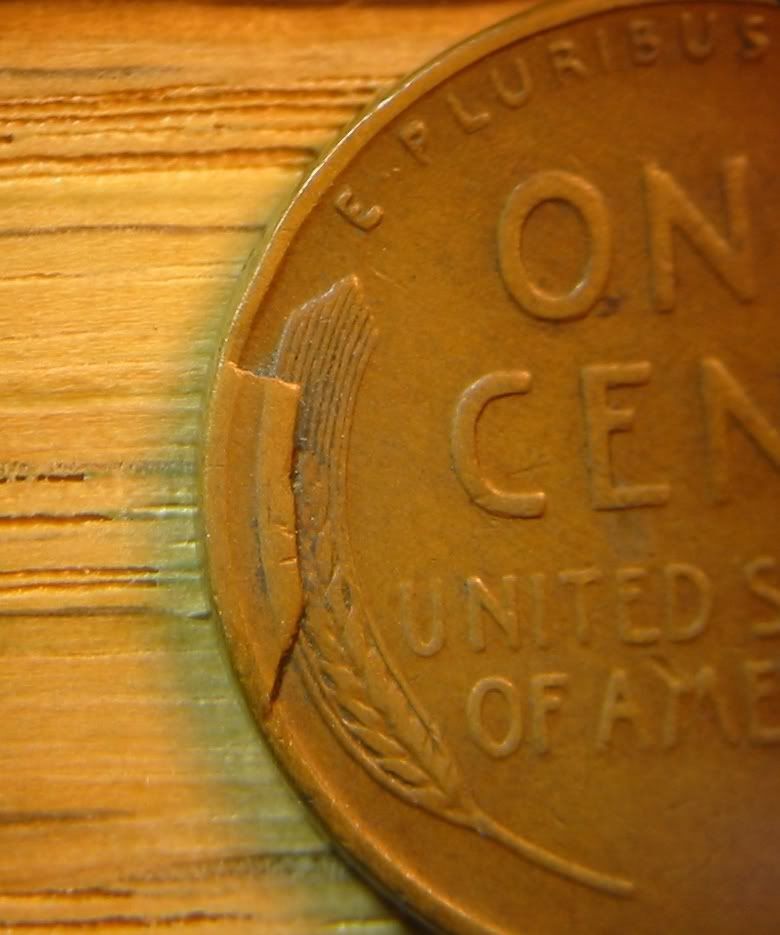 [/img] [/img]
|
|
|
|
|
 |
 eagamesExpert Member eagamesExpert Member
Posts: 3013
Joined: 15 Nov 2005
|
|
| Posted: Mon Feb 18, 2008 6:34 pm |
|
|
There might be a weak area on the obv directly behind that area?
_________________
Ed
|
|
|
|
|
|
mikediamondAdvanced Member
Posts: 191
Joined: 09 Oct 2003
Location: Western Illinois
|
|
| Posted: Tue Feb 19, 2008 8:21 am |
|
|
Yes, it's a retained cud.
_________________
President of CONECA; Host of Error Coin Information Exchange (Yahoo:Groups). Opinions rendered do not necessarily reflect those held by any organization I am a member of.
|
|
|
|
|
|
noheaMember
Posts: 46
Joined: 05 Mar 2007
Location: HAWAII
|
|
| Posted: Tue Feb 19, 2008 11:47 am |
|
|
|
Thank you for taking a look. The obverse does not have any marks or damage. It is in the area of LIBERTY and the LI is a little weak compared to the rest of the letters. I will post some pictures when I get a chance. This is the first cud that I have found and I am curious as to the die progression. Would it first start as a crack, then a break with the piece retained, then the die piece falls out and a smooth cud is formed? It would be interesting to find another stage of this break.
|
|
|
|
|
|
eagamesExpert Member
Posts: 3013
Joined: 15 Nov 2005
|
|
| Posted: Tue Feb 19, 2008 12:32 pm |
|
|
The weak area on the obv is because after that area of the rev die was gone there's no pressure in that area of the obv.
On big cuds the opposing side will be a low spot since the metal moves the other direction into where the section of die is missing.
_________________
Ed
|
|
|
|
|
|
 DickExpert Member DickExpert Member
Posts: 5780
Joined: 21 Sep 2006
Location: Rialto, CA.
|
|
| Posted: Tue Feb 19, 2008 1:37 pm |
|
|
Ed, correct me if I am wrong, but the "weak spot" around "LI' would be because the opposing pressure that would be there , had the anvil die not had the loose segment, which produced the cud on the reverse. The segment was loose, and gave way to the pressure from above, resulting in the "retained CUD" No doubt the anvil die was changed out shortly after it was noticed. The anvil die was, then, the reverse, I believe. An afterthought: judging from the photo, the next thing that might happen, (to the die), is a complete failure, across the die from the righ-angle at the top of the "CUD" area. IMHO.
Dick
_________________
" Deja Moo: The feeling that you've heard this bull before".
|
|
|
|
|
|
eagamesExpert Member
Posts: 3013
Joined: 15 Nov 2005
|
|
| Posted: Tue Feb 19, 2008 1:57 pm |
|
|
I always wonder where the chipped off piece of the die goes, it could get in between the dies and cause strange damage or even get a coin made that has a piece of the die stuck in it.
_________________
Ed
|
|
|
|
|
|
mikediamondAdvanced Member
Posts: 191
Joined: 09 Oct 2003
Location: Western Illinois
|
|
| Posted: Tue Feb 19, 2008 4:24 pm |
|
|
| nohea wrote: |
| Thank you for taking a look. The obverse does not have any marks or damage. It is in the area of LIBERTY and the LI is a little weak compared to the rest of the letters. I will post some pictures when I get a chance. This is the first cud that I have found and I am curious as to the die progression. Would it first start as a crack, then a break with the piece retained, then the die piece falls out and a smooth cud is formed? It would be interesting to find another stage of this break. |
There's no certain or consistent progression. I have seen some cuds preceded by pre-cud die cracks and one cud preceded by a retained cud. But these cases are the exception. I suspect many cuds develop very quickly or even instantaneously.
_________________
President of CONECA; Host of Error Coin Information Exchange (Yahoo:Groups). Opinions rendered do not necessarily reflect those held by any organization I am a member of.
|
|
|
|
|
|
mikediamondAdvanced Member
Posts: 191
Joined: 09 Oct 2003
Location: Western Illinois
|
|
| Posted: Tue Feb 19, 2008 4:26 pm |
|
|
| eagames wrote: |
| I always wonder where the chipped off piece of the die goes, it could get in between the dies and cause strange damage or even get a coin made that has a piece of the die stuck in it. |
There are a number of cases of dies being damaged by broken die fragments, usually from the same die. When the die strikes the working face of the die fragment, you end up with a "floating die clash". In other words, the die picks up the design from the die fragment and transfers it to subsequent coins.
_________________
President of CONECA; Host of Error Coin Information Exchange (Yahoo:Groups). Opinions rendered do not necessarily reflect those held by any organization I am a member of.
|
|
|
|
|
|
DickExpert Member
Posts: 5780
Joined: 21 Sep 2006
Location: Rialto, CA.
|
|
| Posted: Tue Feb 19, 2008 6:18 pm |
|
|
ED, you wonder where the ":extra piect of the die would go...
You remember the ANVIL die is the one on the bottom, "generelly", and it is beneath the COLLAR, (the third die). this collar will "support the die, broken as it may be, until it is changed out, or shatters, and both, most likely would have to be replaced. Mike? opinion?
Dick
_________________
" Deja Moo: The feeling that you've heard this bull before".
|
|
|
|
|
|
eagamesExpert Member
Posts: 3013
Joined: 15 Nov 2005
|
|
| Posted: Tue Feb 19, 2008 6:31 pm |
|
|
Good point Dick, it might stay there.
And my silly question....
What is meant by "Retained" when talking about CUDs? Does it mean what Dick said that the chipped section of die was retained (held there by the collar or something) instead of falling off completely?
_________________
Ed
|
|
|
|
|
|
DickExpert Member
Posts: 5780
Joined: 21 Sep 2006
Location: Rialto, CA.
|
|
| Posted: Tue Feb 19, 2008 6:44 pm |
|
|
ED, that would be my impression, and when it refers to one on the "hammer" die, there you have me at a dis-advantage, because I have asked the same question. It depends on how the "fracture" occurs, I suppose. Again I refer you to Mike Diamond, among others.
Dick
_________________
" Deja Moo: The feeling that you've heard this bull before".
|
|
|
|
|
|
eagamesExpert Member
Posts: 3013
Joined: 15 Nov 2005
|
|
| Posted: Tue Feb 19, 2008 6:52 pm |
|
|
On the coin you can still see the edge of the wheat ear in the cud so I'm assuming that means the section chipped off and pushed back but stayed there.
_________________
Ed
|
|
|
|
|
|
DickExpert Member
Posts: 5780
Joined: 21 Sep 2006
Location: Rialto, CA.
|
|
| Posted: Tue Feb 19, 2008 7:29 pm |
|
|
nohea said the "LI" of Liberty has a weaker strike, which would indicate the reverse resistance was not normal, because the loose segment in the anvil die was loose enough to 'give way" a small amount, making the "LI" weaker than normal. At the same time the same pressure from the hammer die was there, enough to lreave the impression we see on the reverse, on the wheat stem, but at the same time pushing the whole area a bit farther than normal. Make sense?
Dick
_________________
" Deja Moo: The feeling that you've heard this bull before".
|
|
|
|
|
|
mikediamondAdvanced Member
Posts: 191
Joined: 09 Oct 2003
Location: Western Illinois
|
|
| Posted: Tue Feb 19, 2008 8:26 pm |
|
|
A retained cud is a die fragment that is held in place after it separates from the main portion of the die neck. A die fragment is much more likely to be held in place if it breaks away from the anvil die, since the collar will prevent it from escaping. Retained cuds of the hammer die are known, but are much rarer. It requires that the die fragment be held in place by the bolts that anchor the hammer die in place.
_________________
President of CONECA; Host of Error Coin Information Exchange (Yahoo:Groups). Opinions rendered do not necessarily reflect those held by any organization I am a member of.
|
|
|
|
|
|
|



