Why does MM make such a $ difference?
|
  |
| Author |
Message |
 TerybleVeteran Member TerybleVeteran Member
Posts: 316
Joined: 17 Apr 2008
|
|
 Posted: Sat Jul 12, 2008 12:34 am Posted: Sat Jul 12, 2008 12:34 am |
 |
|
Does anyone know why the 1886O Morgan is worth so much more than a plain 1886 (which I posted & nobody responded to...  ) Is it just because of New Orleans or the amount produced? Either way since mine isn't, how can I change the rules? Another thing I have pondered on was who decides the markers for ID purposes? You can't hardly see them. I suppose that it is because of all the specimens found have the same? But what if the coin is a first, who is the responsible for deciding the markers or deciding it's the same die, just worn out more? Since they are worn out more and the errors are more pronounced, should they not be valued more than the less dramatic ones?...i.e. State Quarters? I know I have some coins that almost the same in doubling, but the markers aren't there, so then it is not valid (and or less valuable)? Last question, besides the obvious 55 & 72, say the 57 DDO-004 & 005 is worth (valued) more than the other 57DDO's? Also other years with same kind of doubling,...because of production #'s. ) Is it just because of New Orleans or the amount produced? Either way since mine isn't, how can I change the rules? Another thing I have pondered on was who decides the markers for ID purposes? You can't hardly see them. I suppose that it is because of all the specimens found have the same? But what if the coin is a first, who is the responsible for deciding the markers or deciding it's the same die, just worn out more? Since they are worn out more and the errors are more pronounced, should they not be valued more than the less dramatic ones?...i.e. State Quarters? I know I have some coins that almost the same in doubling, but the markers aren't there, so then it is not valid (and or less valuable)? Last question, besides the obvious 55 & 72, say the 57 DDO-004 & 005 is worth (valued) more than the other 57DDO's? Also other years with same kind of doubling,...because of production #'s.
Hopefully I got some of my questions answered correctly! Maybe now I won't have to count pennies to sleep....  
Report is due by Monday
_________________
In the 60's, people took acid to make the world weird.. Now the world is weird and people take Prozac to make it normal.
|
|
|
|
|
 |
 GarryNExpert Member GarryNExpert Member
Posts: 1296
Joined: 09 Jul 2003
Location: Chicago
|
|
| Posted: Sat Jul 12, 2008 6:47 am |
|
|
Are you a high school student, Teryble? A college student? There are so many answers to you questions, I dont know where to begin. I can only put a comment in about mint marks. Morgan Dollars are a separate issue when it comes to mint marks. People who collected coins in the 19th century didnt pay attention to mint marks, only dates. Then, later on when mintage figures were available you could come to a relative value. Then many coins were melted. Then coins were hoarded by individuals and in the mint. The 1903-S went from a rare coin to common after the mint vaults were emptied. Then there are prooflike coins and deep mirror prooflike coins. Now with all our sophistication, we go into condition census issues. Each mint mark is a subset of all those variables. So there are a myriad of reasons coins are valued the way they are, some valid some not, some logical, some not. This book is an excellent resource on Morgans. Only $17.95 and available anywhere. You have to read!!!
http://www.stacks.com/shop_booklistdetails.aspx?1=AN00000005&id=AN00000053
|
|
|
|
|
|
 Bob PSite Admin Bob PSite Admin
Posts: 3482
Joined: 01 Jul 2003
Location: Niceville, Florida
|
|
| Posted: Sat Jul 12, 2008 8:25 am |
|
|
Tery...To kind of add to what Garry has already said, certain markers on the coin are a way of determining which particular coin you have. When I do an attribution, it is up to me to identify markers before I post them on the site. When I do so, it makes it a lot easier for others to be able to identify a particular coin to a particular die as a way of confirming you have the variety you are looking for. So..to answer one of your questions directly, the attributer normally determines the markers, and sometimes they are so minor that it is indeed difficult to see. That is also another reason why we use scopes or loupes so that we can determine if a marker is legitimate.
You must also remember that as the dies strike more coins, it begins to wear. If something happens to the die that is not catastrophic, the die may be removed, cleaned up a bit (by means of polishing) and re-used again. In this case, the earlier struck specimens will not necessarily have the same markers as those struck after the die was repaired. When dies begin to break down and crack, the earlier cracks will not be as severs as others struck later on down the line. As far as those with more markers or more severe cracks, they are not worth more because a coin struck with a pristine and early die state die, are in much better shape and more pleasing to the eye. Common cracks and wear would normally decrease the values rather than enhance it. On the other hand, if a cracked die leads to a cud, or something spectacular in the error category, there are folks who collect those, and supply and demand dictates price. In this case, they would be worth more than the pre-error specimen.
As far as which varieties are worth more...even though they may be similar, this comes down to a couple of factors. We use auction data, sales information and other things to determine a coins value. You must also understand that coin prices are subjective, and most sites include a caveat explaining that coin prices listed are not the price coins should be sold or bought at. It is meant only as a guide. In addition, as time goes on, the value of some coins may increase or decrease. On sites such as this one, it is impractical (if not nearly impossible)to go through over 2100 varieties to see how the prices have done over the years they have been listed. I have changed this information on those that are more popular and have shown significant increases/decreases in value.
Anyway....I hope this answered some of your questions. I would be happy to expand on some issues if necessary.
_________________
Bob Piazza
Site Admin/Moderator
Attributer/Photographer
bobp@coppercoins.com
mustbebob1@gmail.com
|
|
|
|
|
|
TerybleVeteran Member
Posts: 316
Joined: 17 Apr 2008
|
|
| Posted: Sat Jul 12, 2008 8:32 am |
|
|
Well Gary, truth be I am going to be 46 in Sept. But I did put in my profile on another board as 13, cuz I figured I'd be smart for that, instead of dumb for 45! This all new to me & ya'll have been doing this much longer than me! 3 or 4 months ago I knew absolutely nutin'. Also that's how long it took for me to finally understand & find a DDO, yes it just got listed as 1937S DDO-004. I appreciate all the skoolin' ( ) I have received here as well as everyone patience. Now I realize there is so much more to learn! I really had no idea how complicated the anomalies & processes used to make a coin.So much so I can't get enough! I'm not working at the moment (I do disaster restoration catering). So I thought I could make some money, by selling my money!? ( I'm one of those jar coin hoarders for over 30 years!) I do not want to misrepresent myself or my pennies! But from what I'm seeing on Ebay, $8.00 for a maxi double (hyped up of course) Jefferson 5 cent coin, I think the key word to selling is "rare" double lettering, decide by pics......Instead of stating the true facts and or opinions of my peers. K....Here is another question, do you know what kind schooling you need to be an attributionist/attributer (if these are even a words), No I did not go to college, have been out of my "nest" & self supportive since 16. If I do not understand something here or a mechanics shop etc., I'm going to ask! Besides if I were not here, who would you make fun of or feel good ( or am I annoying )about helping, bet it makes ya feel smarter too!( I did get a GED, all above average scores I have to add  ) OK I'M BORED & AM TIRED OF HAVING COINS EVERYWHERE! Got a house & some swamp land for sale too! REALLY, but it is not swamp land....Interested? Also actually I collect ALOT of things, occupied japan stuff, fossils, antique spoons & various other clutter. Sorry to ramble but you asked! I'm done, so don't be afraid to give me your opinions in the future, cuz every little bit helps.........................Stepping of the soap box ) OK I'M BORED & AM TIRED OF HAVING COINS EVERYWHERE! Got a house & some swamp land for sale too! REALLY, but it is not swamp land....Interested? Also actually I collect ALOT of things, occupied japan stuff, fossils, antique spoons & various other clutter. Sorry to ramble but you asked! I'm done, so don't be afraid to give me your opinions in the future, cuz every little bit helps.........................Stepping of the soap box
Teryble
_________________
In the 60's, people took acid to make the world weird.. Now the world is weird and people take Prozac to make it normal.
|
|
|
|
|
|
 DickExpert Member DickExpert Member
Posts: 5780
Joined: 21 Sep 2006
Location: Rialto, CA.
|
|
| Posted: Sat Jul 12, 2008 11:42 am |
|
|
Teri, You sound a lot like my life has been. Been there, done that. I got the GED, and spent some time in college, but ran out of money, before I finished. Family to raise had a lot to do with that.
Now for a bit to add to the "more learned " who have enlightened you in many ways. Allow me to put my 2 cents in, as well. The die is what makes the coin. the condition of the die will make a coin in the image of the maker. That sauid, then consider this: The coin in hand will have any, and all kinds of markings, both from the die, and from the circulation, both in hoppers, bags Fedweral reserve vaults, collectors hands, to those that are tossed into a "wishing well". All will leave it's mark. the secret, and chice one has, is to determine which ones were made by the die,and as such are and can and will be used for "markers". not every attributor will use the same markers, for thone particular coin, unless it is so pristine, that they do not exist. I gope this clears some of the clutter we all have had to deal with. As for the site, I have been blessed in that they have put up with by blabbering, and pointless rambling, AND have taught me a lot more than I realize, yet. You have come to the right place. The right people for explanations, information, etc Even advice! If you want to learn something here is the place. Just pick the subject, and there are those who can guide you. I am deeply in debt to my fellow collectors.
Dick
_________________
" Deja Moo: The feeling that you've heard this bull before".
|
|
|
|
|
|
 coopExpert Member coopExpert Member
Posts: 3402
Joined: 17 Sep 2003
Location: Arizona
|
|
| Posted: Sat Jul 12, 2008 2:03 pm |
|
|
Bob touched on a good point, but to expand it a bit more. Markers are best to identify die state. If the markers found on a MDS coin are present on a coin your trying to match up, then it is a MDS coin. If the markers are fading (Older die scratches that fade in the fields with continued use) then the coin was made after the markers known. If the coin doesn't have any of the known markers, it could have been made before the marker was present, or later after the marker was there but now gone. OR it could be from a different die entirely and if the markers matched it would just be a coincidence. Die scratches are like fingerprints, but die dots, die gouges, die cracks/chips/breaks will remain with the die for a lot longer. Sometime you look at a variety and NOTHING stands out. Those are harder to match. But sometimes the markers are easy to spot. It is just what the die went through to make your coin that determines markers. If markers are not present on a certain die does that mean it is not from that die. That all depends. If the spread/location is the same with an overlay, then it might be from the same die. If the markers match but the location/spread is NOT the same, then it would be from a different die. Because coins go the same pitfalls/damage/wear/cleaning/breaks/clashes they are subject to the smae appearing markers but in differing degrees. But that in it self is not proff that they were from the same die. So the doubling/RPM need to be there first, location spread considered next, then markers just as a confirmation with the idea also that because the marker isn't there doesn't disqualify your coin.
_________________
Richard S. Cooper
You may be only one person in the world, but you may also be the world to one person.
|
|
|
|
|
|
 eagamesExpert Member eagamesExpert Member
Posts: 3013
Joined: 15 Nov 2005
|
|
| Posted: Sat Jul 12, 2008 2:18 pm |
|
|
Tery,
One thing I've seen is that there is more fact and less opinion in variety coins than it seems like when you first start collecting.
What I mean is the experts are very sharp and if they all see the same coin they will probably (95%) of the time going to all agree on the type of doubling and the die state. Then as more of the same variety are seen other details like markers are documented. The few coins we see experts argue over are very tough ones like the 1980 D/S which if you look at is very hard to call as a MM or gouge or whatever so to make the determination required many coins in different die states so the reason they might not initialy agree is each expert only saw it in one or a few states and it took the combined info of seeing it in many states to make the final determination.
So what I'm saying is it's more science than art LOL...
As far as prices go. For varieties the price is set by a combination of interest factor (is it neat like a 55 ddo or do you need an electron microscope to see it) and rarity. Rarity includes grades so a coin can be rare in any grade or more rare in high grades.
Some examples of grade rarity..... 1909 (even S VDB) cents are not a grade rarity, if you look at the prices they cost a lot in any grade and a bit more (but not 10 times more) in the higher grades. The reason is 1909 was the first year so many were saved in unc condition. Then look at a 1914-d cent, it is less rare by mintage but it was not hoarded so very few unc ones exist so an unc 1914-d is worth many times 10-100 times what a lower grade one is worth and the high grade 14-d is worth more than a 1909 S VDB in UNC even though more were made because less 1914-D were saved. 1931-S is another, it was hoarded in high grades so if you look at the price it's very flat, a nice circ is maybe half the cost as an unc because most are nice and many are unc and few are low grade. In fact the low grade 1931-S might be rarer than a high grade. I've never seen a low grade 31-S.... LOL! so the price is very flat over all grades.
As far as mint marks go.... just think of a different MM as a different coin. The rarity is specific to the MM so one can be dirt cheap and the other can be big $.

_________________
Ed
|
|
|
|
|
|
DickExpert Member
Posts: 5780
Joined: 21 Sep 2006
Location: Rialto, CA.
|
|
| Posted: Sat Jul 12, 2008 3:59 pm |
|
|
Ed, I think I posted a couple 1931-S photos, some time back. Both '31-S coins I have are , *my opinion, VF, at best.
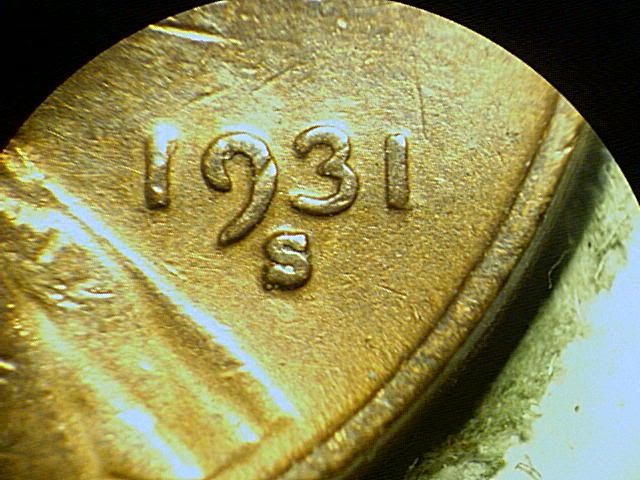
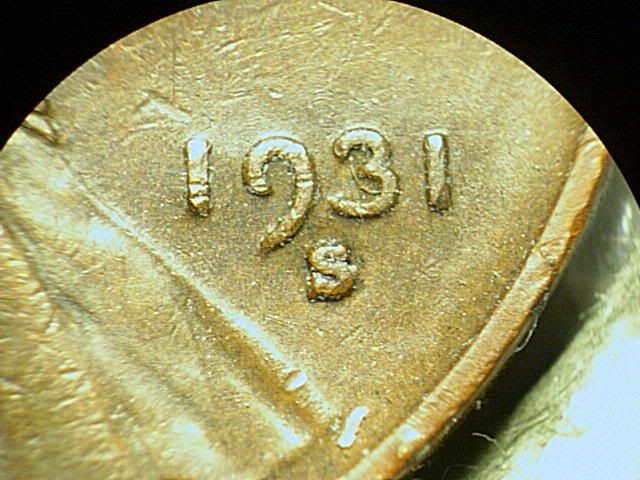
You grade, and let me know what you think.
Dick
_________________
" Deja Moo: The feeling that you've heard this bull before".
|
|
|
|
|
|
eagamesExpert Member
Posts: 3013
Joined: 15 Nov 2005
|
|
| Posted: Sat Jul 12, 2008 11:04 pm |
|
|
Dick,
Still a very nice coin that fits most sets but you're right it lower than most of them. It must have had a short tour of duty. 
_________________
Ed
|
|
|
|
|
|
|
|
|
| Page 1 of 1 |
|
|



