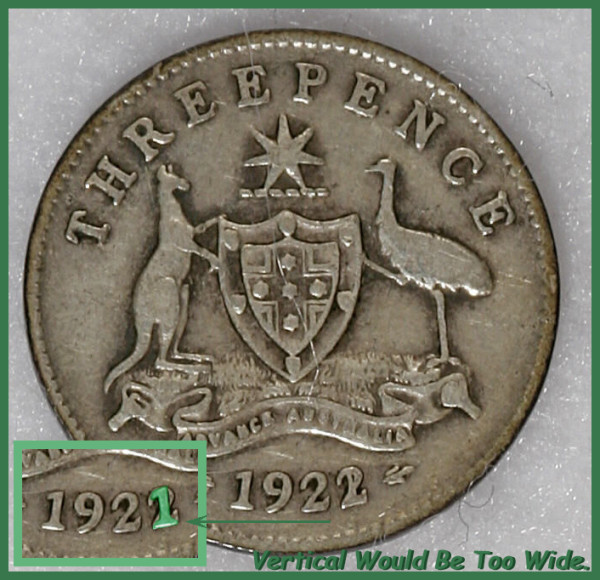
Australia 1922 threepence with reverse mark
Goto page Previous 1, 2 |
  |
| Author |
Message |
 coopExpert Member coopExpert Member
Posts: 3402
Joined: 17 Sep 2003
Location: Arizona
|
|
 Posted: Sat Apr 11, 2009 8:08 pm Posted: Sat Apr 11, 2009 8:08 pm |
 |
|
Thought it appears the size of the digit would fit on the 2 over 1, the width of the vertical on the one is to narrow to be a 1.
_________________
Richard S. Cooper
You may be only one person in the world, but you may also be the world to one person.
|
|
|
|
|
 |
 KurtSSenior Member KurtSSenior Member
Posts: 875
Joined: 15 Feb 2008
|
|
| Posted: Sat Apr 11, 2009 8:33 pm |
|
|
Coop, nice overlay and yes--I was struck by the thickness of the 1 
As an interesting comparison, I have an 1882/1 overdate from Sweden with a thin underlying 1 too. But in better grades, you can actually see the top flag of the 1 crossing into the 2. What do you think about this one? I'm pretty certain about the 1882/1 based on seeing some more evidence.
I guess for the 1922/1 it would be a real issue if I planned to pay top dollar for one, only to find it disproven later. I seem to recall a few people got burned by paying $$$ for the 1888 IHC that was supposedly a 1888/7 (Snow-2), which has now been downgraded by Rick Snow after research suggested it was just an RPD.
Here's the Sweden 5 Ore 1882/1:

|
|
|
|
|
|
 DickExpert Member DickExpert Member
Posts: 5780
Joined: 21 Sep 2006
Location: Rialto, CA.
|
|
| Posted: Sat Apr 11, 2009 9:43 pm |
|
|
Hi Kurt! The one you show, definitely is not an overdate, because the vertical bar si tapered visibly, and is much too narrow. same case as the 22/21 supposesdly. It was apparent from the overlay that it could onlt be a chip, or foreign debris. Not an RPD. I guess the Aussies will hate us for this, but, remember, the RAM also called it a chip., and seemingly was overruled. I may be in error on this last.
Coop, thanks for your overlay. I knew if one came up, it would show something definite, and now we know.
Dick
PS See the "news" sector....
_________________
" Deja Moo: The feeling that you've heard this bull before".
|
|
|
|
|
|
coopExpert Member
Posts: 3402
Joined: 17 Sep 2003
Location: Arizona
|
|
| Posted: Sat Apr 11, 2009 9:44 pm |
|
|
An overlay of the 1 over the 2 shows that there should be more of a 1 there than showing.

But I think we are perceiving that the digits were punched with a hub. So I did an overlay of the 8 over the second 8. They are not the same. So the date may have been hand engraved and altered on the 2. The mark on the inside cross tail makes me wonder if this happened? We don't really know how their dies were created. From Country to Country they have different standards for coins. So I'm not sure if it is a over date or an altered over date die? Clues make me wonder in this coin Kurt.
_________________
Richard S. Cooper
You may be only one person in the world, but you may also be the world to one person.
|
|
|
|
|
|
KurtSSenior Member
Posts: 875
Joined: 15 Feb 2008
|
|
| Posted: Sun Apr 12, 2009 12:09 am |
|
|
Coop,
That's an interesting overlay--thanks for doing it!  One thing I'll add here is that this is a recognized overdate among collectors in Sweden. I'll need to read up more on exactly why, but as I said on higher grade examples, you can see the short downstroke "flag" from the top of the 1 cross over the curl of the 2. As to why the vertical stroke of the 1 isn't thick enough, one might guess reasons...including the date impression being deeper on one side, and when it was partially polished away for a new date, what's remaining of the 1 is thinner. Or perhaps underlying digit punch was shaped differently than the first? Definitely more data is needed here regarding repunching vs re-engraving One thing I'll add here is that this is a recognized overdate among collectors in Sweden. I'll need to read up more on exactly why, but as I said on higher grade examples, you can see the short downstroke "flag" from the top of the 1 cross over the curl of the 2. As to why the vertical stroke of the 1 isn't thick enough, one might guess reasons...including the date impression being deeper on one side, and when it was partially polished away for a new date, what's remaining of the 1 is thinner. Or perhaps underlying digit punch was shaped differently than the first? Definitely more data is needed here regarding repunching vs re-engraving
Like you noted, it's interesting to note is how overdates of different countries have a different look, due to each country's die making methods. At this point in Sweden, I believe that the hub had "18", and they used a two digit punch to complete the date on the die, which often weren't the same as the hub digits. As my other overdates suggest, the last two digits were repunched for the new year. Well, probably more details than you need to know.  Suffice to say, overdate markers don't always correspond to what we'd like to see. Have a look at this overdate on a US coin below. Without knowing already, would anybody be able to guess (much less prove) this is an overdate? Suffice to say, overdate markers don't always correspond to what we'd like to see. Have a look at this overdate on a US coin below. Without knowing already, would anybody be able to guess (much less prove) this is an overdate?
From doing a few of my own, I think overlays are a real help to look for confirming details, but the absence of details in a certain place might not disprove it's an overdate...if that makes sense. The hard part is deciding how much data confirms an overdate.

|
|
|
|
|
|
DickExpert Member
Posts: 5780
Joined: 21 Sep 2006
Location: Rialto, CA.
|
|
| Posted: Sun Apr 12, 2009 12:27 am |
|
|
Coop, I noticed the "8"s also, but thought it might be "hits'. The two are both different, from each other, like they might have meen hand-made, (free-hand). They aren't identical, as one would expect to see. I tried to "mentally" locate the one over the two, and it is too wide, cbviously.
Dick
_________________
" Deja Moo: The feeling that you've heard this bull before".
|
|
|
|
|
|
coopExpert Member
Posts: 3402
Joined: 17 Sep 2003
Location: Arizona
|
|
| Posted: Sun Apr 12, 2009 6:35 am |
|
|
Kurt: Not sure what the arrow is pointing to on the U.S. Coin. But know the Indian Head Cent was made different todays coins. The doubled die I like the Best of that series is this one. 1873 doubled headbands.

_________________
Richard S. Cooper
You may be only one person in the world, but you may also be the world to one person.
|
|
|
|
|
|
KurtSSenior Member
Posts: 875
Joined: 15 Feb 2008
|
|
| Posted: Sun Apr 12, 2009 10:23 am |
|
|
Coop, I was thinking of the IHC series too--a great example , Often for RPDs, what remains is only a faint reminder of the date, such as the 1894/1894. Of course, in many ways--this is a clear by the direct relationship of the underlying digits to the main date.

The prior example of the 58 is an overdate for Flying Eagle cents: 1858/7. I can only guess they figured that out from an MS EDS coin. I would never find that one on my own
On the other end, there are overdates which are very obvious, perhaps because they didn't prepare the die before impressing the new date? This an overdate from Peru: 1901/1891

Coop, those sure are great IHC DDOs!  I want to find an 1873 Snow-1 someday--that's a key variety! Thanks again for all your insights! I want to find an 1873 Snow-1 someday--that's a key variety! Thanks again for all your insights!
|
|
|
|
|
|
DickExpert Member
Posts: 5780
Joined: 21 Sep 2006
Location: Rialto, CA.
|
|
| Posted: Sun Apr 12, 2009 12:26 pm |
|
|
Kurt, on the "58", it shows the two digits, had "slid, to the left or were rtepunched, on great magnification. O use 4X, on the magnifier, and it sure helps. As you said, it normmally would not have been noticed, without attention being called to it.
I was thinking that the punches had to be heavy body, going down to the digit-point, maybe they were rounded, and if hit harder, might leave that depression on the die. I was looking at some wheats yesterday, that had the same depression.
Dick
_________________
" Deja Moo: The feeling that you've heard this bull before".
|
|
|
|
|
|
KurtSSenior Member
Posts: 875
Joined: 15 Feb 2008
|
|
| Posted: Sun Apr 12, 2009 1:07 pm |
|
|
Dick, good catch on the 5!
That's actually MD on the 5--FEs were notorious for it in the date, more so than IHCs for some reason.
To the best of my knowledge, the only direct markers for this overdate have been seen on the 8. And of course, there's that stray marker in the field between the date and eagle (not shown in my pic).
|
|
|
|
|
|
|
|



