| Author |
Message |
wavysteps2003Expert Member
Posts: 1344
Joined: 25 Feb 2005
|
|
 Posted: Fri May 05, 2006 5:41 pm Posted: Fri May 05, 2006 5:41 pm |
 |
|
Okay all you coin collectors out there, I need some help.
Recently, I have embarked on an adventure to find out the cause of wavy steps and their relationship, if any, to "tails", those little tapering lines that come off some of the design elements. I have been fortunate and have had people respond to my request to see the "tails" that they had on Lincoln cents and because of this, to gain some valuable information in my quest.
However, a need has arisen where I would like to see if "tails" has appeared on other denominatios. I remember seeing one coin, a Sacagewea dollar, that had "tails" from the wings of the eagle on the reverse.
If any of you out there have a coin with "tails" on it, no matter what denomination, will you please contact me. This is an important study that may change the views of how we see certain dies and their classifications. Of course all and any help is great appreciated.
If you do have any of these dies, please PM on this site. Thank you very much.
WAVYSTEPS2003
|
|
|
|
|
 |
 Bob PSite Admin Bob PSite Admin
Posts: 3482
Joined: 01 Jul 2003
Location: Niceville, Florida
|
|
| Posted: Fri May 05, 2006 7:27 pm |
|
|
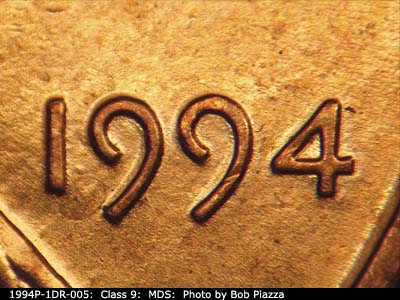
To piggy back on what BJ is saying, this has turned into quite an endeavor for BJ. If any of you do not know what he is talking about as far as the tails go, take a look at this pic and you can see them running SW from the A in STATES, and the E and P of the motto. These 'tails' can run in any direction also.
_________________
Bob Piazza
Site Admin/Moderator
Attributer/Photographer
bobp@coppercoins.com
mustbebob1@gmail.com
|
|
|
|
|
|
wavysteps2003Expert Member
Posts: 1344
Joined: 25 Feb 2005
|
|
| Posted: Fri May 05, 2006 8:12 pm |
|
|
|
|
|
|
|
|
 StevenExpert Member StevenExpert Member
Posts: 1298
Joined: 30 Nov 2005
Location: S/E Missouri
|
|
| Posted: Fri May 05, 2006 8:36 pm |
|
|
My being probably the most inexperienced of anyone here and know next to nothing about the minting process I would like to throw in a guess and see what comes of it as far as these tails go or at least some of them are formed on layered coins, possibly others. Hope this doesn't sound dumb.
Here goes, in looking at the cent Bob posted here the tails follow the flow of the metal it seems. Wouldn't the pressure of the dies striking the planchet force trapped gasses to follow that same flow into the field causing what looks like a tail connected to that particular device.
Even though I had this thought I'm keeping in mind, what I believe Chuck put in a post, that it may be the brushes catching the corner of the devices causing wear to them. Or at least that is what I can recall reading somewhere here and this sounds more likely than my guess if this is something going on with coins that are not layered as well.
Still learning and hope you don't mind me jumping in here.
Thanks,
Steven
|
|
|
|
|
|
wavysteps2003Expert Member
Posts: 1344
Joined: 25 Feb 2005
|
|
| Posted: Fri May 05, 2006 9:09 pm |
|
|
Hi Steven - You are not alone in think the "metal flow" theory. Both the mint and James Wiles (at least he thinks it MAY be a possibility) have said that this is the cause of wavy steps and now, since these tails may be the same as wavy steps, tails also. The one major problem of metal flow is that it should be random in direction and follow no particular pattern of directions. Both wavy steps and tails have two quadrants that they always seem to fall in; northeast to northwest and southeast to southwest.
As far as wear, some of the heaviest tails (from the top of the columns) are in the deepest recesses of the die; how would wear appear in a recess and not on the surface of the die? This is also why I have ruled out die cleaning; the removal of gunk deposits by the use of a caustic agent. Just cant happen and leave the marks that it does.
Thanks for your thoughts though, they are appreciated.
WAVYSTEPS2003
|
|
|
|
|
|
|



