| Author |
Message |
 fiddle-fartVeteran Member fiddle-fartVeteran Member
Posts: 479
Joined: 27 Jul 2008
Location: Charlestown, Indiana
|
|
 Posted: Sun Jan 04, 2009 9:46 am Posted: Sun Jan 04, 2009 9:46 am |
 |
|
Big 'ol cud
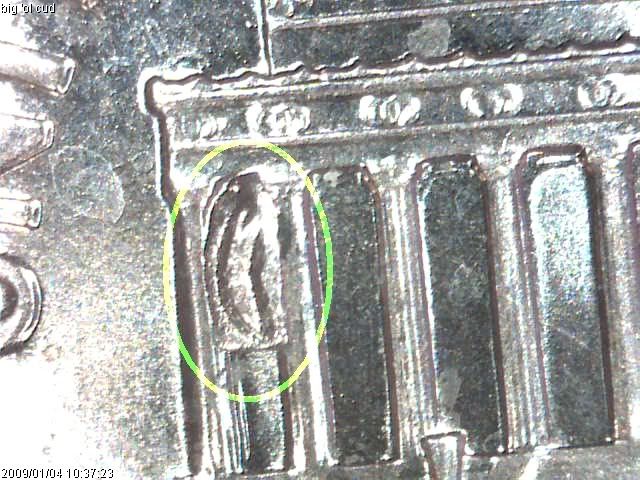
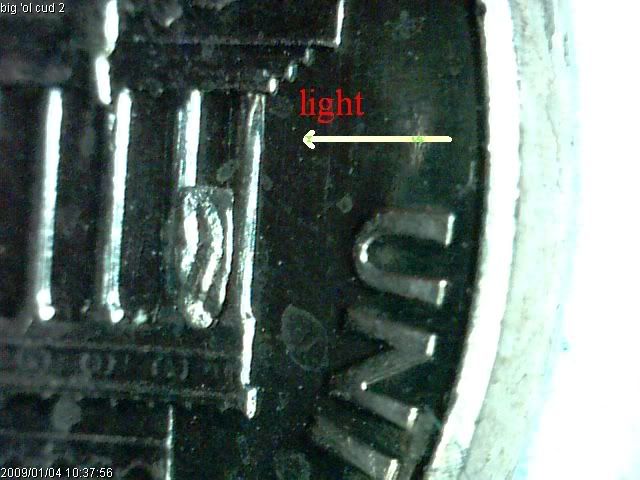
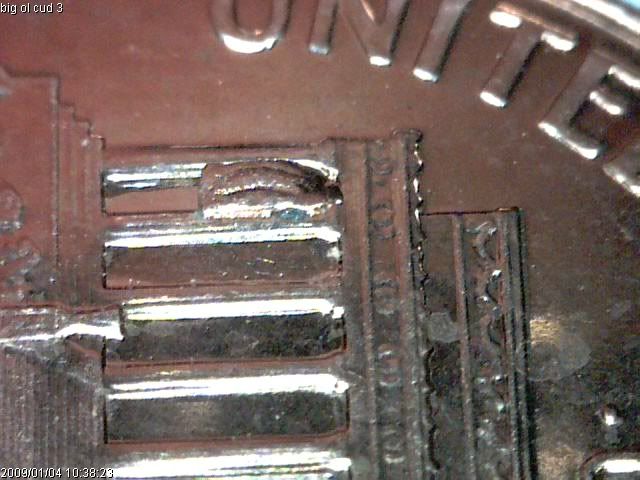
Mike
_________________
Only 1% control the wealth
so that makes me a 99%
|
|
|
|
|
 |
 coopExpert Member coopExpert Member
Posts: 3402
Joined: 17 Sep 2003
Location: Arizona
|
|
| Posted: Sun Jan 04, 2009 10:25 am |
|
|
More like a big ol' die break. A cud involves the edge of the coin where the die has broken off the outside edge.


Note how the die with the break even affect the reverse as the are missing, doesn't make a complete strike in that area.
_________________
Richard S. Cooper
You may be only one person in the world, but you may also be the world to one person.
|
|
|
|
|
|
fiddle-fartVeteran Member
Posts: 479
Joined: 27 Jul 2008
Location: Charlestown, Indiana
|
|
| Posted: Sun Jan 04, 2009 10:31 am |
|
|
So with a Die break, the following coins will have a hole in that area?
or
This is the result of die missing a piece and the surrounding coinage just filled in that area
MIke
_________________
Only 1% control the wealth
so that makes me a 99%
|
|
|
|
|
|
coopExpert Member
Posts: 3402
Joined: 17 Sep 2003
Location: Arizona
|
|
| Posted: Sun Jan 04, 2009 10:36 am |
|
|
Mike: Correct. With the die design missing, the devices are not formed in that area. With continued use the die erodes even more like a pot hole. With the area getting deeper, the higher the break becomes. Eventually the die is retired, but makes a lot of weird coins till then.

_________________
Richard S. Cooper
You may be only one person in the world, but you may also be the world to one person.
|
|
|
|
|
|
fiddle-fartVeteran Member
Posts: 479
Joined: 27 Jul 2008
Location: Charlestown, Indiana
|
|
| Posted: Sun Jan 04, 2009 10:41 am |
|
|
That is why I love this forum.
You learn a lot and there is a lot to learn
Thanks Coop
_________________
Only 1% control the wealth
so that makes me a 99%
|
|
|
|
|
|
 eagamesExpert Member eagamesExpert Member
Posts: 3013
Joined: 15 Nov 2005
|
|
| Posted: Sun Jan 04, 2009 12:43 pm |
|
|
Mike,
| Quote: |
| following coins will have a hole in that area |
The coins made after the die has a cud will have a big bump/raised area. The die is a mold (negative) of the coin. So when a piece of the die is gone the next coins from it will have a bump since the metal pushes up into the hole in the die.
Look at Coops pics, on the CUD coins the side with the CUD has the bump but look close at the other side. On the opposite side you'll see an area that is missing the design and lower. The reason is that since the the die section was missing on the opposite side so theres nothing to push the metal into the opposite side.
Notice on Coops 1987 CUD that on the rev the design is missing from the side opposing the CUD on the obv. Then on his 1977 coin the weak area shows on the rev on ONE. That's one of the diagnostics of CUDs, the missing design on the opposite side.
Think of a cud as the die being like a hammer. One edge cracks and comes off. Its almost like rock chipping when cavemen made tools from rock.
_________________
Ed
|
|
|
|
|
|
 DickExpert Member DickExpert Member
Posts: 5780
Joined: 21 Sep 2006
Location: Rialto, CA.
|
|
| Posted: Sun Jan 04, 2009 2:37 pm |
|
|
Nice going Ed! here, I thought I was the only "caveman" in the bunch!
Mike, notice the dime cud. The one side seems to be "rising", like dough in a loaf of bread. the other side of the area seems to "sag". I don't know for sure which side is the anvil, but the indications are that the "missing part of the die, will allow the "dough to rise", indicating that the reverse die is the "tails", in this case the anvil die. This brings up a question: Is there a known case where the anvil die was the die with the broken , and missing piece? I ask because the DDR's of late are rev, and the cent shown has the "sag on the rev die, indicarting the lack of 'equal, and opposite pressure was from the anvil die. Maybe the die positions are chenged at times.
Dick
_________________
" Deja Moo: The feeling that you've heard this bull before".
|
|
|
|
|
|
 CoinboyJayMember CoinboyJayMember
Posts: 99
Joined: 22 Nov 2008
|
|
| Posted: Sun Jan 04, 2009 8:27 pm |
|
|
Way cool pictures Coop. Thanks for posting them!!
JAY
|
|
|
|
|
|
mikediamondAdvanced Member
Posts: 191
Joined: 09 Oct 2003
Location: Western Illinois
|
|
| Posted: Mon Jan 05, 2009 9:02 am |
|
|
| coop wrote: |
More like a big ol' die break. A cud involves the edge of the coin where the die has broken off the outside edge.
Note how the die with the break even affect the reverse as the are missing, doesn't make a complete strike in that area. |
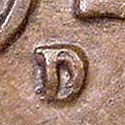
"Die break" is a non-specific term that includes, cuds, rim cuds, interior die breaks, die chips, and other forms of brittle fracture that leave a void in the die face. The term the Mint prefers to use is the admirably straightforward "piece-out".
The blob between the columns of the Memorial is best characaterized as a "die chip".
_________________
President of CONECA; Host of Error Coin Information Exchange (Yahoo:Groups). Opinions rendered do not necessarily reflect those held by any organization I am a member of.
|
|
|
|
|
|
 coppercoinsSite Admin coppercoinsSite Admin
Posts: 2809
Joined: 29 Jun 2003
Location: Springfield, Missouri.
|
|
| Posted: Mon Jan 05, 2009 10:48 am |
|
|
Chalk it to being my fault in training people that a small 'piece out' is a die chip, while larger ones are die breaks.
Does all of the authoritative community now follow this convention? I know I had to have learned it that way from somewhere, and obviously my definitions don't follow yours. So somewhere I got the wrong idea through reading. I believe it was either something Wexler or Wiles wrote.
As long as all the authoritative folks follow the same convention, I would be glad to change the way I define these things.
_________________
C. D. Daughtrey
owner, developer
www.coppercoins.com
cd@coppercoins.com
|
|
|
|
|
|
mikediamondAdvanced Member
Posts: 191
Joined: 09 Oct 2003
Location: Western Illinois
|
|
| Posted: Mon Jan 05, 2009 11:12 am |
|
|
My usage seems to be in accordance with how most other folks use these terms nowadays. However, I can't say it's been universally adopted. Part of the problem lies in Alan Herbert's totally unworkable terminology. He calls any cud a "major die break" even if it's trivial in size. He has other terms like "small die break" for tiny die chips like those that form in the loop of the 9, and "large die break" for larger die chips. You should never, ever incorporate an adjective denoting size or magnitude into any term, especially if the term has no connection to actual size.
| coppercoins wrote: |
Chalk it to being my fault in training people that a small 'piece out' is a die chip, while larger ones are die breaks.
Does all of the authoritative community now follow this convention? I know I had to have learned it that way from somewhere, and obviously my definitions don't follow yours. So somewhere I got the wrong idea through reading. I believe it was either something Wexler or Wiles wrote.
As long as all the authoritative folks follow the same convention, I would be glad to change the way I define these things. |
_________________
President of CONECA; Host of Error Coin Information Exchange (Yahoo:Groups). Opinions rendered do not necessarily reflect those held by any organization I am a member of.
|
|
|
|
|
|
DickExpert Member
Posts: 5780
Joined: 21 Sep 2006
Location: Rialto, CA.
|
|
| Posted: Mon Jan 05, 2009 11:39 am |
|
|
All the above says in effect, "That unless, and until the terms are standardized, it will be a case of "semantics". It would be better if everyone used the same term to describe what they are seeing, thus the one heariong, or reading will know what exactly is being described. One of my biggest, (amongmany) problems, was, an fact is, todat, in the difference between a "die break, and a die crack". I contend that a break will allow a large amount of metal to be extruded, whereas a crack will show very little, by comparison. Please correct me if, ( as usual ), I am in error.
Dick
_________________
" Deja Moo: The feeling that you've heard this bull before".
|
|
|
|
|
|
mikediamondAdvanced Member
Posts: 191
Joined: 09 Oct 2003
Location: Western Illinois
|
|
| Posted: Mon Jan 05, 2009 11:57 am |
|
|
There is no disagreement as to what constitutes a die crack and what constitutes a die break. A die crack is a linear fracture in the die face, with no metal lost. A die break is a void in the die face -- metal IS lost.
| Dick wrote: |
All the above says in effect, "That unless, and until the terms are standardized, it will be a case of "semantics". It would be better if everyone used the same term to describe what they are seeing, thus the one heariong, or reading will know what exactly is being described. One of my biggest, (amongmany) problems, was, an fact is, todat, in the difference between a "die break, and a die crack". I contend that a break will allow a large amount of metal to be extruded, whereas a crack will show very little, by comparison. Please correct me if, ( as usual ), I am in error.
Dick |
_________________
President of CONECA; Host of Error Coin Information Exchange (Yahoo:Groups). Opinions rendered do not necessarily reflect those held by any organization I am a member of.
|
|
|
|
|
|
fiddle-fartVeteran Member
Posts: 479
Joined: 27 Jul 2008
Location: Charlestown, Indiana
|
|
| Posted: Mon Jan 05, 2009 4:06 pm |
|
|

Too many terms
So little time
I'll get it right one of these days
Thanks Mike D., Chuck, Dick, Coop, eagames. Thank God you all are here and helping us.
Mike
_________________
Only 1% control the wealth
so that makes me a 99%
|
|
|
|
|
|
DickExpert Member
Posts: 5780
Joined: 21 Sep 2006
Location: Rialto, CA.
|
|
| Posted: Mon Jan 05, 2009 8:24 pm |
|
|
Mike, you have placed me with some very high caliber folks, and I can only say I am not worthy of that credit! I am barely a learner, but thanks for making my day!
Dick
_________________
" Deja Moo: The feeling that you've heard this bull before".
|
|
|
|
|
|
|



