| Author |
Message |
MetalmanNew Member
Posts: 7
Joined: 30 Jan 2006
|
|
 Posted: Sun Feb 05, 2006 8:41 pm Posted: Sun Feb 05, 2006 8:41 pm |
 |
|
Please take a look at this coin !!
2000-D Lincoln cent
The first pic is of the obverse ,, the cent has a normal appearance other than the small die crack across the date.
[URL="http://photobucket.com"]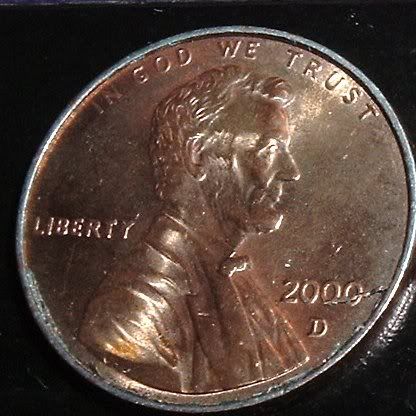 [/URL] [/URL]
Now check out the edge view,, this cent is twice the thickness of an ordinary cent held along side as a reference,, the cent is a bit larger in diameter, but only at the outside of the bevel that is apparent on the cent .
[URL="http://photobucket.com"]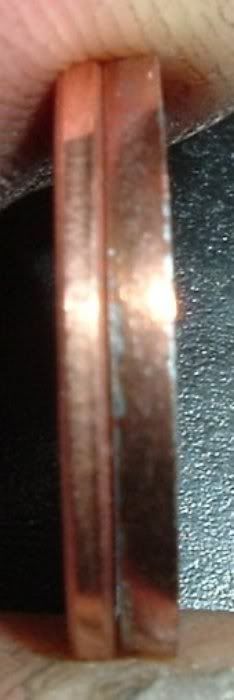 [/URL] [/URL]
any Ideas ??
Thanks
Rick
_________________
Collecting Raw Lincoln Proofs !!
|
|
|
|
|
 |
 coopExpert Member coopExpert Member
Posts: 3402
Joined: 17 Sep 2003
Location: Arizona
|
|
| Posted: Sun Feb 05, 2006 10:07 pm |
|
|
I've noticed on the 1999-D Cents that some were thicker on the rims. The weight was the same, but the rims were thicker. I think the set up on the rim after the planchet was cut raised the rim higher. I saved a few of them till I figured out what was happening. But yours looks like the collar around the coin wasn't in the right position. I've seen some called Railroad rims that just part of the rim is taller like a railroad rail. But not saying that is what yours is. Just some possible explinations. Maybe others can also comment to get another view on this. We don't always know what happens during minting. We just have to guess what it is as none of us here work there. That would be a good job. You would probably make a whole lot of money there..... (Pun intended)
_________________
Richard S. Cooper
You may be only one person in the world, but you may also be the world to one person.
|
|
|
|
|
|
coopExpert Member
Posts: 3402
Joined: 17 Sep 2003
Location: Arizona
|
|
| Posted: Sun Feb 05, 2006 10:13 pm |
|
|
Did you ever notice the setup on some Cents are usually thinner on one side and thicker on the opposite. Makes you wonder how the counters with the tubes that measures the coins is ever close. They might have 49 coins in one roll and 51 in another....
_________________
Richard S. Cooper
You may be only one person in the world, but you may also be the world to one person.
Last edited by coop on Thu Feb 23, 2006 9:10 am; edited 1 time in total
|
|
|
|
|
|
 coppercoinsSite Admin coppercoinsSite Admin
Posts: 2809
Joined: 29 Jun 2003
Location: Springfield, Missouri.
|
|
| Posted: Sun Feb 05, 2006 11:59 pm |
|
|
You have a coin that was likely double struck, thus mashed more metal into the collar causing the higher, sharper rims. That's my take on it, but I know that there are some who believe these coins with the thicker, sharper rims are struck on proof planchets. I haven't seen or heard much on the subject of late, so I figure most have put it to rest.
I opened a 2001D bag back when it was new and ended up with a double fistful of coins that were a lot like the one you're posting about here. I also ended up with about a dozen partial-collar errors - the "railroad rim" that Coop speaks of. This happens when the planchet isn't sitting completely inside the striking chamber and the coin is struck with only a part of its thickness inside the retaining collar. The rest pancakes outward like a broadstrike. The effect ends up looking like the wheel on a boxcar, with the lip that keeps the train on the rail. This, however, is not what your coin is.
_________________
C. D. Daughtrey
owner, developer
www.coppercoins.com
cd@coppercoins.com
|
|
|
|
|
|
coppercoinsSite Admin
Posts: 2809
Joined: 29 Jun 2003
Location: Springfield, Missouri.
|
|
| Posted: Mon Feb 06, 2006 12:01 am |
|
|
And also - it looks thicker because the rim is squared off and thickened because of the double strike. I can assure you that the coin's design area is a micron or two thinner to compensate for the extra flow outward, and I can reasonably guess that the coin is within normal tolerance for weight.
_________________
C. D. Daughtrey
owner, developer
www.coppercoins.com
cd@coppercoins.com
|
|
|
|
|
|
|



