| Author |
Message |
 coppersleuthAdvanced Member coppersleuthAdvanced Member
Posts: 119
Joined: 21 Jul 2006
|
|
 Posted: Mon Jul 24, 2006 4:20 am Posted: Mon Jul 24, 2006 4:20 am |
 |
|
|
|
|
|
|
 |
 Bob PSite Admin Bob PSite Admin
Posts: 3482
Joined: 01 Jul 2003
Location: Niceville, Florida
|
|
| Posted: Mon Jul 24, 2006 1:46 pm |
|
|
Jim,
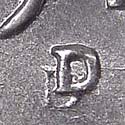
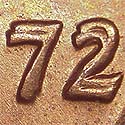
This is nothing more than die fatigue causing some rather nice breaks and filled numbers or letters.
One point I should make concerning terminology. The word 'cud' pertains to a coin minted with a die that has a piece broken out of it. It will appear as raised metal near the edge of the design where the missing piece of the die failed to strike the coin.
In the case of this coin, the area(s) you referred to as a cuds are known as a chips, breaks, or blobs.
These conditions are actually very common in the 50's and 60's as the mint let the dies go a long way before changing them out. 1955-68 are great years for these.
_________________
Bob Piazza
Site Admin/Moderator
Attributer/Photographer
bobp@coppercoins.com
mustbebob1@gmail.com
|
|
|
|
|
|
 coopExpert Member coopExpert Member
Posts: 3402
Joined: 17 Sep 2003
Location: Arizona
|
|
| Posted: Mon Jul 24, 2006 4:32 pm |
|
|
On a cud, the outside edges of the die shatter away leaving a small or large area exposed as a gap in the die. When continued to be used the gap get wider as it crumbles away or eventually gets pulled as the operator may notice a problem and replace the upper, lower or just one die to get more wear out of the good die left. This usually happens to the obverse die the hammer, but can happen to the lower die the anvil. Nice to find as they do bring a nice premium to the seller. (I had to borrow an image to use as an example below.)

Note even lower die (Reverse) was affected. Not the weakness on the letters at 7:00. Without the metal that would be there during the striking process, the image is weaker.
_________________
Richard S. Cooper
You may be only one person in the world, but you may also be the world to one person.
|
|
|
|
|
|
|



