| Author |
Message |
 eagamesExpert Member eagamesExpert Member
Posts: 3013
Joined: 15 Nov 2005
|
|
 Posted: Wed Nov 22, 2006 10:10 pm Posted: Wed Nov 22, 2006 10:10 pm |
 |
|
|
|
|
|
|
 |
 Bob PSite Admin Bob PSite Admin
Posts: 3482
Joined: 01 Jul 2003
Location: Niceville, Florida
|
|
| Posted: Thu Nov 23, 2006 7:40 am |
|
|
You gotta be kidding! Would be pretty easy to separate the zinc from copper cents, but to be able to search at high speeds for varieties? Unless there are programs designed to identify each and every type of doubled die, and on each side of the coin, it is HIGHLY unlikely anything home made could do this consistently and accurately
_________________
Bob Piazza
Site Admin/Moderator
Attributer/Photographer
bobp@coppercoins.com
mustbebob1@gmail.com
|
|
|
|
|
|
 ldarrellcSenior Member ldarrellcSenior Member
Posts: 510
Joined: 05 Oct 2006
|
|
| Posted: Thu Nov 23, 2006 8:14 am |
|
|
well there ya go just like the United States Mint ( I bet that guy works for them)
wants to take the fun out of searching lincoln cents. After all isnt that what the mint wanted to do with the single hub Squeezing..... Get rid of the double dies. well that didnt work so I am betting that machine wont work either 
|
|
|
|
|
|
eagamesExpert Member
Posts: 3013
Joined: 15 Nov 2005
|
|
| Posted: Thu Nov 23, 2006 12:39 pm |
|
|
Fingerprint or eye readers can do it. The software already compensates for position, remembers many different prints. Fingerprints are similar to recognizing varieties. Not the cheapest fingerprint readers, the better ones.
The machine would put cents between 2 readers one per side so orientation and heads or tails wont matter. Each variety is like another users print. There's stuff below the resolution it could see but would find big varieties. If it had a billion cents (like coinstar) it should find many.
But still I like looking the old fashioned way. 
_________________
Ed
|
|
|
|
|
|
 RobertSenior Member RobertSenior Member
Posts: 896
Joined: 05 Jul 2003
Location: Oklahoma
|
|
| Posted: Thu Nov 23, 2006 2:46 pm |
|
|
There are many reasons why I don't believe the ad.
1. It's filmed in someone's kitchen.
2. Too many typos in the description for them to be accidental.
3. "All sales final"... look out!
4. A video and "instructions" (verbal?) do not equal blueprints.
5. Inflation hedge? Where did that come from?
6. What data do they have to back up their claim of "tripple"-ing your money?
7. If these projects are so "for real", why did they go to the trouble of making a 2-hour video rather than "tripple"-ing their own money?
8. If it says "You can't 'loose'" then you probably can lose.
9. Why is the "buy it now" price only a nickel more than the starting bid?
10. Their other two auctions are how-to videos for stringed instruments. That doesn't fill me confidence regarding cent sorting.
Here are some technical issues that come to mind regarding the checking of cents for die varieties:
1. Lighting. (Right, Chuck?)
2. Cent orientation. Heads/tails, and "clock" position. Although I grant you that a serious system could theoretically handle these issues.
3. Debris on the cent obscuring viewing. Will the system puke out the bad coins?
4. CCD camera resolution. It's not as easy as you think. Higher res and larger pictures make dealing with the resulting huge picture files very difficult and therefore slow down the system.
5. Stray marks such as scratches near the date causing the software to be confused. Where do you draw the line between readable and non-readable coins?
6. Shiny/dull coins giving different amounts of reflected light to the camera, causing the coins to either appear almost black or almost white. (Please don't tell me they're using color CCDs!)
7. The size (or lack thereof) of 95% of the varieties we look for. Here is why #4 is so imporant.
8. Will the machine wobble/rotate the coin/change the lighting conditions when trying to determine the variety (like each of us does instinctively?) If not, how will it be able to tell if it's a D/D split serif or just an oddly-shaped mint mark?
9. Does the system have a database with known varieties in it? Will it compare with known varieties or will it just spit out possible candidates? (in which case you'll be looking them up by hand anyway).
10. The previous nineteen items refer to cents. The ad says "any other denomination" can be done as well?
As you can see, I'm a little skeptical. But then again I could be wrong. The seller may be on to something. He may have figured out the problems.
|
|
|
|
|
|
eagamesExpert Member
Posts: 3013
Joined: 15 Nov 2005
|
|
| Posted: Thu Nov 23, 2006 3:57 pm |
|
|
I agree that thing in the video would not help me. It probably only gets coins randomly positioned under a video camera. I can do that faster myself.
I'm saying one could be made that would work.
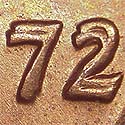
It won't see through gunk but it would still be able to find the nice ones of big varieties 55-72-83-84-95 and if you had access to enough cents like coin rolling companies do just think what it would find.
The trick would be use an existing coin counter that works, add fingerprint readers to one spot so it's just using 2 existing things a coin counter and fingerprint readers.
I'm a biased after working on chips for 25 years. Simple robotics make things well, they do small things using images. Chips are smaller than what we look for on varieties.
For example the CPU in your PC is smaller than a dime and has millions of transistors and interconnects a fraction of microns and machines made it, tested it, stamped a part number on it, put it in a shipping box mounted it on the boards in your pc and sometimes  it works. it works.
http://content.zdnet.com/2346-9595_22-37087-12.html
_________________
Ed
|
|
|
|
|
|
RobertSenior Member
Posts: 896
Joined: 05 Jul 2003
Location: Oklahoma
|
|
| Posted: Thu Nov 23, 2006 8:39 pm |
|
|
The problem isn't so much hardware as software. There is to much variance from coin to coin for something like that to work, at least for several more years. Yes, hardware is improving every day but when it comes to variety searching, even today's software is far from being able to operate at a level of sophistication that even approaches that of human abilities. I mean, the resolution needed to accurately map a fingerprint is much coarser than the resolution needed to distinguish the second RPM from the third. Not to mention the variability of toning/wear/scratches it would have to deal with.
Several things come to mind:
1. I have an HP flat scanner. I have scanned many documents in it, and the automatic image detecting software invariably selects phantom images that it somehow detects but simply aren't there. It selects regions that have no bearing in reality. Why? Because the hardware thinks it detects something and the software isn't good enough to know it's just a false reading.
2. OCR (optical character recognition). Ever have it give you a nonsense word? I have.
3. I remember about 10 or 15 years ago there was an attempt to grade Morgans via digital means. The idea was to assign an MS grade no less (MS60-70) taking into account contact mark severity/location, toning, and maybe even DMPL. The main reason for digitizing it was the repeatability issue. There were some stories on this system in the coin literature of the time but in the end it couldn't be done.
4. Time. How long will you be willing to spend on a coin? The PCGS Expert system takes a while and part of that time is reflected in the cost of certification.
I laughed at the idea of digitally grading coins back then, and I still chuckle at it today because in the end, it's humans who still have the final say (http://www.coingrading.com/compgrade1.html). Why is that, I ask. In the end it was one of those ideas that sounded great at the staff meeting but didn't quite live up to the expectations.
Perhaps one day this will be doable, and so might the variety scanner, but it's not time yet. And I don't think the guy in the Ebay auction is the guy who's going to successfully do it first. But, I could be wrong.
Something like a 1955 DDO can probably be detected 7 times out of ten, but the odds go way down for a 1972 DDO and you can forget almost all RPMs and all split serif DDs.
These are my opinions. I know some people who spent 30+ years in factory automation (to include digital vision development) and it's my opinion that if this project could be done it would have already been done.
If you can do it, my hat's off to you and I might be interested in investing in it. But I'd have to see it in action before I would believe it had been done.
Cheers,
Robert
|
|
|
|
|
|
eagamesExpert Member
Posts: 3013
Joined: 15 Nov 2005
|
|
| Posted: Thu Nov 23, 2006 9:20 pm |
|
|
Robert,
What you say is probably realistic, with a simple reader it might only see the most major DDOs. Other things are harder. It would be best at BU rolls with similar tone and condition.
It would be interesting to try putting a DDO on a cheap one like http://www.securemart.com/cgi-bin/future/IBM11595.html?pcode=4 and see if it can recognize the same coin. It may be too course to see it so any cent would look the same or might be too picky and only see the same exact coin. Still I bet you might be able to scan say a 55 in many grades then like you said if it can pick out half of them that's a start. Those things are cameras and software and like cameras each year they get much better.
_________________
Ed
|
|
|
|
|
|
 garylcsrVeteran Member garylcsrVeteran Member
Posts: 493
Joined: 16 Dec 2005
Location: Tucson Arizona
|
|
| Posted: Fri Nov 24, 2006 12:03 am |
|
|
Dang i was going to get one for meself.
now after reading this thread i have to think again.
see how you are
Gary

_________________
Gary L Cox Sr
http://garyscoins.ecrater.com/
|
|
|
|
|
|
garylcsrVeteran Member
Posts: 493
Joined: 16 Dec 2005
Location: Tucson Arizona
|
|
| Posted: Fri Nov 24, 2006 12:03 am |
|
|
|
|
|
|
|
|
 DickExpert Member DickExpert Member
Posts: 5780
Joined: 21 Sep 2006
Location: Rialto, CA.
|
|
| Posted: Fri Nov 24, 2006 1:16 am |
|
|
Gentlemen, I have one of those machines, already. The other is on order, to be delivered when I reach the jolly old age of 257 years, and 4 months!
My magnet will get every steel cent out here! I think I'll wait a bit longer.
Dick
_________________
" Deja Moo: The feeling that you've heard this bull before".
|
|
|
|
|
|
 murphySenior Member murphySenior Member
Posts: 573
Joined: 02 Sep 2004
Location: New Albany, Indiana USA
|
|
| Posted: Sat Nov 25, 2006 3:16 pm |
|
|
I read somewhere that the U.S. Mint uses scanners to catch error and variety cents before they leave the mint. It's been a while since I ran across the article and don't remember where it was. Besides, I don't know if that's true or not and when I tried to Google up an answer all I could find was this:
http://www.qualitydigest.com/july06/articles/05_article.shtml -
| Quote: |
| As the U.S. Mint receives no appropriated funds from Congress, operations are financed by proceeds from the sales of circulating coins to the Federal Reserve Bank System and numismatic items to the public. To this end, cycle time is important. Through lean manufacturing, the U.S. Mint improved cycle time to 69 days in 2005, from 85 days in 2004, showing marked success in realizing its strategic plan of "adding value, ensuring integrity and realizing world-class performance." |
http://www.coinsite.com/content/Articles/MintErrors.asp -
| Quote: |
The United States Mint, at its various facilities, produces billions of coins annually. This works out to more than 40 million coins daily at the Philadelphia and Denver Mints and somewhat lesser numbers at the specialized West Point and San Francisco Mints. Whenever that much of anything is produced there are bound to be errors made.
Modern coins are struck at such a high rate of speed that the human eye can barely perceive it. The fastest of the new coin presses can strike nearly ten coins per second! If these coins are somehow incorrect, the only way to spot the error is by examining the finished pieces after they fall into the receiving hopper. While this is done on an occasional basis, the day-to-day reality of producing millions of coins is that all but a very few United States coins are shipped without any visual inspection.
To help prevent error coins from leaving the mints or even from being produced in the first place, each coining facility has installed riddling devices. These are mechanical sifters that cull out undersize, oversize and mis-shapen planchets and coins. In theory, this should prevent all but normally-sized and normally-shaped coins from leaving the mint, but the evidence found in the error coins themselves proves otherwise. Though most of the errors that manage to pass through the mints’ quality control stations are of approximately normal configuration, some wildly oversize or mis-shapen pieces do escape. This is sometimes no accident, as mint employees have been caught selling error coins to collectors and dealers for a nice profit. The U. S. Mint is very aggressive about prosecuting this crime, but the high value assigned to rare error coins remains an incentive for mischief. |
http://www.madehow.com/Volume-2/Coin.html -
| Quote: |
Inspecting and sorting
10 The press operator spot-checks each batch of new coins with a magnifying glass. The coins move through another riddler that sorts out blanks that have become misshapen or dented during the striking process. |
| Quote: |
Quality Control
Inspections are carried out at many points throughout the engraving and manufacturing process. Alloys are analyzed using xray fluorescent spectrometers or chemical processes. The surface condition of the blanks is checked frequently for maximum center line average. The diameters of the blanks are measured with gauges such as micrometers. Weights are controlled by weighing a specific number of coins against a standard weight plus a pre-determined allowance.
|
http://www.usmint.gov/downloads/foia/PEF05Q1.pdf - U S Mint's report to Congress (interesting read)
_________________
~ Murph ~
|
|
|
|
|
|
|



