abraision doubling?
|
  |
| Author |
Message |
 DickExpert Member DickExpert Member
Posts: 5780
Joined: 21 Sep 2006
Location: Rialto, CA.
|
|
 Posted: Sat Mar 17, 2007 5:57 pm Posted: Sat Mar 17, 2007 5:57 pm |
 |
|
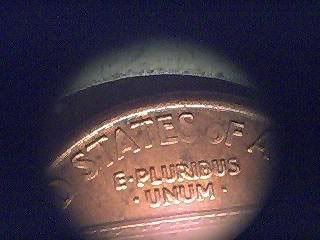
Coop, would this be referred to as "abraision doubling"? I see an awful lot of coind that have obviously have been "ground "down to the field, nearly.
Dick
_________________
" Deja Moo: The feeling that you've heard this bull before".
|
|
|
|
|
 |
 coopExpert Member coopExpert Member
Posts: 3402
Joined: 17 Sep 2003
Location: Arizona
|
|
| Posted: Sat Mar 17, 2007 6:11 pm |
|
|
Not sure exactly what your looking at, but I will comment in general. The plating looks a little flaky at the rim. The letters looks like they may have been grease filled a little. But usually where there is abrasion is from over cleaning and this is usually in the areas where clashes happen. The bays in the memorial, date, edges of the bust/back of head. But these are caused manually. Other area suffer normal wear and shows up more on VLDS coins as a snow drift where the letters.numbers/details flow together. But I'm guessing with the location and the look, that it is minor grease fill or called a strike through. But very minor and usually common on the reverse of memorial Cents. Its usually harder to find ones without it. 
_________________
Richard S. Cooper
You may be only one person in the world, but you may also be the world to one person.
|
|
|
|
|
|
 eagamesExpert Member eagamesExpert Member
Posts: 3013
Joined: 15 Nov 2005
|
|
| Posted: Sat Mar 17, 2007 6:13 pm |
|
|
I'd say that what you see above the letters is something like abrasion doubling because it's in the direction of metal flow out towards the rim. The missing parts of the letters like that is on many modern cents (STATES F AMERICA) and probably is from weakness in the srike and die condition. Looks like a very well used die.
Lets see if Coop agrees with that
_________________
Ed
|
|
|
|
|
|
DickExpert Member
Posts: 5780
Joined: 21 Sep 2006
Location: Rialto, CA.
|
|
| Posted: Sat Mar 17, 2007 6:51 pm |
|
|
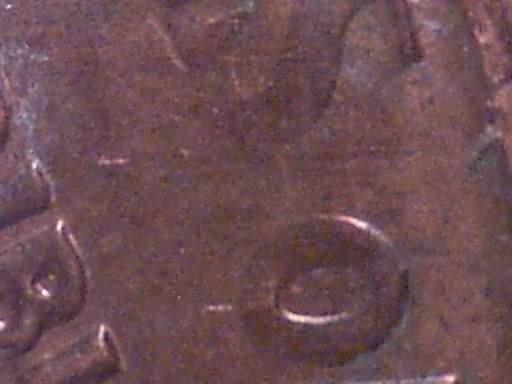
here is another, with the grinding disc marks running 90 degrees to the other marks; You can barely see them in this photo, and in the other, not at all! On the 'scope I see the marks, but in the photos, no. I am about ready to through the whole batcg og junk intio the trash!
Dick
_________________
" Deja Moo: The feeling that you've heard this bull before".
|
|
|
|
|
|
coopExpert Member
Posts: 3402
Joined: 17 Sep 2003
Location: Arizona
|
|
| Posted: Sat Mar 17, 2007 8:26 pm |
|
|
OK, now the lines that you see are old die scratches that are fading. Sometimes they become die flow, but what I see is older die scratches. Common as sand. But it alway nice to know what they are. I usually question everything till I figure out what they are, then they go back into circulation. Chuck usually just stops on things that is a variety. But I get hung up on figuring out what a UFO (Un-Identied Foreign Object) I see on coins passing through. And after I figure it out, they pass through.
I save extreme die clashes, extreme machine doubling, extreme die cracks, extreme grease filled examples and extreme markers in tubes for educational pieces in case there are questions on these subjects, I can find one in a hurry. But these one day will go back to work if they don't find a home first. Always nice to have an example handy I figure. They might not make me rich, but they fill out my educational tools.
_________________
Richard S. Cooper
You may be only one person in the world, but you may also be the world to one person.
|
|
|
|
|
|
DickExpert Member
Posts: 5780
Joined: 21 Sep 2006
Location: Rialto, CA.
|
|
| Posted: Sat Mar 17, 2007 10:07 pm |
|
|
Coop, I am more confused now, than ever!
I see coins witha "cherry" surface, and others thjat have been "down the road", and the field(s) is smooth, unless there has been a change in the area, such as a hit, that has been ground out, or a clash, which also has to be smoothed over. I see these marks from the grinder-discs, and from the stones that also are used to smooth over these marks. I don;t understand how these "marks can be scratches on the die, unless they were put there in some sort of "cleaning" action, namely smoothing out rough spots, caused by something hitting the surface of the die. These "marks, have been seen from the top to the bottom of the obverse on some coins, in the rear face of the bays, behind the devices. ( Check the 1955S photos on the site, for one that has the field well "ground", in several directions, at the end of the wheat sprig, but, the tip of the wheat sprig, is clean).
I don't mean to be contrary, but I have seen the marks a disc, or stone does to a metal surface, and no matter how much you "polish" it, they are still there. Where have I "missed the boat"?
Dick
_________________
" Deja Moo: The feeling that you've heard this bull before".
|
|
|
|
|
|
coopExpert Member
Posts: 3402
Joined: 17 Sep 2003
Location: Arizona
|
|
| Posted: Sun Mar 18, 2007 9:07 am |
|
|
Dick: Let's go back to the subjuct of the clashed die. What creates the marks on each die? The die doesn't have a planchet between so two areas of the dies hit together. What protion of the die makes a mark on each other? Just looking at a coin you would think the highest spots on the coin. But the opposite is true. That hightest spot on a coin is the deepest spot on die. The die is the opposite of a coin. High areas of patterns are deep into the die and the shallow area are the fields around the devices on the die. This area hits together when a clash happens. The fields being the outside edge of the die is where the contact is made and tranfered to each die a part of the field pattern. This field area that is the outside edge is where the cleanings affect the coin the most. So you find cleanings wear/scuffs/clashes/die scratches in these areas in the field. Sometimes you will find a single brush hair that scratches in the deeper parts of the die, but this normally doesn't happen, just usually on the field part affected. Dir flow which you can see on the die is also just on the field areas of the coin, lets say the background of the coin. Scratches/clashes may flow through depper parts of the die pattern only when view the correct way. They are marks on the field only and don't go into the deeper part of the die. Die scratches to cover previous clashes clean the field contact areas. Shen these are deep it takes several coin struck over and over on that area to level the die scratch area, but in time the matterial fills in with other metal. The dis scratch fades/fades untill it is not seen any longer. The fields have the surface for change to take place. Cleanings remove part of the surface. In areas clashed over and over, you start to see where letters/numbers look not as tall as before on coins struck earlier in the coins life. When something makes a mark in the deeper/med depth of the die, this remains a lot longer as the only way to remove this is to scrub deeply or wait for wear to wear it off. Sometimes we forget the steel to steel contact to make the die. The steel to steel cleanings. The steel to copper strikings. It all put wear on a die, especially after it has been done over and over. Hundreds/thousands/hundreds of thousands of times. The wear become apartent. So when se see die flow/wear/fading scratches/die scratches, you are seeing just a small part of the dies life recorded on each following coin after any event it was been through. Its kind of like us, we are starting to show our age. We are not as strong as before when we were younger. Out appearance fades with the days/weeks/years/decades pass by. Events happen to us all and leave their scars, we continue as long as we can bespite what happens. We get touchups by physicians, but that is all they are as touch ups, as no man can ever turn back the clock. So when thing happen we adapt. Continue to deal with our lot in like until we can go no further and are set aside. As this happens to a die, it hasppens with us.
_________________
Richard S. Cooper
You may be only one person in the world, but you may also be the world to one person.
|
|
|
|
|
|
DickExpert Member
Posts: 5780
Joined: 21 Sep 2006
Location: Rialto, CA.
|
|
| Posted: Sun Mar 18, 2007 4:29 pm |
|
|
Coop, I believe we both are saying the same thing. The only difference is the way I express my question, I think.
I was referring to the "remaining" portion of the devices, (letters), which, thru wear, etc, cause the widening of the letters, as they wear down to the field.
The marks left from the cleaning, honing, filing, polishing, etc, are what I thought I was seeing. These are, in fact scratches, whether deep, or shallow, on the die. I re-read both our posts, and still say we are saying the same thing.. I don't express myself too well, at times, and it tends to cause confusion. To cite an example of how I wish I could express myself, look at Chuck. Brief, and to the point! That is one thing I have never been able to develop. I have always "rambled", and I'm sure everyone here will agree, still do!
Dick
_________________
" Deja Moo: The feeling that you've heard this bull before".
|
|
|
|
|
|
coopExpert Member
Posts: 3402
Joined: 17 Sep 2003
Location: Arizona
|
|
| Posted: Sun Mar 18, 2007 7:03 pm |
|
|
I bet I know what kind of car your drived in the past? A Rambler?? 
_________________
Richard S. Cooper
You may be only one person in the world, but you may also be the world to one person.
|
|
|
|
|
|
DickExpert Member
Posts: 5780
Joined: 21 Sep 2006
Location: Rialto, CA.
|
|
| Posted: Sun Mar 18, 2007 10:36 pm |
|
|
Coop, to answer your question, see if this fits:
1915 Model "T"
1948 chev
1949 ford 6 cyl
1950 ford 6 cyl
1948 caggie
1948 chrylser, indsor-Highlander w/semi-automatic xmsn, and clutch.
Pont. J-2000
'79 olds st wgn/diesel engine
56 chev wagon
60 chev wgn
60 jeep
60 olds
'64 Rambler, Put nearly 100,000 miles on it, until a '58 rag-top VW "t"-boned it.
67 dodge pu
67 dodge omni
91 ford Taurus
86 ford pu
98 chev pu, (16,000 miles)
79 ford pu
99 Mercury, astill drining it. Thought you might like to know! LOL
late edit. Coop, I have never put a car in the shop for mechanical, or body work. The paint jobs were done by my oldest son.
Dick
_________________
" Deja Moo: The feeling that you've heard this bull before".
|
|
|
|
|
|
coopExpert Member
Posts: 3402
Joined: 17 Sep 2003
Location: Arizona
|
|
| Posted: Mon Mar 19, 2007 2:14 pm |
|
|
When you mentioned "Rambled" I figured there had to be a Rambler in there somewhere.
1948 Caggie? Not sure what the model is? Now if you had said Hudson, Kaiser/Frazer, Henry J, Nash, Crosley, Star, Tucker, Willys, Moon, Franklin, or Woods. I know what they looked like. Caggie??
_________________
Richard S. Cooper
You may be only one person in the world, but you may also be the world to one person.
|
|
|
|
|
|
DickExpert Member
Posts: 5780
Joined: 21 Sep 2006
Location: Rialto, CA.
|
|
| Posted: Mon Mar 19, 2007 6:15 pm |
|
|
Coop, the '48 Caddie had tail lights that were raised, and rounded. One of them covered the gas cap. You know, the kind that you turned to close. Then they came out with a gas cap that you could lock with a key. The '51 Caddie had the feather guides llike the arrows use ,to keep them stable in flight.
Ok, you got me! the word "caggie" is what comes out when I am having a good day.....Had I said CADILLAC, I'll bet you would have known what it was. Caggie! Maybe it is a new one they are testing in Hangar 51, near Vegas.
Dick
_________________
" Deja Moo: The feeling that you've heard this bull before".
|
|
|
|
|
|
|
|
|
| Page 1 of 1 |
|
|



