| Author |
Message |
 coppersleuthAdvanced Member coppersleuthAdvanced Member
Posts: 119
Joined: 21 Jul 2006
|
|
 Posted: Sun Aug 05, 2007 6:57 am Posted: Sun Aug 05, 2007 6:57 am |
 |
|
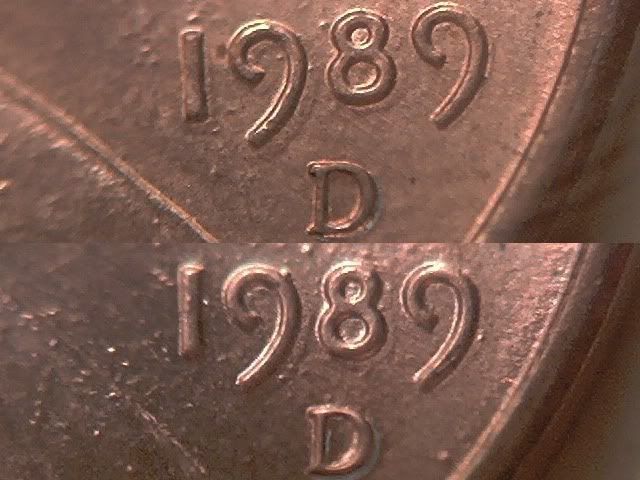
Take a look at the date, especially the 8. See how there are 3 images of the 8. I realize this is nothing more than mechanical doubling/tripling. But I was curious about the 89-D coin. Notice in the full pic of the coin the indented circle within the coin surface. You can see it passing thru between B & E on LIBERTY, around the top of Lincoln's head, and down again through the date. It seems I've seen this with some frequency on 89-D cents. I know this contributed to the illusion of doubling/tripling to the 8. But what causes this depressed surface area, since it seems to be common for the 89-D. Thanks


|
|
|
|
|
 |
 Bob PSite Admin Bob PSite Admin
Posts: 3482
Joined: 01 Jul 2003
Location: Niceville, Florida
|
|
| Posted: Sun Aug 05, 2007 8:58 am |
|
|
I believe (but am not absolutely sure) that a lot of these coins with the extra 'ring' around them, all suffer from striking pressure problems. I am guessing that the hammer die is slamming down onto the anvil with too much pressure, and the resulting 'ring' is devices from the reverse pushing up to the obverse. This is only a guess though. Maybe someone else knows for sure.
_________________
Bob Piazza
Site Admin/Moderator
Attributer/Photographer
bobp@coppercoins.com
mustbebob1@gmail.com
|
|
|
|
|
|
 StevenExpert Member StevenExpert Member
Posts: 1298
Joined: 30 Nov 2005
Location: S/E Missouri
|
|
| Posted: Sun Aug 05, 2007 9:56 am |
|
|
|
|
|
|
|
|
 DickExpert Member DickExpert Member
Posts: 5780
Joined: 21 Sep 2006
Location: Rialto, CA.
|
|
| Posted: Sun Aug 05, 2007 12:19 pm |
|
|
Bob, I think you have it pretty well covered. The only comment I might add is that due to the construction of the blank material, it might be theat when the hammer comes down, it also tends to compact the zinc inside the "case", and cause pressure ridges to form I have seen this on all the '82, and forward cents to a lessor degree. Altho some have been very pronounced. I think this might also account for the "pressure ridge" that is seen on many of the cents, but not completely around, like it appears to be on coppersleuth's coin. This is an anomily, that has been commented on by several members, but no final decision, as yet.
Dick
_________________
" Deja Moo: The feeling that you've heard this bull before".
|
|
|
|
|
|
mikediamondAdvanced Member
Posts: 191
Joined: 09 Oct 2003
Location: Western Illinois
|
|
| Posted: Sun Aug 05, 2007 12:42 pm |
|
|
It's a manifestation of die deterioration, but why it takes this particular form is unclear.
_________________
President of CONECA; Host of Error Coin Information Exchange (Yahoo:Groups). Opinions rendered do not necessarily reflect those held by any organization I am a member of.
|
|
|
|
|
|
 eagamesExpert Member eagamesExpert Member
Posts: 3013
Joined: 15 Nov 2005
|
|
| Posted: Sun Aug 05, 2007 2:04 pm |
|
|
I also think these are from die deterioration.
For some reason 1989-d have a lot of these!
They often have the raised area around the obv that Dick called a "pressure ridge" which also seems to be from die deterioration or strike pressure or a combination.
_________________
Ed
|
|
|
|
|
|
eagamesExpert Member
Posts: 3013
Joined: 15 Nov 2005
|
|
| Posted: Sun Aug 05, 2007 4:57 pm |
|
|
Just adding a pic of some others:
_________________
Ed
|
|
|
|
|
|
wavysteps2003Expert Member
Posts: 1344
Joined: 25 Feb 2005
|
|
| Posted: Mon Aug 06, 2007 8:34 pm |
|
|
For some reason and I can not remember where I read this, but the affect of this die deterioration doubling is caused by the metal flow from the planchet slowly erroding the die.
The easiest example to picture is the ripples in the sand on a beach caused by the water flowing over them. When you have a depression, the flow, as it leaves that indentation sets up a pressure area directly behind that indentation which the flow humps over and then starts scooping away the atomic structure behind that area. That will leave a raised area on the coin, apart from the design element associated. There also may be some correlation between the smaller flow as the metal wavy approaches the rim and the increased speed of the flow due to less volumn being pushed.
Also thought of this one today. For those of you who live in the country, you have seen the affects of a washboard road. Think of the car tires as the metal flow. When the tire comes out of the rut in the road, the movment causes the tire to move over a small portion of that road and land with exerted force, which over time causes another depression. Soon, as more and more cars travel over the same road, the problem increases, with the ruts becoming deeper and more of them. Relate that back to metal flow coming out of a depression on the die and over a period of time, it will form another depression.
BJ Neff
_________________
Member of: Coppercoins, ANA, CFCC (VP), CONECA, FUN, NCADD (Editor), NLG, LCR, traildies.com. and MADdieclashes.com
The opinions that I express do not necessarily reflect the policies of the organizations that I am a member of.
|
|
|
|
|
|
|



