Canadian trail die
|
  |
| Author |
Message |
wavysteps2003Expert Member
Posts: 1344
Joined: 25 Feb 2005
|
|
 Posted: Sat Oct 18, 2008 5:21 pm Posted: Sat Oct 18, 2008 5:21 pm |
 |
|
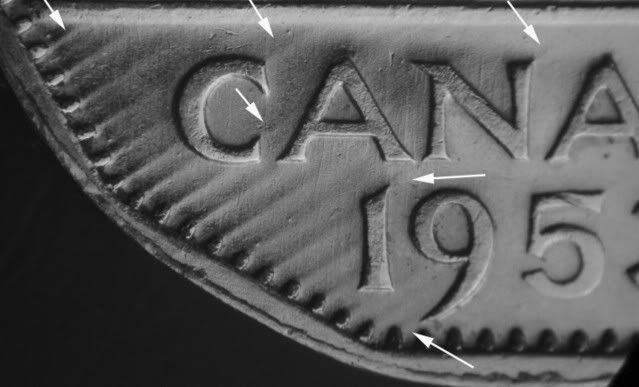
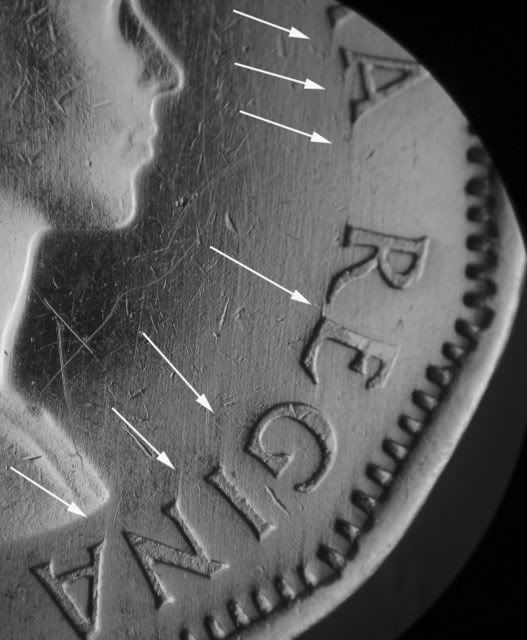
For all that are interested, Bob and I have decided to list this 1953 Canadian nickel, with both obverse and reverse trails on traildies.com.
This is a very interesting die for not only is it the oldest found to date, it is also the first foreign trail die and has dual trail directions on the obverse.
I know, you are thinking that this changes the theory concerning the single squeeze hubbing. Not in the least, however, it does kind of complicate the theory that these are double dies. One thing that I did discuss with Bob and we both agree, is that on multiple hubbed coins, it had to be the last hubbing that had trails.
Anyway, a couple of pictures to get your interest.
BJ Neff
_________________
Member of: Coppercoins, ANA, CFCC (VP), CONECA, FUN, NCADD (Editor), NLG, LCR, traildies.com. and MADdieclashes.com
The opinions that I express do not necessarily reflect the policies of the organizations that I am a member of.
|
|
|
|
|
 |
 coppercoinsSite Admin coppercoinsSite Admin
Posts: 2809
Joined: 29 Jun 2003
Location: Springfield, Missouri.
|
|
| Posted: Sat Oct 18, 2008 5:49 pm |
|
|
These appear to me to have pretty obvious lines from die polishing with some sort of wheel buffer or grinder. How does this have anything to do with the actual hubbing process?
_________________
C. D. Daughtrey
owner, developer
www.coppercoins.com
cd@coppercoins.com
|
|
|
|
|
|
wavysteps2003Expert Member
Posts: 1344
Joined: 25 Feb 2005
|
|
| Posted: Sat Oct 18, 2008 6:35 pm |
|
|
Chuck - what type of grinder or buffing material would be used to have this affect on tempered carbon steel? Why are just the incused parts of the die affected by the action that you describe? Why not on all parts of the field?
I can understand your question if you just took this one die into account, however, there are 700 + dies that have these same lines.
The polishing or abrading of the die has come up frequently as a possible cause for these lines, but the one very big draw back against this argument is the very precise patterns that these lines take. These patterns are not only in direction but the design elements affected as well. Also, they have occurred in the same year and over a span of many years (up to 10 years for trail; up to 15 years for wavy steps).
It is theoretically impossible for the human hand to be so precise in following such patterns.
We can also look at the late 1980s, where more than a few of the dies carry heavy abrasion lines, especially on the reverse dies. We also see trails on those dies and there is no similarity to the two. While the abrasion marks are quite random, the trails are all in the exact same direction.
If we are going to talk about a tool that makes these precises marks, there is only one and that is the hub. It has the ability to mar the surface of the die since it is a harder steel at that point and it is the only tool that can keep a repetitious design over a large number of years going for it does not change.
When you look at these trail, it is simple. All that occurs is the die moving against the hub without the pressure applied and the high points of the hub digging into the surface of the die as it moves. As the hub is retracted, the trails fade since there is less and less pressure. In some cases, like the obverse of the 1953, there is a dual movement, which is generally the first movement and then the return path.
BJ
_________________
Member of: Coppercoins, ANA, CFCC (VP), CONECA, FUN, NCADD (Editor), NLG, LCR, traildies.com. and MADdieclashes.com
The opinions that I express do not necessarily reflect the policies of the organizations that I am a member of.
|
|
|
|
|
|
 eagamesExpert Member eagamesExpert Member
Posts: 3013
Joined: 15 Nov 2005
|
|
| Posted: Sat Oct 18, 2008 7:43 pm |
|
|
The trail lines from the denticles pass the C of Canada but in the area where the C blocks them they stop but new trails come from the corners of the C.
It's like the denticles (raised on the hub) gouged into the die followed by the C (raised on the hub) so the C bulldozed the existing lines and created it's own trails.
Added: The other area near REG look like polish lines but maybe they tried polishing to hide the trails? (they also aren't the same direction as the ones near Canada)


_________________
Ed
Last edited by eagames on Sat Oct 18, 2008 9:21 pm; edited 1 time in total
|
|
|
|
|
|
 DickExpert Member DickExpert Member
Posts: 5780
Joined: 21 Sep 2006
Location: Rialto, CA.
|
|
| Posted: Sat Oct 18, 2008 9:05 pm |
|
|
I don't know how they are made, but I get the impression that they are "stress lines", and there definitely is "stress from the pressure of the press, during the strike in the minting process. beyond this, I am as much in the dark, as any one else. I'll check to see if I am lucky enough to have one, (on any Canadian coin). I understand they also use the "single-squeeze" process
Dick
_________________
" Deja Moo: The feeling that you've heard this bull before".
|
|
|
|
|
|
 KurtSSenior Member KurtSSenior Member
Posts: 875
Joined: 15 Feb 2008
|
|
| Posted: Sun Oct 19, 2008 11:17 am |
|
|
|
This coin still surprises me, because I've looked through hundreds from 1953 for the rare "mule" die pair--but never seen anything like those strong trails near the date.
|
|
|
|
|
|
coppercoinsSite Admin
Posts: 2809
Joined: 29 Jun 2003
Location: Springfield, Missouri.
|
|
| Posted: Sun Oct 19, 2008 12:02 pm |
|
|
My arguement isn't that all such lines are caused by die polishing, but some of them could be. The result looks similar, but the cause could be completely different. I see many thin lines on the obverse of that nickel that look like polishing lines.
Any time a polishing instrument with bristles is used on something with recesses, the bristles would tend to work toward the corners of the recess and come out of the recess in clumps wearing the raised area near the corners of the recesses more than the rest of the raised area. That's exactly what it looks like to me.
I don't refute that some of the effects we are seeing are caused by the hubbing process, but this particular case appears to be nothing more than over zealous die polishing with some sort of tool that spins and has bristles - like some sort of spinning wire brush.
_________________
C. D. Daughtrey
owner, developer
www.coppercoins.com
cd@coppercoins.com
|
|
|
|
|
|
DickExpert Member
Posts: 5780
Joined: 21 Sep 2006
Location: Rialto, CA.
|
|
| Posted: Sun Oct 19, 2008 12:58 pm |
|
|
Just my impression: The trails are definitely visible on the reverse. On the obverse,, under heavy magnification, I see trails from the "IA" of "gracia", and also from the denticles, (only a few), and some "apparent" trails from some of the other letters as well. I do note there is very notable polishing marks visible in the same areas, which confuse the pattern of the trails. IMHO, both parties are correct I had to go to theCharlton catalogue to view the obv, because none of my nickels date before '61, (for the wording).
It is a very noce, and interesting coin! thanks for sharing.
Dick
_________________
" Deja Moo: The feeling that you've heard this bull before".
|
|
|
|
|
|
wavysteps2003Expert Member
Posts: 1344
Joined: 25 Feb 2005
|
|
| Posted: Sun Oct 19, 2008 1:27 pm |
|
|
On the reverse, there are polishing lines, however, they are not in the same direction as the trail lines.
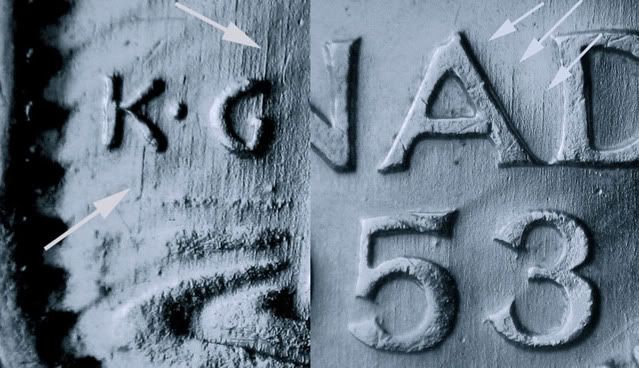
Notice the die scratches through the designers initials. They travel in a north / south direction. So do the polishing lines from the second A in CANADA. The trails are in a 050 direction. Also, one only needs to look at the trail line from the top of the 5 digit and the polishing marks to see the marked difference between them.
I am sorry, there are just to many inconsistencies to attribute these lines (trails) as being generated from either cleaning, polishing or abrading the die.
BJ
_________________
Member of: Coppercoins, ANA, CFCC (VP), CONECA, FUN, NCADD (Editor), NLG, LCR, traildies.com. and MADdieclashes.com
The opinions that I express do not necessarily reflect the policies of the organizations that I am a member of.
|
|
|
|
|
|
KurtSSenior Member
Posts: 875
Joined: 15 Feb 2008
|
|
| Posted: Sun Oct 19, 2008 3:11 pm |
|
|
Here's a useful bit of info from RCM Mint Reports for 1953 regarding die usage:
Mintage: 16.6M, Obverse dies used: 227, Reverse dies used: 161, pieces per pair of dies: 85,750.
There are also two distinct die styles for both the obverse and reverse. One is the earlier "no shoulder fold" obverse which resulted from using a high-relief portrait design that would not strike correctly on the coin--details lost somewhere in the die-making process. This was replaced by the lower-relief "shoulder fold" obverse seen in the trails coin. There are two reverse die types most easily determined by the position of the lower leg of the 9 in the date. This coin is the "near" reverse type.
|
|
|
|
|
|
DickExpert Member
Posts: 5780
Joined: 21 Sep 2006
Location: Rialto, CA.
|
|
| Posted: Sun Oct 19, 2008 3:13 pm |
|
|
I noticed that it does NOT have the extra water line, so it is just another nickel, (ezxcept for the trails).
Dick
_________________
" Deja Moo: The feeling that you've heard this bull before".
|
|
|
|
|
|
KurtSSenior Member
Posts: 875
Joined: 15 Feb 2008
|
|
| Posted: Sun Oct 19, 2008 3:42 pm |
|
|
Dick, right!  some categorize the reverse by the water ripples, but I've found that a bit dependent on strike for me to tell. All told, there are 4 major varieties, the last 2 are rare. some categorize the reverse by the water ripples, but I've found that a bit dependent on strike for me to tell. All told, there are 4 major varieties, the last 2 are rare.
No Shoulder fold obverse paired with the "far date" (or far leaf)
Shoulder fold obverse paired with the "near date" (this coin)
Mules:
No Shoulder fold obverse paired with the "near date" (or near leaf)
Shoulder fold obverse paired with the "far date"
Well, I don't want to confuse things further when this thread is about trails.
|
|
|
|
|
|
DickExpert Member
Posts: 5780
Joined: 21 Sep 2006
Location: Rialto, CA.
|
|
| Posted: Sun Oct 19, 2008 3:57 pm |
|
|
Kurt, I didn't note the presence, or abscense of the shoulder fold, because the whole face was not shown. So, that would leave me with very little to go on. Ditto, the rev. I'm too new to the Cannucks, to remember all of the "good ones"! I keep my Charlton's Catalogue handy as I go thru any batch of coins.
I can't do that with my US coins, too many books!
Dick
_________________
" Deja Moo: The feeling that you've heard this bull before".
|
|
|
|
|
|
KurtSSenior Member
Posts: 875
Joined: 15 Feb 2008
|
|
| Posted: Sun Oct 19, 2008 4:32 pm |
|
|
Dick,
You can also tell the obverse style by the lettering...because a shoulder fold coin is often worn down too much on portrait areas to serve as a marker...particularly for the cent series.
|
|
|
|
|
|
DickExpert Member
Posts: 5780
Joined: 21 Sep 2006
Location: Rialto, CA.
|
|
| Posted: Sun Oct 19, 2008 9:04 pm |
|
|
Kurt, that is very true. I seldom go by the obe shoulder, for that very reason. I rely almost entireely on thepositioning of the "I", and "A" in "Gracia". It is always directly opposite, and the font of the "I" is always clear. Then the Catalogue, is good for reference, as well. When all else fails, it is nice to have a foto of the "Real McCoy". That is why I tend to "lift" photos of coins I am interested in, or will be searching. The site, or my own data base.
I was looking at the site LCRC, and chwecking my '22-D, for p[oints in common. I find that my coin is the "same obe, but eaerlier. The third pair shown is a very good match, even to position of the MM. Id the MM were plugged, it could very well pass for the same coin. I say that, because the firsrt "T" in trust is the same as the site photo, and the last "T" is bigger. The site: LCRC.
Dick
_________________
" Deja Moo: The feeling that you've heard this bull before".
|
|
|
|
|
|
|
|
|
| Page 1 of 1 |
|
|



