1960
|
  |
| Author |
Message |
 fiddle-fartVeteran Member fiddle-fartVeteran Member
Posts: 479
Joined: 27 Jul 2008
Location: Charlestown, Indiana
|
|
 Posted: Tue Jan 06, 2009 6:36 pm Posted: Tue Jan 06, 2009 6:36 pm |
 |
|
|
|
|
|
|
 |
 coppercoinsSite Admin coppercoinsSite Admin
Posts: 2809
Joined: 29 Jun 2003
Location: Springfield, Missouri.
|
|
| Posted: Tue Jan 06, 2009 10:38 pm |
|
|
It's a given that the small date has the 'low 9' and the large date has the 'high 9', but the point is that these terms didn't stick. 'Large date' and 'small date' are what they are called by the collecting community of today. Calling them 'low 9' and 'high 9' are confusing to new-generation collectors who need one term to stick with. For many youngsters today, the less detail you feed them the better they do.
Another point to make - be very careful about using Breen listings to make points (not that this was the case). You should be made aware that many of the listings from Breen's encyclopedia have either been refined by people who studied the subject in better depth, or have been debunked with more modern study. Things such as the 'no initial' cents and the 1958 over 7 cents are listed in Breen, but are no longer recognized by the knowledged populace because they were mistaken by Breen to be something they are not.
Although his work was a masterpiece of his time, so was the typewriter and the crank telephone. These have all been well outdated. Other than as a historical reference, Breen's guide provides no 'new' information that cannot be sought in more appropriately dated references.
I am happy to see his reference online, but caution must be taken in using it as a 'current' reference.
_________________
C. D. Daughtrey
owner, developer
www.coppercoins.com
cd@coppercoins.com
|
|
|
|
|
|
 DickExpert Member DickExpert Member
Posts: 5780
Joined: 21 Sep 2006
Location: Rialto, CA.
|
|
| Posted: Tue Jan 06, 2009 10:48 pm |
|
|
Mike, I mentioned that, ( the "high "9", low "9", and was informed that "there ain't no such animal") or words to that effect. It was puiblidhed in the Coins Magazine. There ARE large, and small dates, and a "large over small date. the site shows these. I think the Position odf the "1", in relation to the "9", should not change, due to rthe fact that the "19" is a "sic, fixed set, and the decades wilkl change. The relation of the "1", and the "0", shoulld vary, in accoerance with the large, or small date. The "9, and "^" change shape, and size possibly. Don't quote me on that. There are over 160 varieties in that one date. I have gone thru them fron "A to Z", in the Denver mint, locating the MM, and thus determining the variety. I by necessity, had to use a different method, and not as accuratee as the "overlay, but I am not profficient with the overlay, so I use "Ratio, and proportion, to locate the MM position, and relationship with the rest of the date. It wasn't easy, and not accuratye, but it is, "Ball-park". It is a time consuming process, as is Overlay. "Them days is gone forever"! That was before I lost my "focal point". I tried it recently, but can't get that close, and be sure. I guess it comes with the teerritory.
Dick
_________________
" Deja Moo: The feeling that you've heard this bull before".
|
|
|
|
|
|
coppercoinsSite Admin
Posts: 2809
Joined: 29 Jun 2003
Location: Springfield, Missouri.
|
|
| Posted: Tue Jan 06, 2009 11:06 pm |
|
|
Dick - your post is confusing in speaking of 160 different varieties when we are talking about the relation of the date figures themselves. Repunched mintmarks and the relative sizes of the dates are two completely different things.
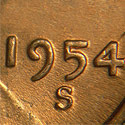
There are ONLY two date sizes, thus only two different 'positions' of the four digits of the date - large date and small date.
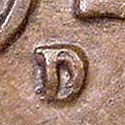
Repunched mintmarks happened on at least 160 dies that year, but they ONLY happened on either large or small dates. Nothing else.
Overlays are used in determining whether two repunched mintmarks that are very similar in appearance belong to the same die. The reason for the overlay is to determine that the mintmark is punched in the exact same spot on two coins, because they were punched into each individual die by hand, which placed most of them in different enough spots to be able to detect the differences using overlays. The chance that two different dies show repunched mintmarks AND the mintmark and its repunching are in the exact same spot on both dies is remote. It has happened, but it's still remote.
If you have two RPMs that look identical, but you cannot find any markers (cracks, gouges, scratches, etc.) that match between the two coins, an overlay helps determine whether the mintmarks are in the same spot on both coins. If they are, they could be fromt he same die. If they are not, they cannot possibly be from the same die. That's the process of attribution with repunched mintmarks.
But it has nothing to do with the position of the 1 in relation to the 9 or 6.
_________________
C. D. Daughtrey
owner, developer
www.coppercoins.com
cd@coppercoins.com
|
|
|
|
|
|
DickExpert Member
Posts: 5780
Joined: 21 Sep 2006
Location: Rialto, CA.
|
|
| Posted: Wed Jan 07, 2009 12:10 am |
|
|
Mike, Now you know what I was TRYING to say! If I live long enough, I'll possibly learn to express myself, properly, AND in a whole lot less words! LOL I'm sure there are folks like Chuck, and several others that are brief, and to the pont! thank You Chuck
Dick
_________________
" Deja Moo: The feeling that you've heard this bull before".
|
|
|
|
|
|
|
|
|
| Page 1 of 1 |
|
|



