A new tool/aid for attributing varieties and counterfeits
|
  |
| Author |
Message |
justafarmerMember
Posts: 33
Joined: 01 Jul 2009
|
|
 Posted: Tue Jul 21, 2009 12:09 pm Posted: Tue Jul 21, 2009 12:09 pm |
 |
|
I have noticed many members of coppercoins use grids, straight edges and overlays as tools in their attribution process. Over the last couple of years I have introduced a new tool into my attribution process which I would like to share and seek input from the community.
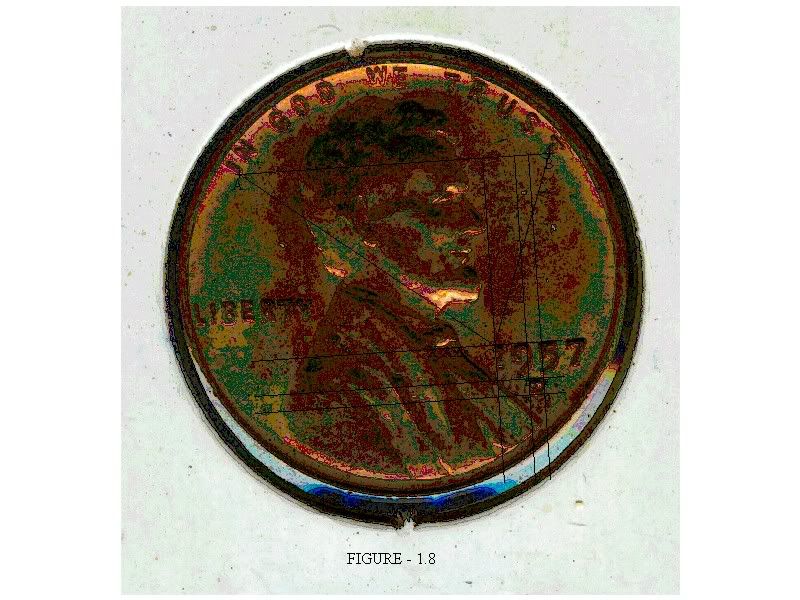
My process involves using the precision of a CAD system (I use TurboCad purchased off the shelf for $39.95) by importing pictures and plotting the coordinates of the mintmark to determine its location relative to set points of the coin's design. These coordinates are then searched in a database of known examples. Sorta like a GPS/Triangulation/Fingerprint/CODIS system for variety attribution. I know the explanation appear complicated and time consuming but actually it is not. Once you’ve got a couple of plotted coins under your belt – you’ll get to the point where it only takes two or three minutes. I am sure there are members here who are a lot more proficient with CAD than I am due to the fact they work with it on a regular basis. And there are features bundled inside CAD software if utilized could make my system better. Any input and suggestions would be appreciated.
The image provided with my post degraded significantly when converted from TCW to JPG.
Step 1 Scan Coin
Step 2 Import scan of coin into CAD system
Step 3 Plot a point on the southwest corner of the (I) of (IN) on the motto. Point (A) on image.
Step 4 Plot a point on the southeast corner of the last (T) of Trust in motto. Point (B)
Step 5 Draw a straight line from point (A) to point (B)
Step 6 Pull a perpendicular line to the south off the line tangent to the west border of the (1) in the date.
Step 7 Draw a line parallel to line (AB) tangent to the north border of the (1) in the date.
Step 7a The two lines drawn in steps 6 and 7 will be your (X) axis and (Y) axis.
Step 8 From the intersection of lines drawn in step 6 & 7 (point C) draw straight lines to point (A) & (B)
Step 8a The triangle ABC created in step 8 is utilized for scaling purposes. Physically drawing triangle ABC is not necessary. But has been done for illustration purposes in the attached image.
Step 9 Draw perpendicular and parallel lines boxing in the mintmark at the northern, eastern, southern and western most tangents.
Step 9a The coordinates of the intersections of the four lines drawn above in step 9 as indicated by points (D), (E), (F), & (G) in the illustration provided is the information of interest. These points provide information of both the location and orientation of the mintmark in relation to the other design elements of the coin. Visualized pivoting the mintmark clockwise or counter clockwise on the image provided. As the mintmark is rotated you can visualize how points (D), (E), (F), and (G) would move north, south, east or west accordingly.
Step 10 Search coordinates of points (D), (E), (F), and (G) in a database on known examples.
|
|
|
|
|
 |
 Bob PSite Admin Bob PSite Admin
Posts: 3482
Joined: 01 Jul 2003
Location: Niceville, Florida
|
|
| Posted: Tue Jul 21, 2009 1:22 pm |
|
|
That's pretty impressive! I don't know if I would ever go so far as to use a CAD program, but people here are industrious enough to find a system that works for them.
Even with a database as big as the one on coppercoins, I don't see many examples where the basic way of attributing a coin won't work. I usually use the overlay as the last way to positively identify a particular variety. Your CAD program is pretty cool though!
_________________
Bob Piazza
Site Admin/Moderator
Attributer/Photographer
bobp@coppercoins.com
mustbebob1@gmail.com
|
|
|
|
|
|
 DickExpert Member DickExpert Member
Posts: 5780
Joined: 21 Sep 2006
Location: Rialto, CA.
|
|
| Posted: Tue Jul 21, 2009 1:43 pm |
|
|
justafarmer, thanks for your rime, and effort. I "see" where you have a point, however, I only use the full date, and position the MM in relation with it. being as there is no SET position for the MM's,. everything has to be relative. As I mentioned, I use the "grid" system,and use only the tail of the "9" for n/s, e/w position, and do not take into consideration. the rotation/tilt of the MM This simplifies the whole operation, (for me). One thing, if you use the angle from the top of the "1", and cross the "9", both the curl, and the end of the tail, as a base, then the photos will help much more, because thety are not all on the same dase settings. IE some are more magnified, than others. The angles of the legs crossing the "9" are 45 degrees, and 60 degrees, curl, and tail. The only "KNOWN' figure in my system is the marks on the scale, in this case 1/8" is the smallest. The E/W is approximated, and compared with a thumbnail, or full date photo, and the markers checked. the N/S is more precise for the position, and has worked for me. it isn't fool-proof, or I would be left out! 
I would be interested in the CAD system, if for no other reason, than to compare with mine, and evaluate. It could be a lot of help, very likely, due to my vision problem. I can't see the the center of the image sent to the brain, (or where-ever). This makes "finetuning" nearly out of the question, unless the image, (on the TV, or computer scdreen is very large). With all Coop's help, and efforts, I still don't get overlays to work out for me, so I went for the simple solution.
Dick
_________________
" Deja Moo: The feeling that you've heard this bull before".
|
|
|
|
|
|
justafarmerMember
Posts: 33
Joined: 01 Jul 2009
|
|
| Posted: Wed Jul 22, 2009 7:26 am |
|
|
I put all the coins I want to analyze in 2x2 cardboard flips. Then put the flips in a paged size 20 flip holder. Scan a full page of 20 coins into the CAD program. I start with the 1st coin and plot point (A) and (B) and set the scaling for the distance between these points @ 12 inches, of course I have the retain aspect ratio feature turned on. I then plot the coordinates of the mintmark as described in my 1st post above and using the CAD text feature type these coordinates onto the image. Repeat the process for all 20 coins. Takes 45 minutes or so to do a whole page. Then I print the 20 coin image out using the print setting of 1 page wide – 1 page tall. I paper clip this image with the coordinates typed on it to the 20 flip holder. I can then plot another page of coins or search the coordinates in my database or maybe even quit for the day and save searching the coordinates for some other time.
Another aspect I like about this system – is a friend can email me a coin photo of any size and as long as the photo contains all the landmark points I can import it into CAD and put it to standard scale with little effort.
|
|
|
|
|
|
 eagamesExpert Member eagamesExpert Member
Posts: 3013
Joined: 15 Nov 2005
|
|
| Posted: Wed Jul 22, 2009 5:00 pm |
|
|
A few easy ones to get in your system would be keys with few dies.
You might start with ebay or other auctions.
(but watch out for fakes on those)
What I mean is start by trying to get the 4 known 1909-S VDB dies in your system.
Maybe the 14-D, we were looking at them and it seems there might only be 2 dies.
1909-S might be another good one, there must not be many dies and there's a few RPMs and you might find auction listings for them.
Are you only looking at varieties?

_________________
Ed
|
|
|
|
|
|
DickExpert Member
Posts: 5780
Joined: 21 Sep 2006
Location: Rialto, CA.
|
|
| Posted: Wed Jul 22, 2009 5:56 pm |
|
|
I hate to sit, and type a reply, and half a page later, discover I haven't typed a single letter!
I don't check, when I start typing, until I finish the sentence, then look,  BLANK! BLANK!
I would try the CAD system, for effects, and compare it with my method, to see which is easier, and faster. BUT, my vision is the big huinderance, so I use the easiest way I am able.
given the CAD system, and my system, I can do the same with my method, because I use the software from the camera to project an image on the CCTV screen, and use the zoom to place the image behind the grid. That gives me two identical sized images, and makes comparing as easy as an overlay. I'm glad you have something that works for you, as I have gor me. There are many who have neither, and all we can do is offer our help to those who seek it. sort of "pay-back' for all the help they have given us over the years, or what ever time is concerned.
Ed, I agree, the keys, and semi-keys, wopuld be the ones to start with, and as the new ones come in, enter into the databank, and watch the "investment" grow! I would try to locate as many images of the counterfeit, and/or "fake coins, to add in a special section, which would be (my first choice, then on to the "legits", for useful checking.
We have been working on the 1914-D dies for some time, trying to locatye any more, (if they exist), dies. Same thing foe the 1909-S VDB.
The 1909-S is another, that will bear some research. I would also include the 1909-S IHC, to make it even more interesting! My point is the more we do, the less someone else will have to do, eventually, and vice-versa.
Dick
_________________
" Deja Moo: The feeling that you've heard this bull before".
Last edited by Dick on Wed Jul 22, 2009 6:02 pm; edited 1 time in total
|
|
|
|
|
|
 coppercoinsSite Admin coppercoinsSite Admin
Posts: 2809
Joined: 29 Jun 2003
Location: Springfield, Missouri.
|
|
| Posted: Wed Jul 22, 2009 9:34 pm |
|
|
I appreciate the method and the effort - and for all intents and purposes, it's likely very accurate and works well for someone who wants to go to that much trouble to plot the exact position of a mintmark.
I do see it as a bit much, though. The overlay process of comparing two coins is quite accurate in its own right, works well with micrographs, which is all I take of mintmarks. I very rarely photograph an entire Lincoln cent except for my web store, and by that time I have already identified the coin as to which die struck it.
Another thing that actually rather bothers me a bit about this method is that it was not explained that this should only come into play when all other much more obvious methods of die variety identification have already been met and an answer is still not apparent. They are, in order:
1. Denomination, date, and mintmark...of course.
2. Type of die variety - doubeld die, repunched mintmark, etc.
3. Direction of spread.
4. Comparison to markers of a known specimen.
5. Comparison to markers listed in a guide (like coppercoins)
6. More exacting overlay or CAD method.
Elimination or discovery by comparison should be used in each step from the first down. Stop at the step where the die number is known.
_________________
C. D. Daughtrey
owner, developer
www.coppercoins.com
cd@coppercoins.com
|
|
|
|
|
|
Bob PSite Admin
Posts: 3482
Joined: 01 Jul 2003
Location: Niceville, Florida
|
|
| Posted: Thu Jul 23, 2009 4:49 am |
|
|
Chuck, it was not specifically mentioned, but it certainly was implied that steps like this should be used as a last resort.
| Quote: |
| I don't see many examples where the basic way of attributing a coin won't work. I usually use the overlay as the last way to positively identify a particular variety. |
_________________
Bob Piazza
Site Admin/Moderator
Attributer/Photographer
bobp@coppercoins.com
mustbebob1@gmail.com
|
|
|
|
|
|
DickExpert Member
Posts: 5780
Joined: 21 Sep 2006
Location: Rialto, CA.
|
|
| Posted: Thu Jul 23, 2009 10:14 am |
|
|
Assuming that there are still a few who do not know about Coppercoins, and the huge database it has, the collector has to rely on the informatin available, and improvise. Therein lies the methods used, such as CAD gridding, Overlays, etc. what ever works for the individual is the best they can use. Many have problems, of one sort, or another, and it is difficult to see, or demonstrate what others can readily see, and make usse of. For example, in the case of CAD, the whole face of the coin is used. Fine. It is a large area to work wiith, It could be just as effective if only the full date, and MM were used. The "19" is as good an anchor, as the full face. The angle of the "curl, and tail of the nine" is as good an anchor as has been stated in the CAD system. The 45, and 60 degree angles from the top of the "1", make a noce "cage" for the MM, and where it is in relation. The presence of a "thumbnail", and the observation of the coin in hand, will give the majority of the info needed, to identify the "separation, location, and MM. Then is is just a case of determining which die did what. Not well stated, but you get the idea.
Dick
_________________
" Deja Moo: The feeling that you've heard this bull before".
|
|
|
|
|
|
justafarmerMember
Posts: 33
Joined: 01 Jul 2009
|
|
| Posted: Fri Jul 24, 2009 6:50 am |
|
|
|
You can utilize any points on any of the design devices as monuments as long as they are not originated from the working die.
|
|
|
|
|
|
DickExpert Member
Posts: 5780
Joined: 21 Sep 2006
Location: Rialto, CA.
|
|
| Posted: Fri Jul 24, 2009 6:49 pm |
|
|
I negltcted to mention, that the second grid is on the magnifier, with 2X, which doubles the readings size, but I use the 1/4" inch lines as 1/8". It makes a bigger image for me. Same technique, but with more power..
Duick
_________________
" Deja Moo: The feeling that you've heard this bull before".
|
|
|
|
|
|
|
|
|
| Page 1 of 1 |
|
|



