| Author |
Message |
 DanesterAdvanced Member DanesterAdvanced Member
Posts: 176
Joined: 18 Aug 2005
Location: Las Vegas, NV
|
|
 Posted: Mon Apr 11, 2011 9:05 pm Posted: Mon Apr 11, 2011 9:05 pm |
 |
|
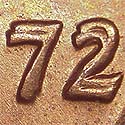
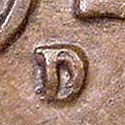
I found this one in a bank wrapped roll. Kind of a Ratty 2004-D Lincoln Cent, but it has a circular-arch die chip below the "4" in the date. It looks like a "hyphenated D". Maybe it is the result of an inadvertent ding from a Mint tool. What do you think - anyone see one like this?


The Danester
_________________
The Danester
"Research is what I do when I don't know what I doing" - Wernher Von Braun
Last edited by Danester on Wed Apr 13, 2011 5:14 pm; edited 1 time in total
|
|
|
|
|
 |
 coopExpert Member coopExpert Member
Posts: 3402
Joined: 17 Sep 2003
Location: Arizona
|
|
| Posted: Tue Apr 12, 2011 11:17 am |
|
|
Probably gas under the plating. They look neater when they flow over a device.

_________________
Richard S. Cooper
You may be only one person in the world, but you may also be the world to one person.
|
|
|
|
|
|
DanesterAdvanced Member
Posts: 176
Joined: 18 Aug 2005
Location: Las Vegas, NV
|
|
| Posted: Tue Apr 12, 2011 12:52 pm |
|
|
Coop, thanks for your input.
If you look at your image of the gas bubbles under the copper plating - they look different than the devises struck up by the die. Now, go back and look at my images.
I considered that it might be something under the copper plating, but after viewing it from all angles under a 30x microscope it looks to be a die chip.
I guess it is possible to be other than a die chip, and as you suggested gas under the plating. Which leads to the question how do you tell the difference between a die chip and something under the plating on a Zinc Copper-Plated Cent?
The Danester
_________________
The Danester
"Research is what I do when I don't know what I doing" - Wernher Von Braun
|
|
|
|
|
|
coopExpert Member
Posts: 3402
Joined: 17 Sep 2003
Location: Arizona
|
|
| Posted: Tue Apr 12, 2011 1:00 pm |
|
|
Try using a toothpick to press down on the area in question. If it dents, then it is a bubble. If it doesn't then if might be something. Maybe a die dent. Not a chip as what is there to chip off? Die chips usally happen mext to devices.
_________________
Richard S. Cooper
You may be only one person in the world, but you may also be the world to one person.
|
|
|
|
|
|
 Bob PSite Admin Bob PSite Admin
Posts: 3482
Joined: 01 Jul 2003
Location: Niceville, Florida
|
|
| Posted: Tue Apr 12, 2011 5:55 pm |
|
|
I think as Coop suggested that it is most likely a die dent. Something hit the die at the mint...maybe a tool.
_________________
Bob Piazza
Site Admin/Moderator
Attributer/Photographer
bobp@coppercoins.com
mustbebob1@gmail.com
|
|
|
|
|
|
 eagamesExpert Member eagamesExpert Member
Posts: 3013
Joined: 15 Nov 2005
|
|
| Posted: Tue Apr 12, 2011 6:31 pm |
|
|
I think it's a plating bubble.
If it was fresh from a new roll it might flatten out with a toothpick. If it's been growing oxide under the plating then it might not flatten. That's what I think it is, a bubble full of zinc oxide.
The coin is growing some junk on the surface, it's probably growing the same junk there but under the plating.
_________________
Ed
|
|
|
|
|
|
 coppercoinsSite Admin coppercoinsSite Admin
Posts: 2809
Joined: 29 Jun 2003
Location: Springfield, Missouri.
|
|
| Posted: Wed Apr 13, 2011 6:16 am |
|
|
|
|
|
|
|
|
DanesterAdvanced Member
Posts: 176
Joined: 18 Aug 2005
Location: Las Vegas, NV
|
|
| Posted: Wed Apr 13, 2011 5:05 pm |
|
|
I will see if I can "dig-up" a toothpick and perform the test. I think I will test it first on a known "gas-bubble" which should not be too difficult to find in my "throw-back" tub.
_________________
The Danester
"Research is what I do when I don't know what I doing" - Wernher Von Braun
|
|
|
|
|
|
DanesterAdvanced Member
Posts: 176
Joined: 18 Aug 2005
Location: Las Vegas, NV
|
|
| Posted: Thu Apr 14, 2011 5:09 pm |
|
|
OK, I fetched a toothpick - a bright red one. When I stuck it under a Microscope at 10x magnification it looked like a giant pointed baseball bat!
I found two Lincoln Cents (1982 and 1987-D), each with a nice gas bubble under the copper plating. Before the test, I’m thinking - "these coins are too old to be able to puncture or dent the gas bubbles with this toothpick. But, I was able to dent both bubbles with the toothpick.
Now, to test the 2004-D Lincoln Cent. The raised arch looked so much different than the gas bubbles (it was higher, larger and seemed to reflect more light), I thought “this test will indicate we could have a die variety”. But, to my surprise I was able to flatten the whole thing with the toothpick!
I am now a supporter of the "Toothpick Test". Go try it on some gas bubbles.
Back to searching rolls.
The Danester
_________________
The Danester
"Research is what I do when I don't know what I doing" - Wernher Von Braun
|
|
|
|
|
|
coppercoinsSite Admin
Posts: 2809
Joined: 29 Jun 2003
Location: Springfield, Missouri.
|
|
| Posted: Fri Apr 15, 2011 5:40 am |
|
|
You wouldn't have a die variety even if it was a die dent. Die varieties are doubled dies, repunched mintmarks, repunched dates, and the sort.
_________________
C. D. Daughtrey
owner, developer
www.coppercoins.com
cd@coppercoins.com
|
|
|
|
|
|
DanesterAdvanced Member
Posts: 176
Joined: 18 Aug 2005
Location: Las Vegas, NV
|
|
| Posted: Fri Apr 15, 2011 1:36 pm |
|
|
Chuck, that's an interesting observation.
If this coin had a Die Dent... then it is specific to an individual die - just as a Die Variety. But if you exclude it from the definition of a Die Variety then it must be in with Cuds, Clashes, and Abraded Dies under Errors (see at bottom).
But Die Dents, Chips, or Gouges are not mentioned in the definition (maybe as etc.).
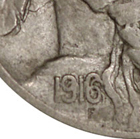
And then we have the new book – The Abraded Die Varieties (Buffalo Nickels) by Ron Pope. Where Abraded Dies are called Die Varieties not Errors, and not considered as Errors by Buffalo Nickel collectors, but Die Varieties.
Perhaps Cuds, Clashes, Abrasions, and Die Dents (Chips and Gouges) should be classified as a Sub Die Variety - i.e. Production Die Variety. Because, they are all specific to an individual die, where an Error is not.
We have been having a similar discussion about numismatic terms on CoinCommunity.com – check it out.
http://www.coincommunity.com/forum/topic.asp?TOPIC_ID=86189
Sorry, I can't help myself - it goes back to my days as a Soil and Foundation Engineer, where we had to define and use terms to classify "dirt".
Error - Subdivided into three classes - Planchet, Die, and Strike. Planchet errors are errors that occurred with the planchets before they entered the coining process. Laminations, although very common, fall under this group. Die errors are problems that occur with the die while it is striking coins. Cuds fall into this group, as do major clashes, overpolishing, etc. They are generally repeated ONLY after they occur. Coins struck BEFORE the die error are normal. Striking errors comprise the vast majority of errors, and happen as the result of the strike. The planchet and die could have been completely normal, but because of a problem at the moment the coin was struck you end up with an error. Double struck, saddle struck, broadstruck, etc.
_________________
The Danester
"Research is what I do when I don't know what I doing" - Wernher Von Braun
|
|
|
|
|
|
 DickExpert Member DickExpert Member
Posts: 5780
Joined: 21 Sep 2006
Location: Rialto, CA.
|
|
| Posted: Fri Apr 15, 2011 1:54 pm |
|
|
Actually, since the change-over to zinc, the "zincolns" are just plain full of gas, or hot air, just like the politicians.
_________________
" Deja Moo: The feeling that you've heard this bull before".
|
|
|
|
|
|
coopExpert Member
Posts: 3402
Joined: 17 Sep 2003
Location: Arizona
|
|
| Posted: Sat Apr 16, 2011 11:28 am |
|
|
I thought their were two parties? Those with empty hands and those who sit on their hands. LOL
_________________
Richard S. Cooper
You may be only one person in the world, but you may also be the world to one person.
Last edited by coop on Mon Apr 18, 2011 12:52 pm; edited 2 times in total
|
|
|
|
|
|
justafarmerMember
Posts: 33
Joined: 01 Jul 2009
|
|
| Posted: Mon Apr 18, 2011 6:57 am |
|
|
|
Danester - I understand your position but I view a die variety as an anomoly usually found in a design device of a coin due to an error in the production process of the die. Die breaks, dents and etc are in most cases attributable to die use in the production of coinage. Although such characteristics might allow a person to arrtibute a coin to the specific working die that struck it; it is atually an indicator and characteristic of die state as opposed to die variety.
|
|
|
|
|
|
coppercoinsSite Admin
Posts: 2809
Joined: 29 Jun 2003
Location: Springfield, Missouri.
|
|
| Posted: Thu Apr 21, 2011 10:34 am |
|
|
Die varieties are on the die when the die is placed into use.
Die errors develop on the die as it strikes coins.
Die errors are the ONLY classification of errors that CAN be cataloged to specific dies...but because they are not necessarily on the die at the time the die was created, they are separate from die varieties by nature and definition. It all has to do with the level of inspection and care at different levels of the minting process. The dies are inspected before they are placed on the press. ALL die varieties should be caught and discarded, but for one reason or another they are not. Die errors occur during the process of making coins on a high speed press. There's very little chance that a die error will be caught before something happens that jams or stops the press. Therein lies your difference.
Die dents and gouges are not classified as errors at all, which is why they aren't mentioned.
The author of your buffalo nickel book is NOT using common convention in defining his listings - which is a growing problem. if authors cannot get together on the definitions it definitely muddies the waters for collectors trying to learn.
_________________
C. D. Daughtrey
owner, developer
www.coppercoins.com
cd@coppercoins.com
|
|
|
|
|
|
|



