






The Goal of Completing a Set
Most collectors begin a Lincoln cent set with a simple goal in mind. They want to complete the set. They want every hole filled, every date and mintmark represented, and every empty space finally occupied by the right coin. There is nothing wrong with that goal. In fact, it is the reason many of us started collecting in the first place. A set folder or album with empty spaces has a way of calling to a collector.
The normal path is familiar. You buy the coins you need, improve them when you can, and keep the better one when a duplicate comes along. Over time, the set grows. A worn 1916 is replaced by a nicer one. A spotted red 1956-D is upgraded when a clean example turns up. A common coin found in change gives way to one bought from a roll. This is how most Lincoln cent sets are built, one small decision at a time.
There is another idea worth considering, though, and it is one many collectors do not think about early enough. Completing a set is not the same thing as building a good set. A completed set can be nothing more than an accumulation of coins placed in order. A good set has intention behind it. The coins look like they belong together. The grade range makes sense. The color makes sense. The budget makes sense. Most importantly, the set has been built in a way that gives it a better chance of staying together when it eventually leaves your hands.
That part matters more than many collectors want to admit.
Understanding the Parts of a Lincoln Cent Set
A Lincoln cent set is not one single collecting challenge. It is several different challenges wearing the same name. The early Lincoln cent set, generally considered to run from 1909 through 1933, is usually filled in circulated grades. These are the coins that include the heavy hitters: 1909-S VDB, 1909-S, 1914-D, 1922 plain, 1931-S, and several semi-key dates that can make a budget wince. A person can build this portion of the set in Good, Very Good, Fine, Very Fine, Extremely Fine, About Uncirculated, or Mint State, but each step up in grade changes the entire financial picture.
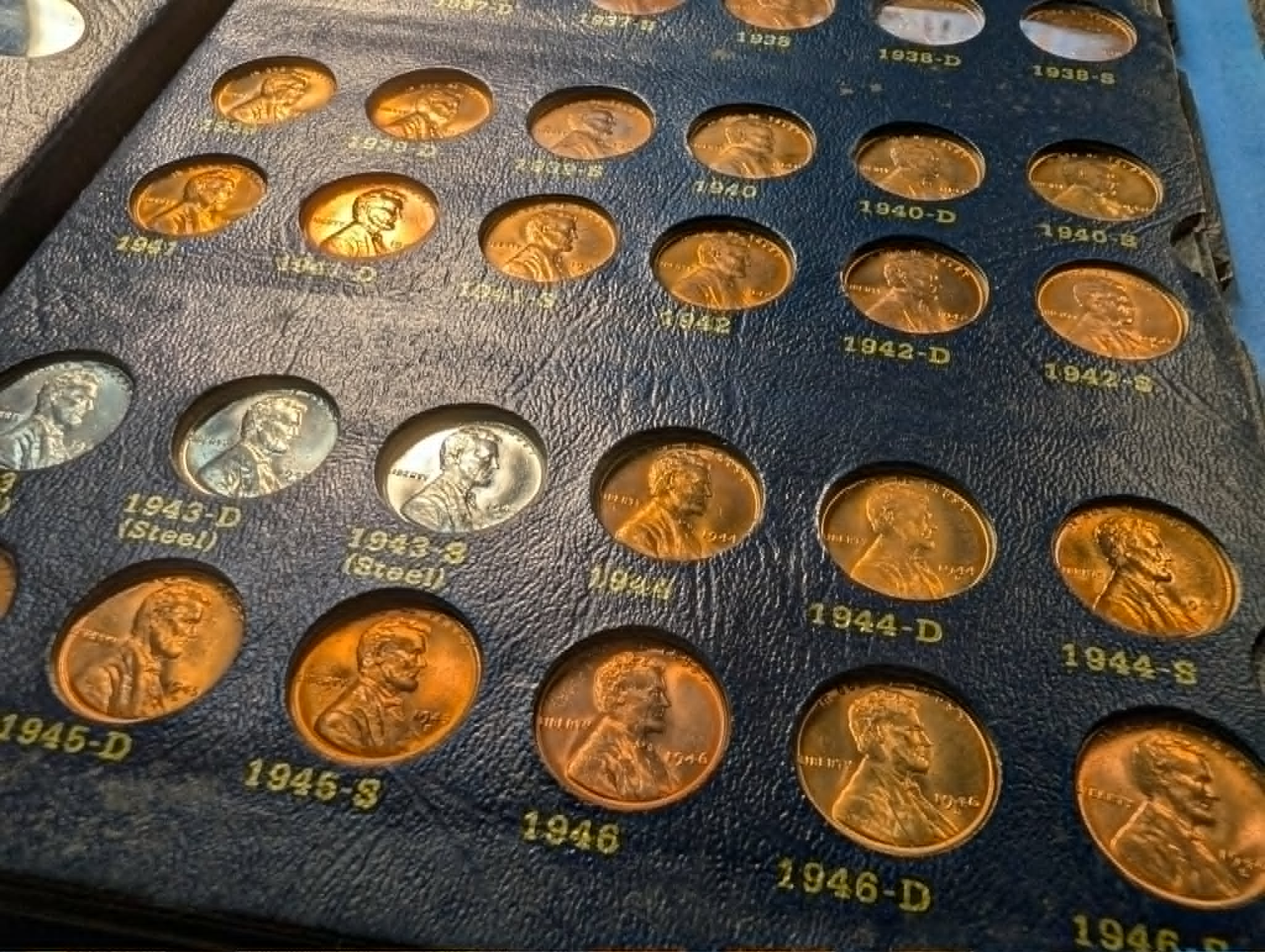
Then there is what many collectors call the short set, 1934 through 1958. This is the later Wheat cent run, and it is far easier to complete. The mintages are generally higher, the coins are more available, and nice examples can still be found without fighting the same level of scarcity found in the earlier dates. Many collectors enjoy building this section in red Brilliant Uncirculated grades. A sharp, matched red BU short set is attractive, satisfying, and not terribly difficult compared to the early dates.
The Memorial set, 1959 through 2008, is another animal. It can be a very fun set in red BU, especially for those who enjoy roll searching, original rolls, mint sets, and cherrypicking. In ordinary uncirculated grades, it is not hard to finish. In higher grades, such as MS66RD or MS67RD, the challenge becomes much more serious. Suddenly the common coins are not so common anymore. A date that seems endless in circulation may be genuinely difficult with clean fields, bright color, full strike, and no distracting spots or carbon.
The 2009 Bicentennial cents sometimes get treated like a separate little set, and sometimes they get attached to the Memorial set as an end-cap. Others include them with the Shield cents because they came after the Memorial reverse ended. It really does not matter where you place them, but they are part of the Lincoln cent story. If you are building a complete Lincoln cent set, you have to put them somewhere.
The Shield cents, beginning in 2010 and running through 2025 as of this writing, are still new enough that their long-term collecting character is not fully settled. They can be challenging in very high grade from rewrapped rolls, especially when you start looking closely for spots, hits, and strike problems. At the same time, many can still be purchased reasonably from mint sets without spending a great deal of money. We will see what happens after the 2026 Semi-quincentennial year is over and what the Mint decides to do for 2027 and beyond.
A Good Set Is More Than Filled Holes
That is the basic structure of the Lincoln cent set, but the real question is not just what goes into the set. The better question is what kind of set you are trying to build.
Buying a good set, a desirable set, is more than matching coins to holes. The album does not care if your 1909-S VDB is Very Good, your 1914-D is Fine, your 1924-D is corroded, your 1931-S is red uncirculated, and your common 1940s coins are whatever you happened to pull from a wheat cent bag. The album will hold them just the same. But a future buyer will care. A dealer will care. Your heirs will care, even if they do not know enough about coins to explain why.
Most completed sets are bought for the key dates and then taken apart. The reason is simple. Many sets look more like accumulations than sets. They contain a few expensive coins, a lot of filler, and a scattering of upgrades that do not match anything around them. A dealer looking at that kind of set sees inventory. The keys go one direction, the semi-keys another, the common coins another, and the album itself may be left behind.
Why Matching the Set Matters
A well-matched set has a better chance of staying together. If a collector or dealer sees a Lincoln cent set built in consistent Very Fine, or consistent Extremely Fine, or consistent red BU from a certain point forward, the set has an identity. It has coherence. It looks deliberate. That does not guarantee it will never be broken up, but it gives the set a much better chance. It also gives you, or later your heirs, a better chance of receiving a stronger price for the set as a unit.
Building a matched set from the beginning also makes the collecting experience more satisfying. Each coin feels like part of the same project. The set develops a personality. It stops being a pile of separate purchases and starts becoming one complete object.
Budget Comes Before Buying
This is where budget enters the conversation, and it is where some collectors have to be honest with themselves.
You have to decide what you can realistically spend on your best set. Not your fantasy set. Not the set you would build if money and time were unlimited. Your real set. You also have to decide how long you want to be building it. If you have little patience and a lot of money, you can probably finish a very nice matching set without much trouble. If you have a modest budget and want a strong set, patience becomes part of the purchase price.
Suppose your budget is $100 a month, and you use that money only for the set. At that rate, you would be just shy of filling a roughly $3,480 Very Fine grade set in just under three years at today’s pricing. That is not unreasonable. It requires discipline, but it is possible.
Now take that same $100 monthly budget and move the goal up to a nice About Uncirculated set. Depending on the current market and the specific coins you require, that same project could stretch to around 125 months, or nearly ten and a half years. That is a very different commitment. It requires not only money, but a level of dedication that many collectors underestimate at the beginning.
Be Honest About the Set You Can Build
This is where the tough advice comes in. If you do not have the patience or the budget to fill the set you dream of, you should seriously consider lowering your expectations. That is not failure. That is smart collecting. A well-matched Very Fine set is far more desirable than an uneven set that is mostly Very Fine, partly Good, partly cleaned, partly red BU, and held together only by the fact that all the holes are filled.
A collector can enjoy a set at almost any grade level. The mistake is not in choosing a lower grade. The mistake is in pretending to build one kind of set while buying coins that belong in another.
| Early Set | Short Set | Memorials | Post-Memorial | Total |
| F - $2520 | BU - $140 | BU - $65 | BU - $25 | $2750 |
| VF - $3450 | BU - $140 | BU - $65 | BU - $25 | $3680 |
| EF - $4500 | Ch+ BU - $320 | Ch+ BU - $120 | Ch+ BU - $40 | $4980 |
| AU - $9650 | GEM - $650 | GEM - $300 | GEM - $75 | $10675 |
Looking at the chart above, you can see the difference grade makes in the overall cost of a full set. Build with these jumps in value in mind. Build with comfor and confidence knowing you have selected the budget for you that is realistic, challenging, and fun. After all, that is the goal in collecting.
Buy the Key Dates First
Once you establish your budget and decide what kind of set you can actually build, buy the key date coins first. This is one of the most important pieces of advice in Lincoln cent collecting. Find the key coins in the grade you have chosen and wait until you have the money together to buy them.
If an About Uncirculated 1909-S VDB is presently around $1,400, and your budget is $100 per month, that coin represents fourteen months of saving. That means no other buying that compromises the schedule. No grabbing common dates because they are available. No buying a pretty coin because it catches your eye. No “temporary” purchases that delay the key coin. If you spend the money elsewhere, the clock starts over.
The common dates are not the problem. They are far easier to acquire than the keys. You do not need to panic-buy a 1944-D, a 1956-D, or a 1939 because it is sitting in front of you. Those coins will still be available after the key dates are handled. What may not be available, at the right grade, with the right look, at the right price, is the key coin you actually need.
Avoid Bargains That Do Not Fit the Set
The worst habit is mixing coins into the set just because they were bargains. Bargains can become expensive mistakes when they do not fit the plan. If you decided to build an Extremely Fine set, stick to that grade. If you decided to build an About Uncirculated set, stick to that grade.
Do not buy a flashy MS65RD 1925 cent simply because it is beautiful unless you also have the budget to own a matching MS65RD 1909-S VDB. At today’s pricing, that could be around $9,000. If that is not your set, then that 1925 does not belong in it, no matter how nice it is.
That money would be better saved for the coins that define the set. Once the keys are purchased, the project becomes much easier emotionally and financially. Instead of staring at the impossible coins, you are working through a list of semi-keys and commons. The set begins to feel achievable, and every purchase fits the structure you chose.
The Set Should Belong Together
The point is simple: do not mix up your grades just to fill holes. A completed set with wildly mismatched coins is usually not treated as a completed set by the marketplace. It is treated as a group of coins. Some may be desirable. Some may not. But the set itself loses much of its power.
Budget what you can. Be honest about your patience. Buy the hard coins first. Stay with the grade and look you chose. If you do that, you will end up with something better than a filled album. You will own a Lincoln cent set that belongs together, one that shows care, discipline, and purpose. That kind of set is easier to enjoy while you own it, easier to explain when you show it, and easier to pass on when the time comes.
A good set is not just complete. It makes sense.


Comments
Share feedback or notes after reading. Keep it civil and on-topic.
No comments yet. Be the first to leave feedback.