





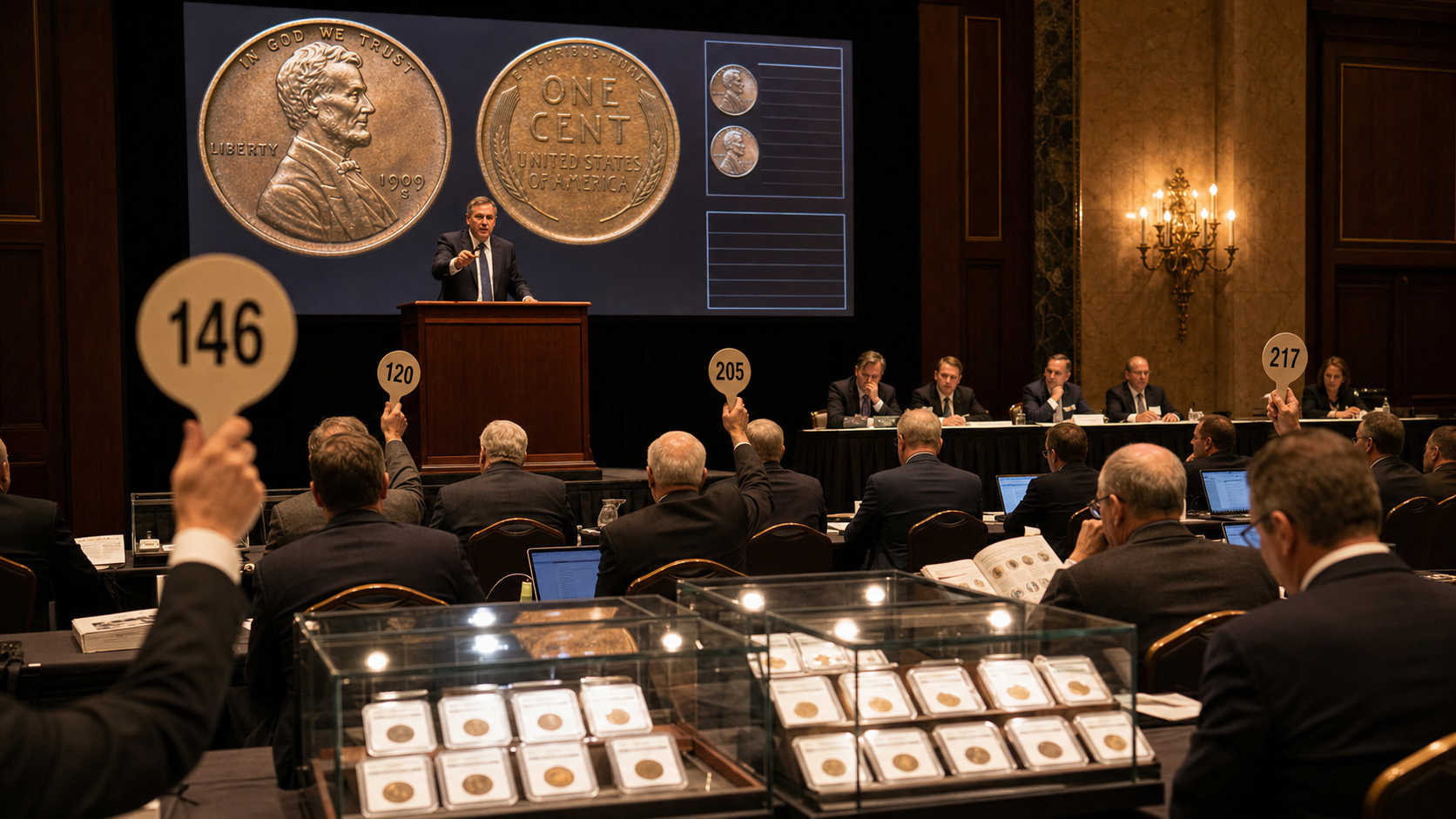

The 2026 Lincoln cent market has already shown that collector demand remains very strong when a coin combines rarity, variety importance, condition, and a strong story. The highest-value sales are not coming from ordinary date-and-mintmark coins alone. The coins bringing the most attention are major die varieties, famous key issues in exceptional condition, and dramatic mint errors with unusual visual appeal.

One of the most important Lincoln cent sales reported in 2026 was the 1988 doubled ear Lincoln cent, FS-101, graded PCGS MS63RB. This coin sold through David Lawrence Rare Coins for $64,000 as part of the TropicalBats PCGS Registry Set of Lincoln cents. The price was remarkable because the 1988 doubled ear is a modern Lincoln cent variety, not a classic Wheat cent key date. Its strength came from rarity, collector competition, and the fact that the variety has an easy-to-understand diagnostic. “Doubled ear” is the kind of variety description that immediately makes sense to collectors.
This sale is especially important because it shows how far the market may move when a variety is both rare and registry-important. The coin was reported as one of only three PCGS-graded examples across all grades and color designations. That kind of population pressure can create strong bidding when two or more serious collectors need the same coin. The $64,000 price was far beyond what many collectors would expect from a 1988 cent, but the result makes sense when viewed as a rare variety rather than as a regular 1988 Lincoln cent.

Another major 2026 result came from GreatCollections with the Deep Powder Registry Set of Lincoln Cents. One of the highlighted coins from that offering was a 1922 No D Lincoln cent, Strong Reverse, graded PCGS MS63 RD in an old green holder, which sold for $48,459. The 1922 No D has always been one of the classic Lincoln cent keys because it is both famous and unusual. Unlike a normal date-and-mintmark rarity, its appeal comes from the missing mintmark itself. Collectors recognize it as one of the major varieties in the Wheat cent series.
The 1922 No D result shows how powerful the combination of classic status and high-grade red preservation can be. Many 1922 No D cents are circulated, brown, weak, or problematic. A Mint State Red example with the Strong Reverse designation is in a very different category. Collectors are not just paying for the variety. They are paying for the variety in a condition and preservation level that is difficult to duplicate.
The same GreatCollections sale also showed continued demand for early Lincoln cents in high grade. The Deep Powder Registry Set included coins such as a 1924 Lincoln cent in PCGS MS67 RD with CAC approval, a 1923-S in PCGS MS65 RD with CAC approval, a 1920-S in PCGS MS65 RD, a 1916 in PCGS MS67+ RD with CAC approval, a 1915-D in PCGS MS66+ RD with CAC approval, and a 1914 in PCGS MS67 RD. Even without quoting every realized price, the offering itself is important because it demonstrates where the upper end of the market is strongest: early dates, red color, high numerical grade, CAC approval where present, and registry-quality status.

Mint errors also produced notable 2026 Lincoln cent prices. Heritage Auctions sold an undated Lincoln Memorial cent struck on a 2.8 gram screw, graded PCGS MS64+, for $20,740 in January 2026. This is not a conventional die variety or date rarity. Its value came from the dramatic nature of the error. A Lincoln cent struck on a screw is the kind of error that crosses over from coin collecting into curiosity, manufacturing accident, and conversation piece. The price shows that unusual errors with strong visual impact can bring substantial money, even when the date is not the main attraction.
Heritage also sold a 1958 Lincoln cent overstruck on a 1958 Cuba centavo, graded NGC MS63, for $4,880 in January 2026. This kind of error appeals to collectors because it combines a familiar U.S. coin type with an unusual foreign-coin undertype. The overstrike nature gives the coin a story. It is not simply off-center, clipped, or broadstruck. It represents an unusual production event that specialists can study and explain.
Another Heritage result was a 1957-D Lincoln cent struck on a silver dime planchet, described as a double denomination error and graded NGC MS63, which sold for $3,172 in January 2026. Double denomination errors are popular because they are easy to understand and visually interesting. A cent design struck on a dime planchet immediately creates a mismatch between denomination, size, metal, and intended production process. Even though this result was far below the top variety prices, it still shows strong collector demand for certified Lincoln cent errors.
Modern proof Lincoln cents also had activity in 2026, though generally at lower levels than the major variety and error coins. GreatCollections’ Hartford Collection of Modern Proof Lincoln Cents included numerous Proof-70 Lincoln cents, and one reported highlight was a 1980-S Lincoln cent graded PCGS Proof-70 RD DCAM that sold for $1,069. Modern Proof-70 cents are a different market from doubled dies and classic Wheat cent keys. Their value is usually tied to perfect grade, registry competition, and population data rather than dramatic variety status.
Taken together, these 2026 sales show several clear market lessons. First, rare die varieties can bring exceptional prices when the variety is important and the certified population is extremely low. The 1988 doubled ear at $64,000 is the best example of that. Second, classic Lincoln cent keys remain strong when offered in high grade and desirable color, as shown by the 1922 No D Strong Reverse at $48,459. Third, dramatic mint errors can bring serious money when the error is unusual, visual, and easy to explain. Finally, modern perfect-grade proofs have a market, but they generally trail the major varieties, key-date issues, and spectacular errors.
The most important point is that value is not based on age alone. A 1988 cent can bring more than a classic Wheat cent if it is the right rare variety. A common-era Memorial cent can become valuable if it was struck on something extraordinary. A famous key date can bring a premium when it survives in exceptional grade and color. The 2026 market continues to reward coins that combine rarity, visibility, condition, and collector demand.




Comments
Share feedback or notes after reading. Keep it civil and on-topic.
No comments yet. Be the first to leave feedback.