





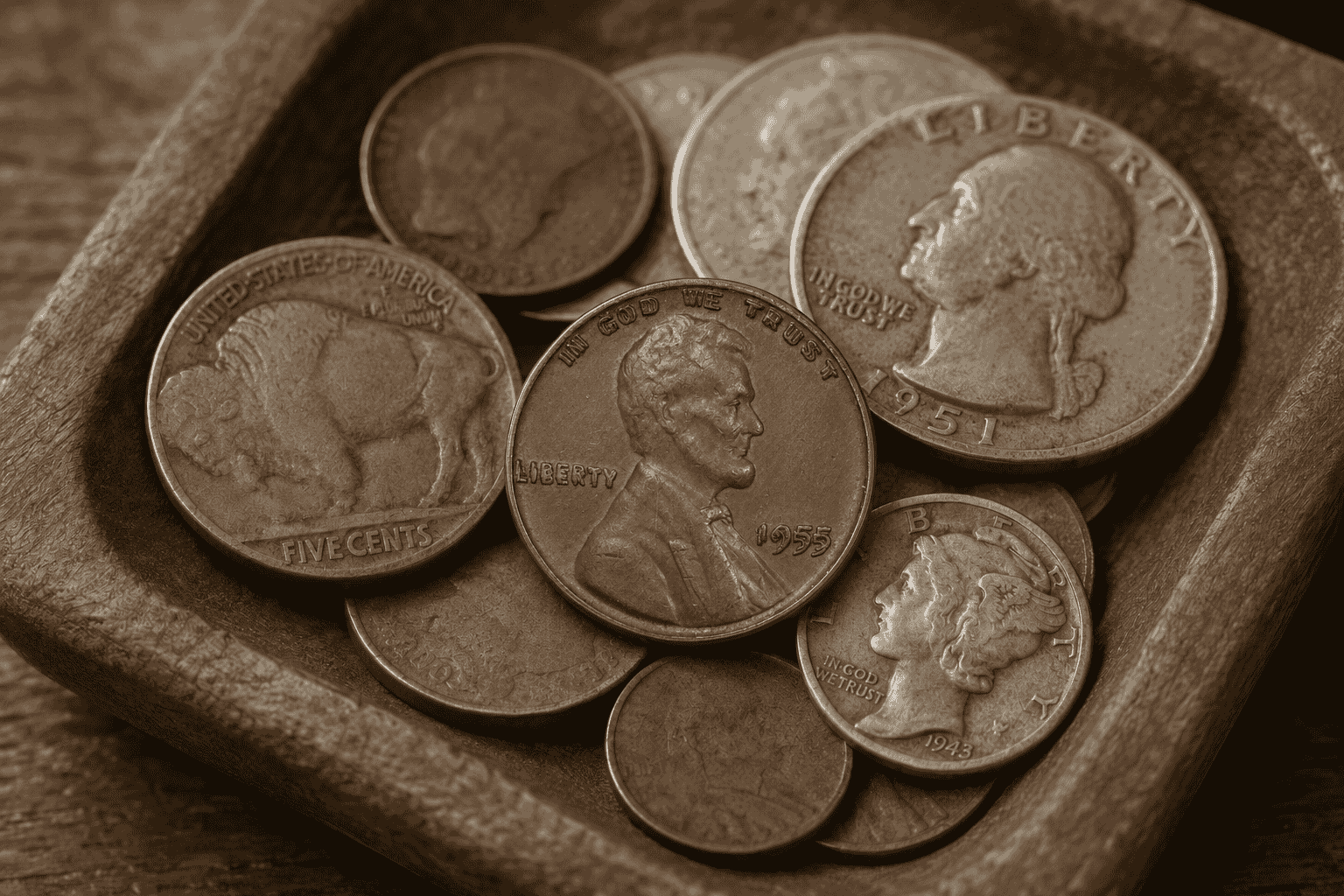

There are famous Lincoln cents, and then there are Lincoln cents that changed the way collectors look at coins. The 1955 doubled die obverse cent is one of the few that can honestly claim both honors. It is famous because it is dramatic. It is important because it helped pull die variety collecting out of the specialist’s notebook and into the hands of ordinary collectors searching through pocket change. In fact, this coin gave birth to the die variety collecting hobby.

The coin was produced at the Philadelphia Mint during the working die preparation process. The obverse die received misaligned impressions from the hub, creating bold doubling on the date, LIBERTY, and IN GOD WE TRUST. This was not the flat, shelf-like look of machine doubling, nor was it a late die deterioration effect. It was true hub doubling, strong enough that no microscope is needed to understand why the coin matters. The doubled date alone is enough to stop a collector cold.
Most published estimates place the number released into circulation at roughly 20,000 to 24,000 pieces. Heritage Auctions, citing Q. David Bowers, notes that Mint officials did become aware of the mistake, but the doubled die cents had already been mixed with normal cents and were released rather than destroyed. [1] That practical decision gave collectors one of the great circulation finds of the twentieth century.

The escape story is part of the charm. Many examples are reported to have surfaced in the Northeast, particularly in parts of Massachusetts and upstate New York. A favorite part of the story is the “cigarette cent” connection. At the time, some vending machines sold packs of cigarettes for 23 cents but accepted a quarter. Since the machines could not make change, two cents were sometimes placed inside the cellophane wrapper. PCGS notes that many 1955 doubled die cents were distributed through this route. [2] It is hard not to enjoy the image of one of America’s most famous die varieties slipping into the world as change in a cigarette pack.

The coin seems to have been recognized quickly, though solid contemporary 1955 printed references are not easy to document online. The earliest commonly cited published report appears in the January 1956 issue of Numismatic Scrapbook Magazine, in an article credited to Ameil Druila and W. S. Meadows. [3] Q. David Bowers later recalled that the coin was first discussed by some as a “shift cent” before the doubled die terminology became standard in collector use. [4]
Market strength has never really left the 1955 doubled die. PCGS CoinFacts currently describes typical examples through AU58BN as trading around $2,500 to $3,000, with red Mint State pieces rising sharply from there. [5] Recent public sales bear that out. A PCGS AU58BN sold through Stack’s Bowers in June 2025 for $2,520, while an NGC MS65RD example brought $20,400 in June 2024. [6] At the upper end, the coin becomes a trophy. A PCGS MS65+RD CAC example sold for $114,000 in 2018, and CoinWeek reported a GreatCollections sale of $124,875 in 2020 for a finest-known full red example. [7]
For all of that money and fame, the 1955 doubled die remains wonderfully easy to understand. That is its real strength. A collector can look at one and immediately see the mistake. Then comes the deeper lesson: how dies are made, how hub doubling differs from mechanical doubling, how distribution affects survival, and how a single coin can shape collector behavior for decades.
The 1955 doubled die did not merely become a valuable Lincoln cent. It taught collectors to look twice.
Sources For Live Article
[1] Heritage Auctions, description for 1955 1C Doubled Die Obverse MS64 Red PCGS, citing Q. David Bowers: Heritage Auctions archive
[2] PCGS CoinFacts, “The Cigarette Cent” note for the 1955 Doubled Die Obverse: PCGS CoinFacts RB listing
[3] The Spruce Crafts summary citing the January 1956 Numismatic Scrapbook Magazine article by Ameil Druila and W. S. Meadows: 1955 Double Die Lincoln Penny
[4] CoinAppraiser article quoting Q. David Bowers on early mentions and terminology: 1955 Double Die Lincoln Cent
[5] PCGS CoinFacts value commentary: 1955 1C Doubled Die Obverse, RD
[6] PCGS Auction Prices, Stack’s Bowers June 2025 AU58BN and June 2024 MS65RD sales: AU58BN sale, MS65RD sale
[7] PCGS Auction Prices and CoinWeek reports on high-end sales: 2018 PCGS MS65+RD CAC sale, 2020 GreatCollections sale via CoinWeek




Comments
Share feedback or notes after reading. Keep it civil and on-topic.
No comments yet. Be the first to leave feedback.