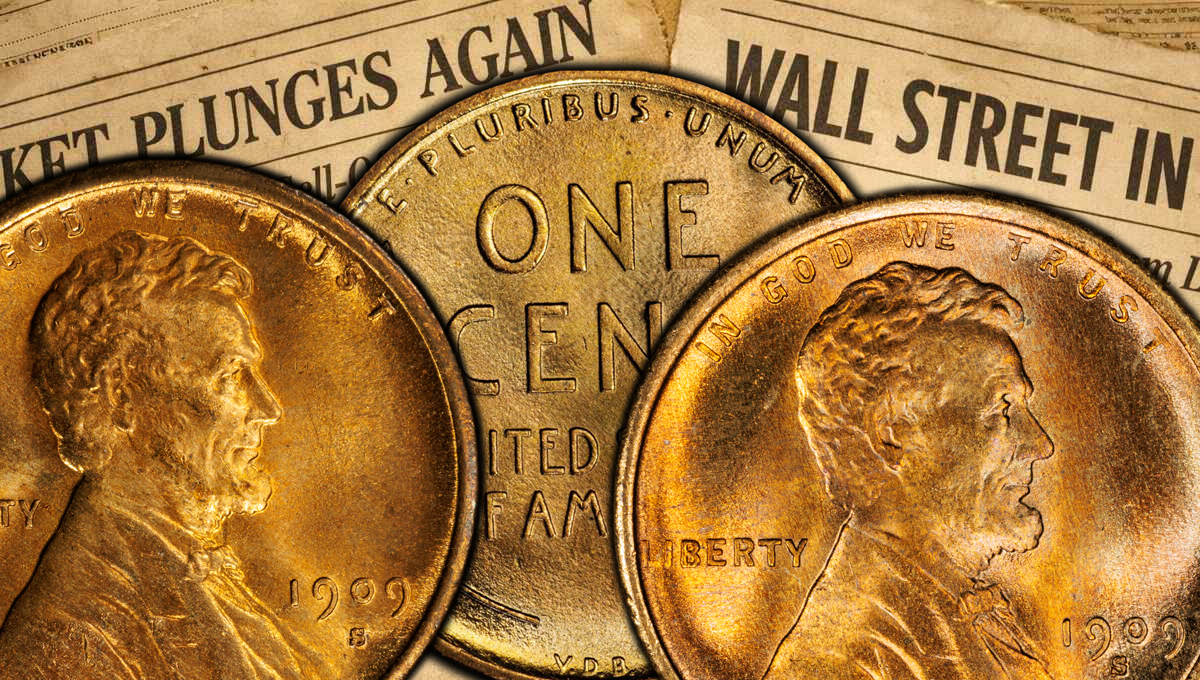
1909 Lincoln Cent Date Guide

Birth year of the Lincoln cent

(sponsored)

1909 overview Mintage, history, and notes for this year's cents

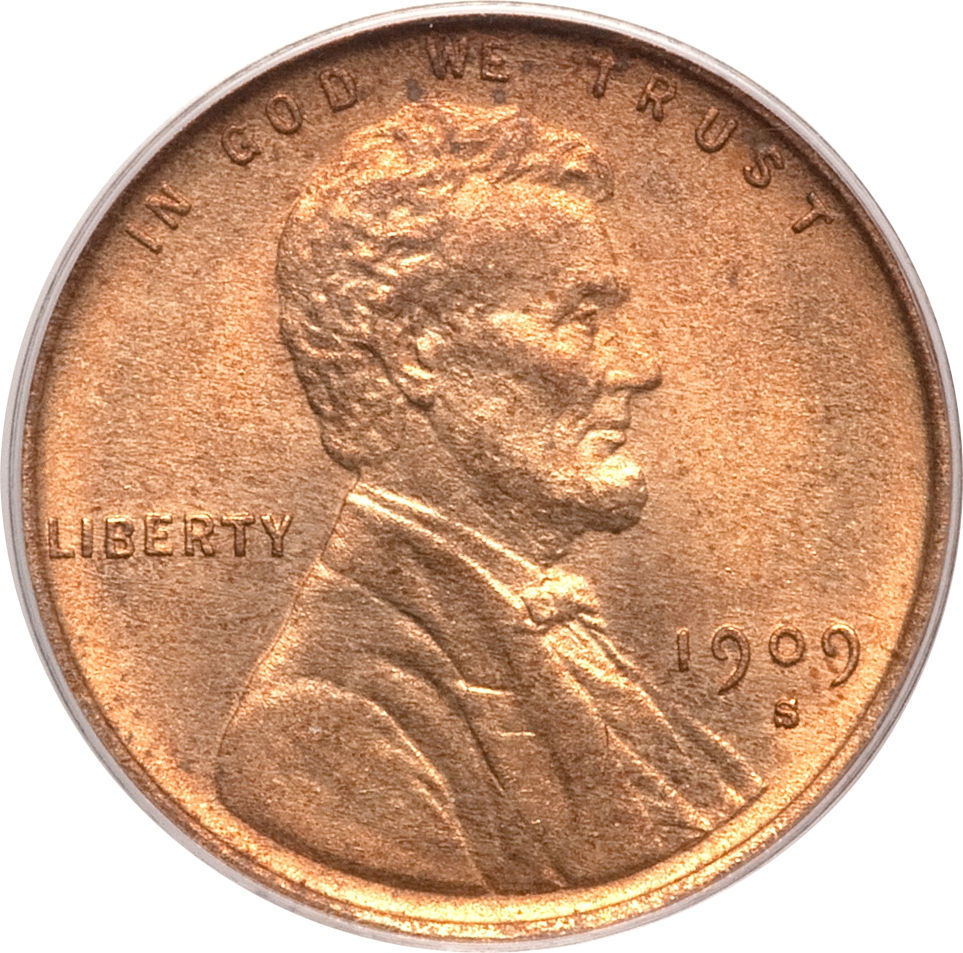
Philadelphia (MS)

Photo Credit: Cotgreave Collection

(click images above to see larger view)

Mintage
72,702,618
Mintage Ranking for Type
(76 of 140)

Philadelphia VDB (MS)

Photo Credit: Cotgreave Collection

(click images above to see larger view)

Mintage
27,995,000
Mintage Ranking for Type
(104 of 140)

San Francisco (MS)

Photo Credit: Cotgreave Collection

(click images above to see larger view)

Mintage
1,825,000
Mintage Ranking for Type
(137 of 140)

San Francisco VDB (MS)

Photo Credit: Cotgreave Collection

(click images above to see larger view)

Mintage
484,000
Mintage Ranking for Type
(140 of 140)

Philadelphia (PR)

Photo Credit: PCGS Coinfacts

(click images above to see larger view)

Mintage
2,352
Mintage Ranking for Type
(21 of 26)

Philadelphia VDB (PR)

Photo Credit: PCGS Coinfacts

(click images above to see larger view)

Mintage
1,194
Mintage Ranking for Type
(24 of 26)

1909 in history

1909 in history
  • The United States Mint introduced the Lincoln cent on August 2, replacing the Indian Head cent after 50 years.
  • Sculptor Victor David Brenner designed the portrait from a 1907 Lincoln plaque; his VDB initials appeared on the reverse.
  • Public complaints about prominent VDB initials led the Mint to remove them later in 1909, making early VDB cents collectible.
  • The 1909-S VDB from San Francisco is one of the most famous key dates in Lincoln cent collecting.
  • William Howard Taft succeeded Theodore Roosevelt as president on March 4.
  • Robert Peary reported reaching the North Pole in April, though the claim was later disputed.
  • Louis Bleriot made the first airplane flight across the English Channel in July.
  • The National Association for the Advancement of Colored People (NAACP) was founded in New York.

1909 Lincoln cent year notes

First Issue

The 1909 Lincoln cent was born from a bronze plaque carved by Victor David Brenner in 1907. Upon seeing it, President Theodore Roosevelt immediately grew fond of the idea of using that design to adorn U.S. Coinage in honor of the 100th birthday of our 16th President, Abraham Lincoln. He immediately set into motion the plan to change the now 50-year-old Indian cent design to that of Lincoln.

He contacted the mint and the artist to have them design a one cent coin with the Lincoln bust on one side, and a simple design of the mint's choosing on the other side. Brenner was tasked with both sides of the design, and immediately set forth to create the art for the coin.

By August the design was completed, and on August 02, 1909, the first Lincoln Cents were struck in San Francisco and Philadelphia. Upon striking these coins, the Indian Head design was retired. What resulted were 1909 dated cents bearing both different designs.

Stoppage and Change

The first year of the Lincoln cent didn't come without problems. Although placing the designer's initials on coins was customary, public protest demanded the immediate removal of the designer's initials (V.D.B., for Victor David Brenner) from the reverse of the coin shortly after its release to the public in August of 1909.

The Mint obliged and made the difficult and costly decision to remove the initials less than a week into production of the new cent.

The prominent position of the deisgner's initials in the lower reverse between the stems of two wheat ears prompted Mint Engraver Charles E. Barber to halt the presses so he could change the design of the reverse of the coin to omit the initials. This caused the 1909 design variety with the VDB initials to be in shortage, especially in San Francisco, where only 484,000 coins would be minted. All remaining 1909 cents would be minted wihout the initials of the artist on the coins.

About the Coins

1909 Lincoln cents are not difficult to obtain, but can be valuable in higher grades especially. Because of the much lower mintage, the S-mint (especially those with the VDB initials) can be much more valuable. Great caution must be exercised when purchasing such coins, because there are unfortunately more counterfeit coins on the market than the real ones.

Original rolls are nearly completely gone, save the 1909-P VDB issue. Because of the immediate change in design people hoarded rolls of these coins, leaving some of them to still remain unopened today. All other uncirculated 1909 cents are generally gone or sold in made-up rolls or as singles.

Images/Mintage Mint issues and coin images for 1909

Philadelphia (MS)

Photo Credit: Cotgreave Collection

(click images above to see larger view)

Mintage
72,702,618
Mintage Ranking for Type
(76 of 140)

Philadelphia VDB (MS)

Photo Credit: Cotgreave Collection

(click images above to see larger view)

Mintage
27,995,000
Mintage Ranking for Type
(104 of 140)

San Francisco (MS)

Photo Credit: Cotgreave Collection

(click images above to see larger view)

Mintage
1,825,000
Mintage Ranking for Type
(137 of 140)

San Francisco VDB (MS)

Photo Credit: Cotgreave Collection

(click images above to see larger view)

Mintage
484,000
Mintage Ranking for Type
(140 of 140)

Philadelphia (PR)

Photo Credit: PCGS Coinfacts

(click images above to see larger view)

Mintage
2,352
Mintage Ranking for Type
(21 of 26)

Philadelphia VDB (PR)

Photo Credit: PCGS Coinfacts

(click images above to see larger view)

Mintage
1,194
Mintage Ranking for Type
(24 of 26)
1909 in history What else was happening that year
1909 in history
  • The United States Mint introduced the Lincoln cent on August 2, replacing the Indian Head cent after 50 years.
  • Sculptor Victor David Brenner designed the portrait from a 1907 Lincoln plaque; his VDB initials appeared on the reverse.
  • Public complaints about prominent VDB initials led the Mint to remove them later in 1909, making early VDB cents collectible.
  • The 1909-S VDB from San Francisco is one of the most famous key dates in Lincoln cent collecting.
  • William Howard Taft succeeded Theodore Roosevelt as president on March 4.
  • Robert Peary reported reaching the North Pole in April, though the claim was later disputed.
  • Louis Bleriot made the first airplane flight across the English Channel in July.
  • The National Association for the Advancement of Colored People (NAACP) was founded in New York.
1909 cent notes Collector notes for this year's Lincoln cents

First Issue

The 1909 Lincoln cent was born from a bronze plaque carved by Victor David Brenner in 1907. Upon seeing it, President Theodore Roosevelt immediately grew fond of the idea of using that design to adorn U.S. Coinage in honor of the 100th birthday of our 16th President, Abraham Lincoln. He immediately set into motion the plan to change the now 50-year-old Indian cent design to that of Lincoln.

He contacted the mint and the artist to have them design a one cent coin with the Lincoln bust on one side, and a simple design of the mint's choosing on the other side. Brenner was tasked with both sides of the design, and immediately set forth to create the art for the coin.

By August the design was completed, and on August 02, 1909, the first Lincoln Cents were struck in San Francisco and Philadelphia. Upon striking these coins, the Indian Head design was retired. What resulted were 1909 dated cents bearing both different designs.

Stoppage and Change

The first year of the Lincoln cent didn't come without problems. Although placing the designer's initials on coins was customary, public protest demanded the immediate removal of the designer's initials (V.D.B., for Victor David Brenner) from the reverse of the coin shortly after its release to the public in August of 1909.

The Mint obliged and made the difficult and costly decision to remove the initials less than a week into production of the new cent.

The prominent position of the deisgner's initials in the lower reverse between the stems of two wheat ears prompted Mint Engraver Charles E. Barber to halt the presses so he could change the design of the reverse of the coin to omit the initials. This caused the 1909 design variety with the VDB initials to be in shortage, especially in San Francisco, where only 484,000 coins would be minted. All remaining 1909 cents would be minted wihout the initials of the artist on the coins.

About the Coins

1909 Lincoln cents are not difficult to obtain, but can be valuable in higher grades especially. Because of the much lower mintage, the S-mint (especially those with the VDB initials) can be much more valuable. Great caution must be exercised when purchasing such coins, because there are unfortunately more counterfeit coins on the market than the real ones.

Original rolls are nearly completely gone, save the 1909-P VDB issue. Because of the immediate change in design people hoarded rolls of these coins, leaving some of them to still remain unopened today. All other uncirculated 1909 cents are generally gone or sold in made-up rolls or as singles.

Key Dates & Errors Key dates, valuable errors, and genuine vs fake guidance for 1909

1909-S VDB Key date

Mintage 484,000 struck from only four known dies (about 121,000 coins per die on average). The most iconic Lincoln key — and a prime target for alterations and counterfeits.

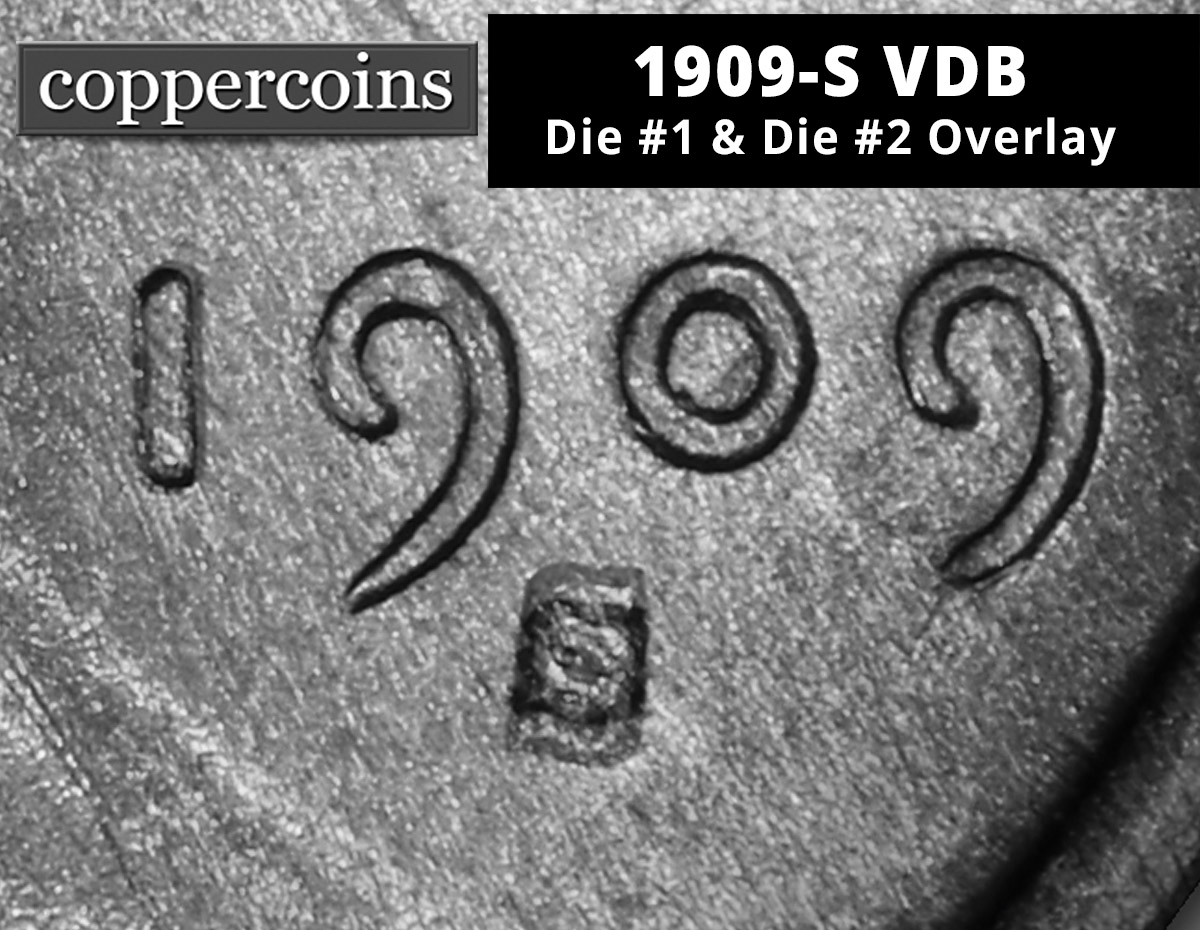
  • Overlay comparison — Die #01 vs Die #02 mint-mark positions
    Overlay comparison — Die #01 vs Die #02 mint-mark positions
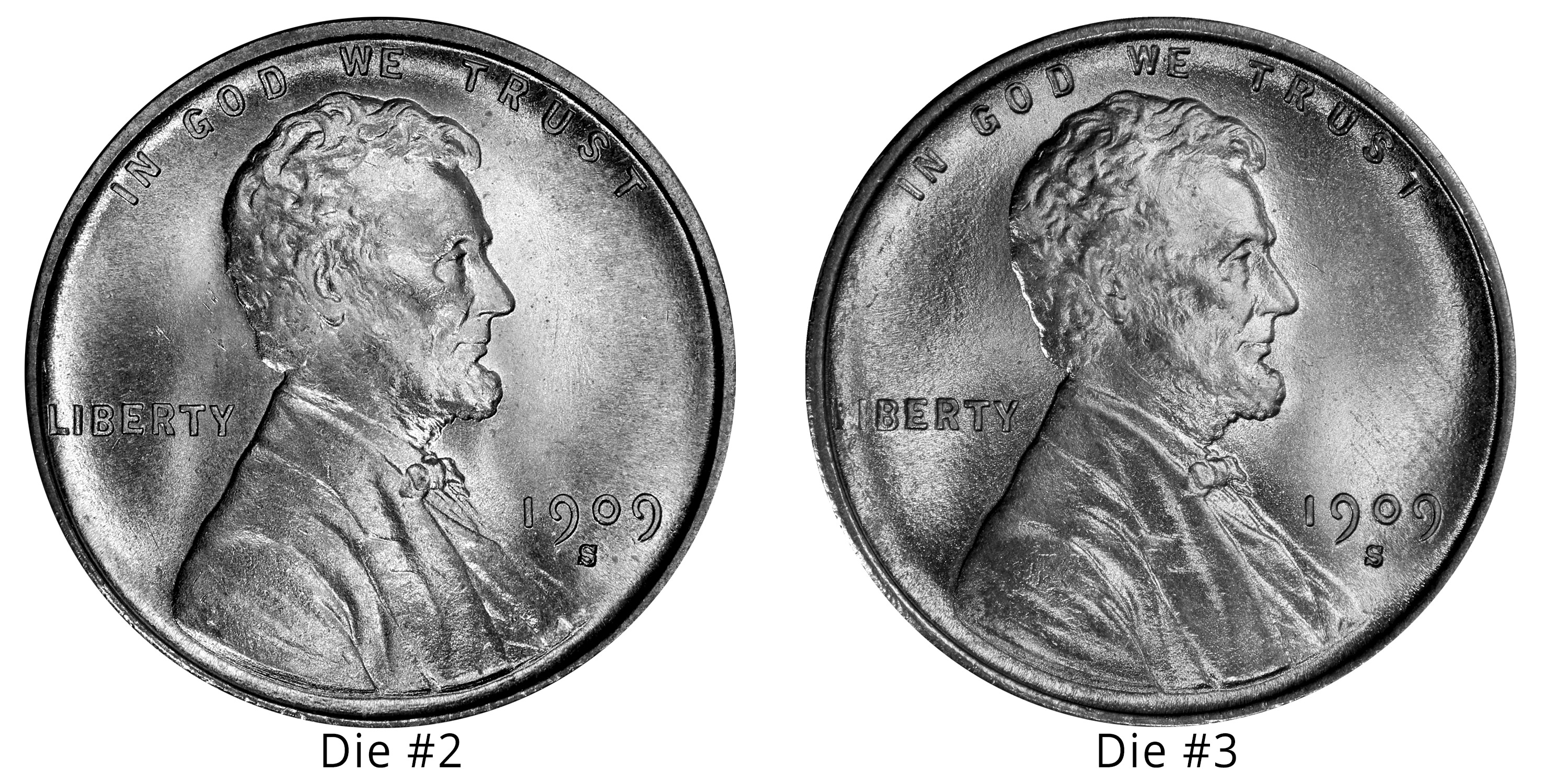
  • Comparison plate — Die #02 vs Die #03
    Comparison plate — Die #02 vs Die #03

Diagnostics in this package come from Chuck Daughtrey’s die study (Keys to the Lincoln, 2018). Mint marks were punched into working dies by hand until 1990, so position (and often tilt) separates dies. Overlays against fixed design elements such as the date make those differences obvious. Measurements between the closest point of the middle date digits and the mint mark help confirm which die struck a coin.

Study sample: 312 different 1909-S VDB coins. Die numbers follow the sequence previously published by John Wexler and Kevin Flynn (The Authoritative Reference on Lincoln Cents, 1996).

Use the die-pair panels below to match mint-mark placement. Relative frequencies from the study: Die #01 scarce (~11%), #02 common (~35%), #03 common (~30%), #04 uncommon (~24%).

Known fakes & alterations

Key and semi-key Lincoln cents are the focus of authenticators and counterfeiters alike. Common alteration methods include:

  • Adding a mint mark to a common Philadelphia issue of the same date (for example, turning a 1914 into a 1914-D).
  • Scraping or altering digits of a common date (for example, turning a 1944-D into a 1914-D).
  • Copying genuine coins by spark erosion or soft-die transposition.

Crude alterations usually fail under close study because device details and mint-mark character are wrong. Matching a coin to one of the few known genuine dies for the issue is a powerful authenticity check. When in doubt, use a trusted third-party grading service.

For 1909-S VDB specifically, added “S” mint marks on 1909 VDB Philadelphia cents and wholly fabricated pieces are well known. A coin whose mint-mark position does not match any of the four documented dies should be treated with extreme caution.

Quick checklist

  1. Match mint-mark height, left-right placement, and tilt to one of the four known dies
  2. Compare centerline of the S through the date digits
  3. Look for Die #04 north–south date-area scratches when the mint mark is very low/right
  4. If mint-mark position matches no known die, treat as suspect and seek authentication

Die pairs that struck this issue

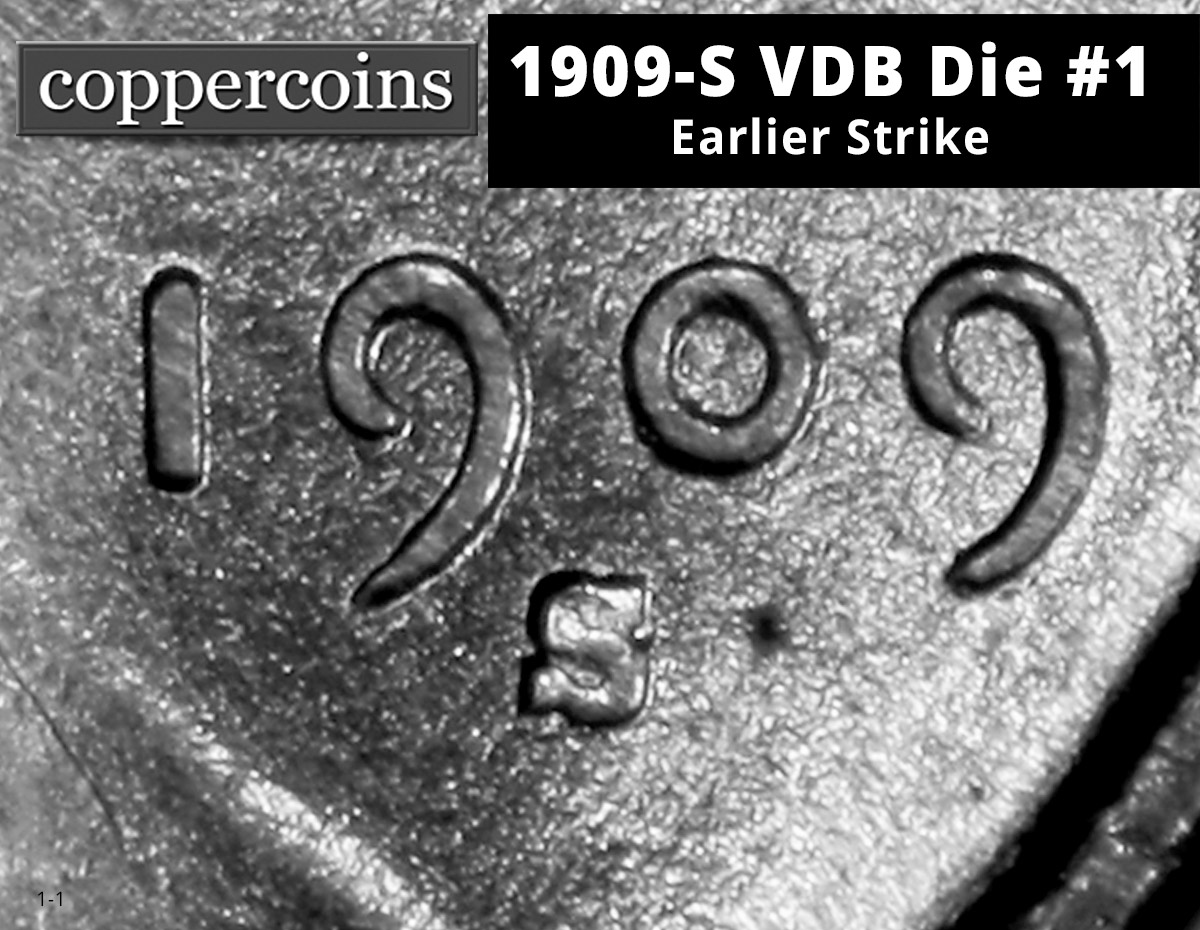
Die #01 Scarce. Mint mark quite high and left, close to the first 9; centerline passes between center date characters and tilts slightly forward. Often somewhat incomplete/soft punch. Mostly earlier die states.

How to recognize: Scarce. Mint mark quite high and left, close to the first 9; centerline passes between center date characters and tilts slightly forward. Often somewhat incomplete/soft punch. Mostly earlier die states.

Relative frequency: Scarce. Study sample: 34 of 312 (10.9%). Assumed die mintage: ~52,750. The least common of the four known dies. The mint mark is always somewhat incomplete (as if softly struck or punched) and sits very high and slightly left of a normal centered position. No major markers beyond mint-mark position itself; scarcity is reinforced by early-die-state survival.

  • 1909-S VDB Die #01 — high-left mint mark (earlier die state)
    1909-S VDB Die #01 — high-left mint mark (earlier die state)
  • 1909-S VDB Die #01 — later example with more complete strike
    1909-S VDB Die #01 — later example with more complete strike
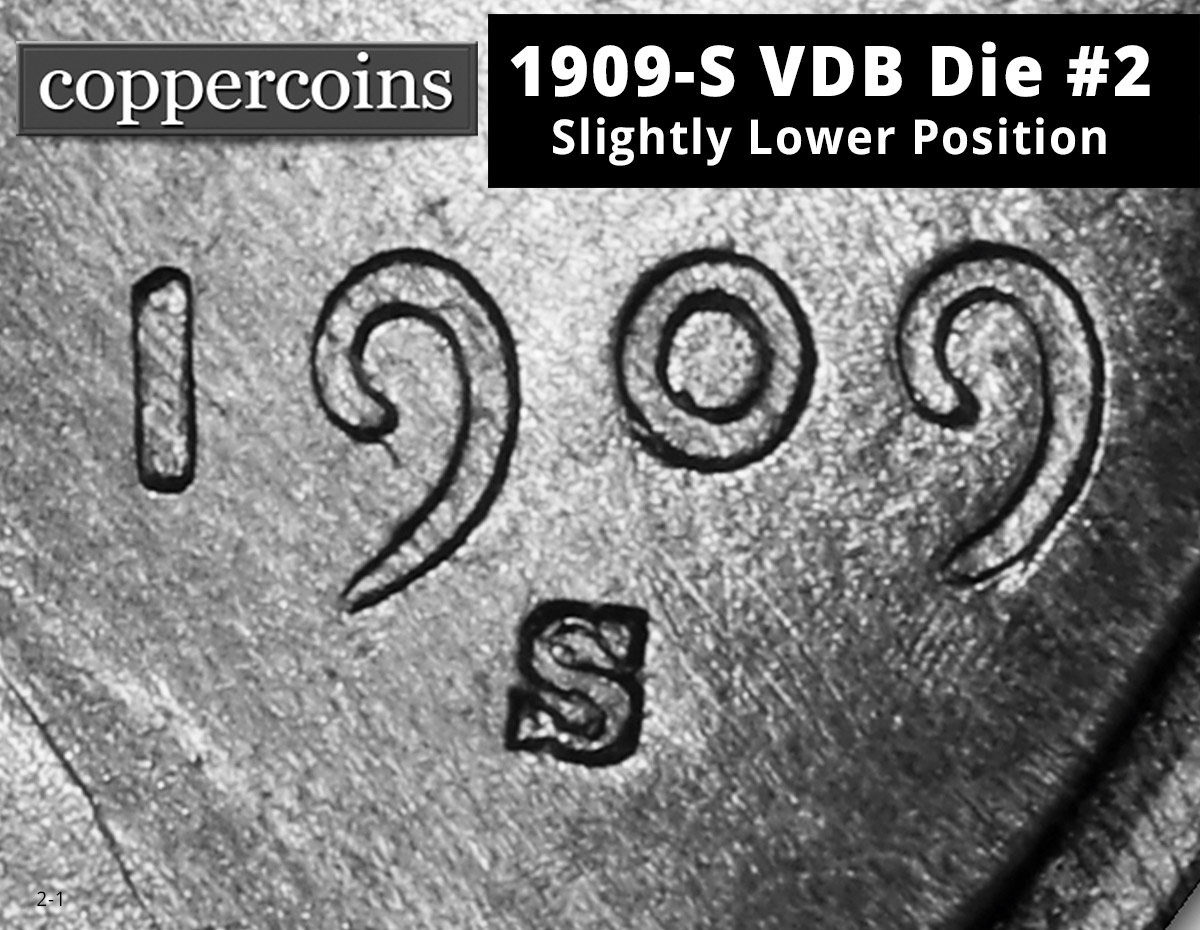
Die #02 Common. Mint mark lower than #01 and tilted slightly right; centerline of the S touches the left side of the zero. Often seen in higher uncirculated grades.

How to recognize: Common. Mint mark lower than #01 and tilted slightly right; centerline of the S touches the left side of the zero. Often seen in higher uncirculated grades.

Relative frequency: Common. Study sample: 109 of 312 (34.9%). Assumed die mintage: ~168,900. One of the more common dies and relatively available in uncirculated grades. Mint mark is slightly lower than Die #01 and tilted right enough that its centerline touches the far left side of the zero. Known to mid die state.

  • 1909-S VDB Die #02 — lower mint mark, slight right tilt
    1909-S VDB Die #02 — lower mint mark, slight right tilt
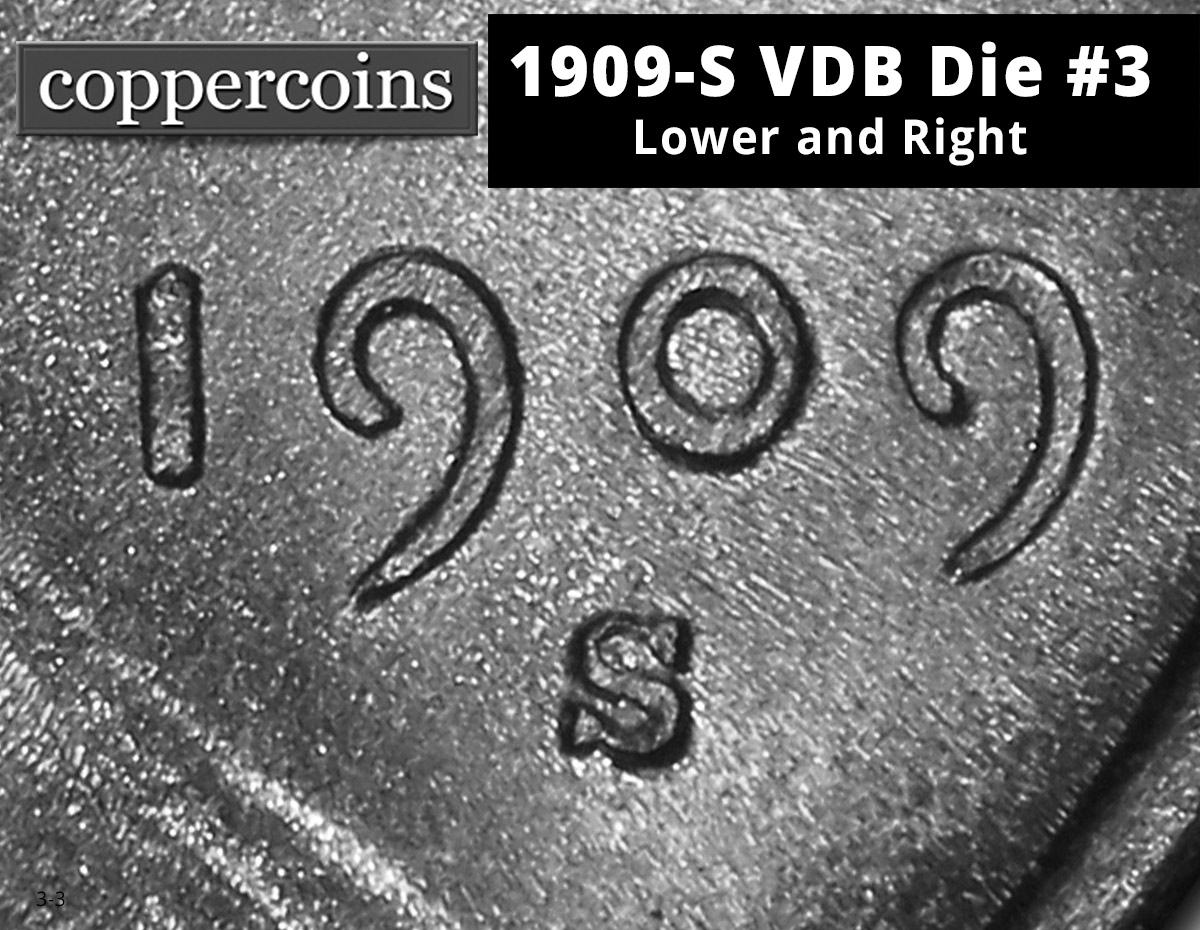
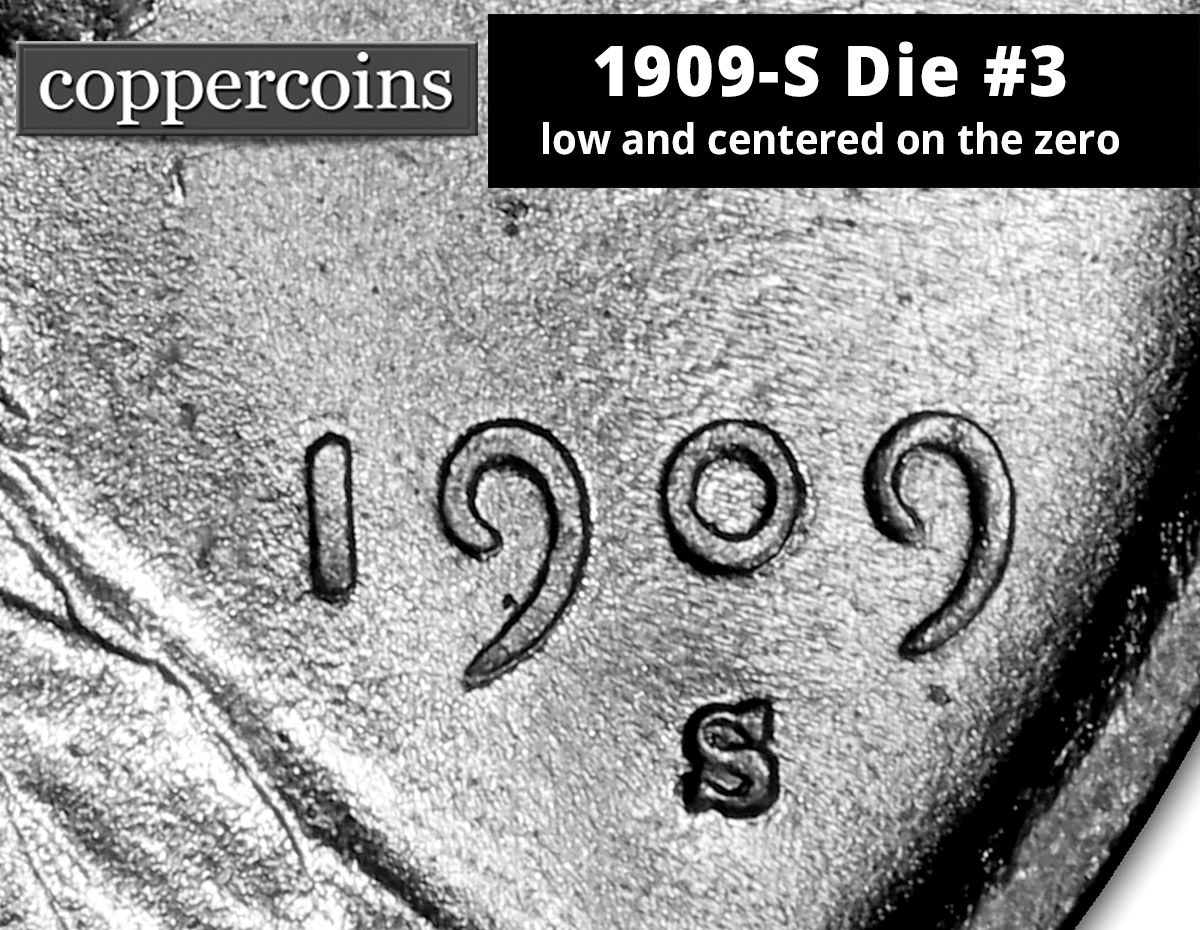
Die #03 Common. Mint mark somewhat low and right of center; only a very slight right tilt. Appeared most often in circulated grades in the study.

How to recognize: Common. Mint mark somewhat low and right of center; only a very slight right tilt. Appeared most often in circulated grades in the study.

Relative frequency: Common. Study sample: 94 of 312 (30.2%). Assumed die mintage: ~146,175. Second most common die found. Flow lines near the rim appear on many examples. In the study this die showed up more often in circulated grades than the other three, suggesting wider dissemination.

  • 1909-S VDB Die #03 — low/right mint-mark placement
    1909-S VDB Die #03 — low/right mint-mark placement
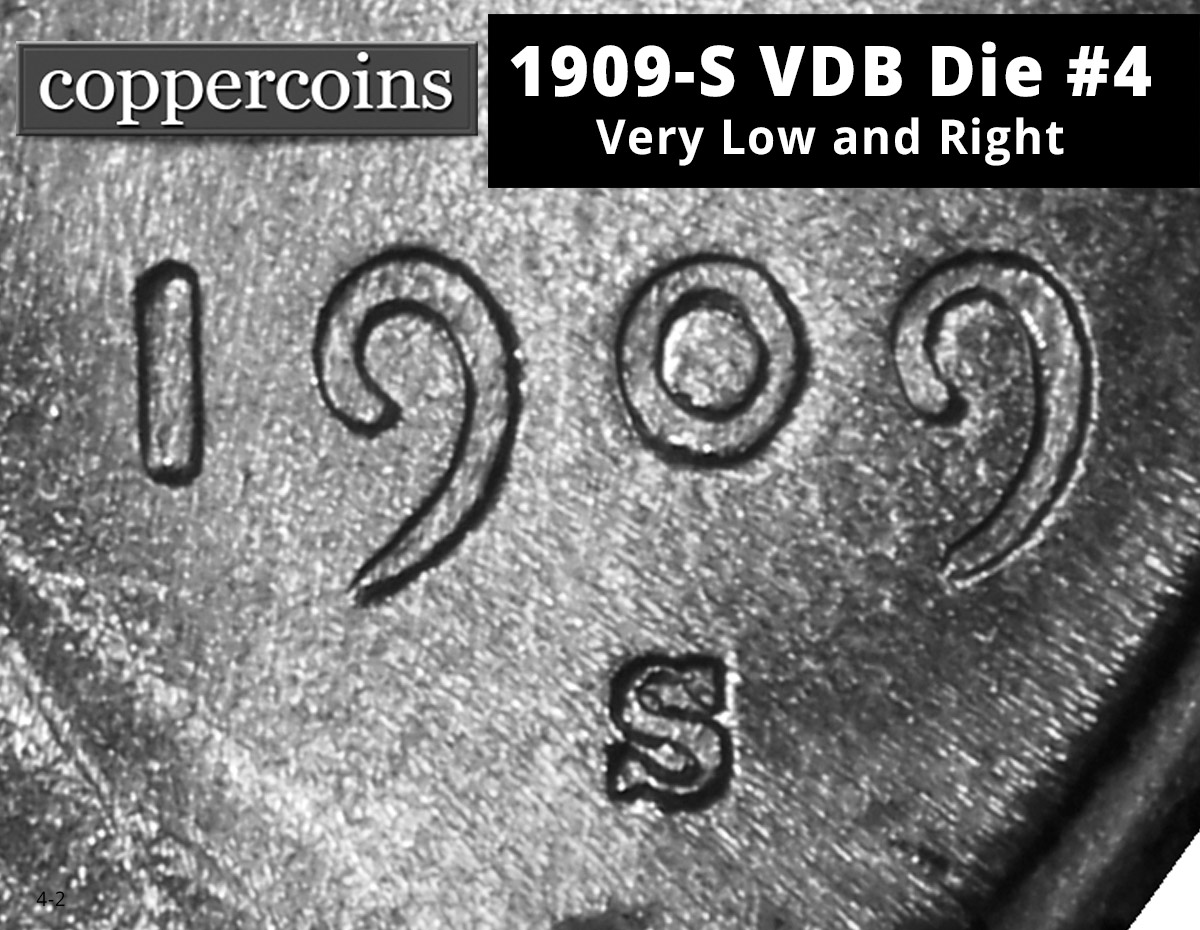
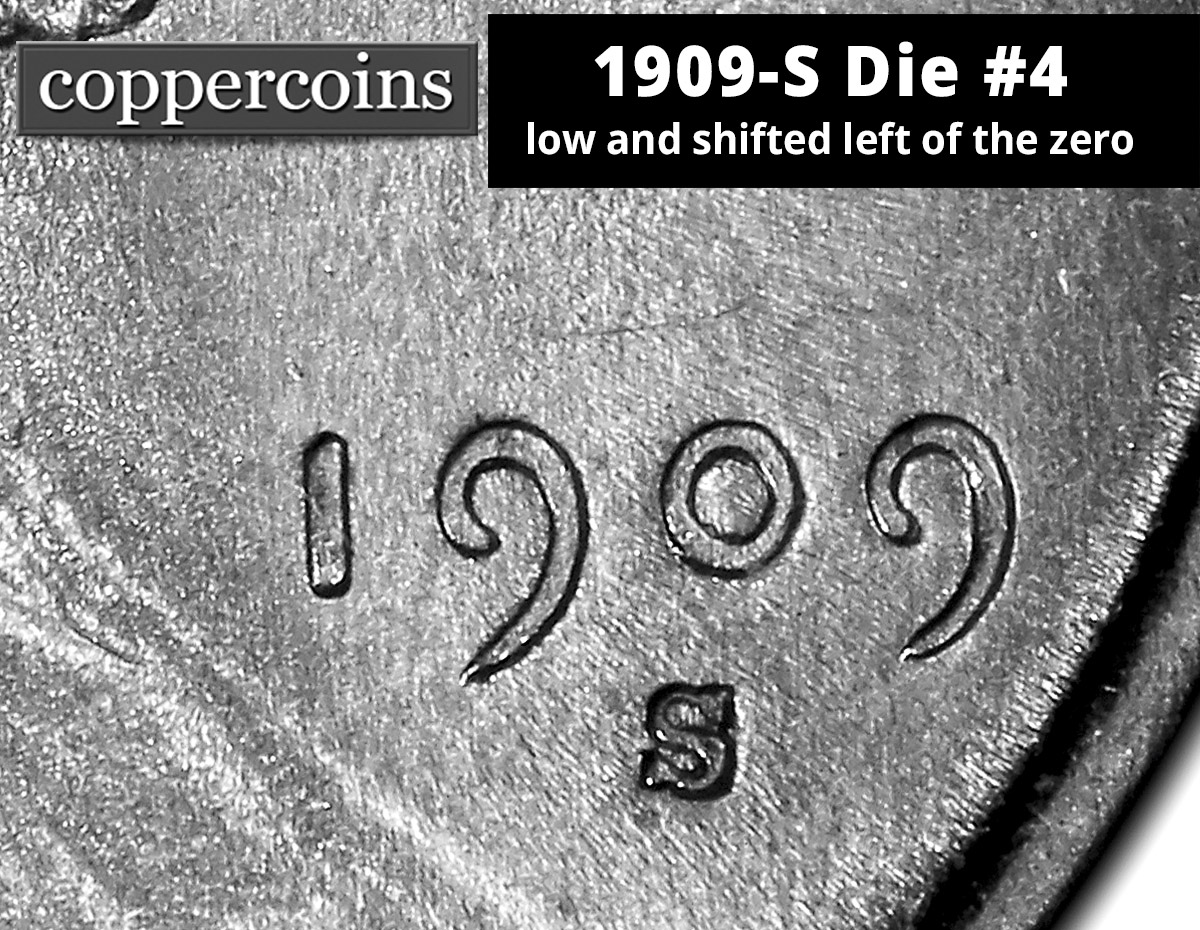
Die #04 Uncommon. Lowest and farthest-right mint mark of the four; nearly upright, centerline points inside the zero. Often shows N–S die scratches in the date area.

How to recognize: Uncommon. Lowest and farthest-right mint mark of the four; nearly upright, centerline points inside the zero. Often shows N–S die scratches in the date area.

Relative frequency: Uncommon. Study sample: 75 of 312 (24.0%). Assumed die mintage: ~116,150. The odd-ball of the issue — easy to separate once you see how far right and low the S sits. Secondary marker: north-to-south die scratches through the date and mint-mark area on many examples.

  • 1909-S VDB Die #04 — very low/right mint mark
    1909-S VDB Die #04 — very low/right mint mark

1909-S Key date

Mintage 1,825,000 from seven known dies (about 260,700 coins per die on average). Includes two well-known RPMs plus five position-only dies — mint-mark placement is critical.

Diagnostics in this package come from Chuck Daughtrey’s die study (Keys to the Lincoln, 2018). Mint marks were punched into working dies by hand until 1990, so position (and often tilt) separates dies. Overlays against fixed design elements such as the date make those differences obvious. Measurements between the closest point of the middle date digits and the mint mark help confirm which die struck a coin.

Study sample: 428 different 1909-S coins. Die numbers were assigned by this study as coins were examined.

Two dies carry repunched mint marks (RPMs). The remaining five are separated mainly by mint-mark position. Relative frequencies from the study: #01 scarce RPM (~9%), #02 common S/horizontal S (~26%), #03 common (~21%), #04 uncommon (~13%), #05 scarce (~9%), #06 uncommon (~12%), #07 uncommon (~11%).

Known fakes & alterations

Key and semi-key Lincoln cents are the focus of authenticators and counterfeiters alike. Common alteration methods include:

  • Adding a mint mark to a common Philadelphia issue of the same date (for example, turning a 1914 into a 1914-D).
  • Scraping or altering digits of a common date (for example, turning a 1944-D into a 1914-D).
  • Copying genuine coins by spark erosion or soft-die transposition.

Crude alterations usually fail under close study because device details and mint-mark character are wrong. Matching a coin to one of the few known genuine dies for the issue is a powerful authenticity check. When in doubt, use a trusted third-party grading service.

Added S mint marks on 1909 Philadelphia cents are the main alteration threat. RPM characteristics on Dies #01 and #02, or a clean match to one of the five position dies, strongly support genuineness.

Quick checklist

  1. Check first for the two RPMs (Die #01 and Die #02 / S over horizontal S)
  2. If not an RPM, match mint-mark height, left-right placement, and tilt
  3. Use centerline of the S through the zero of the date
  4. Die #05 = highest/left; Die #06 = lowest/farthest right

Die pairs that struck this issue

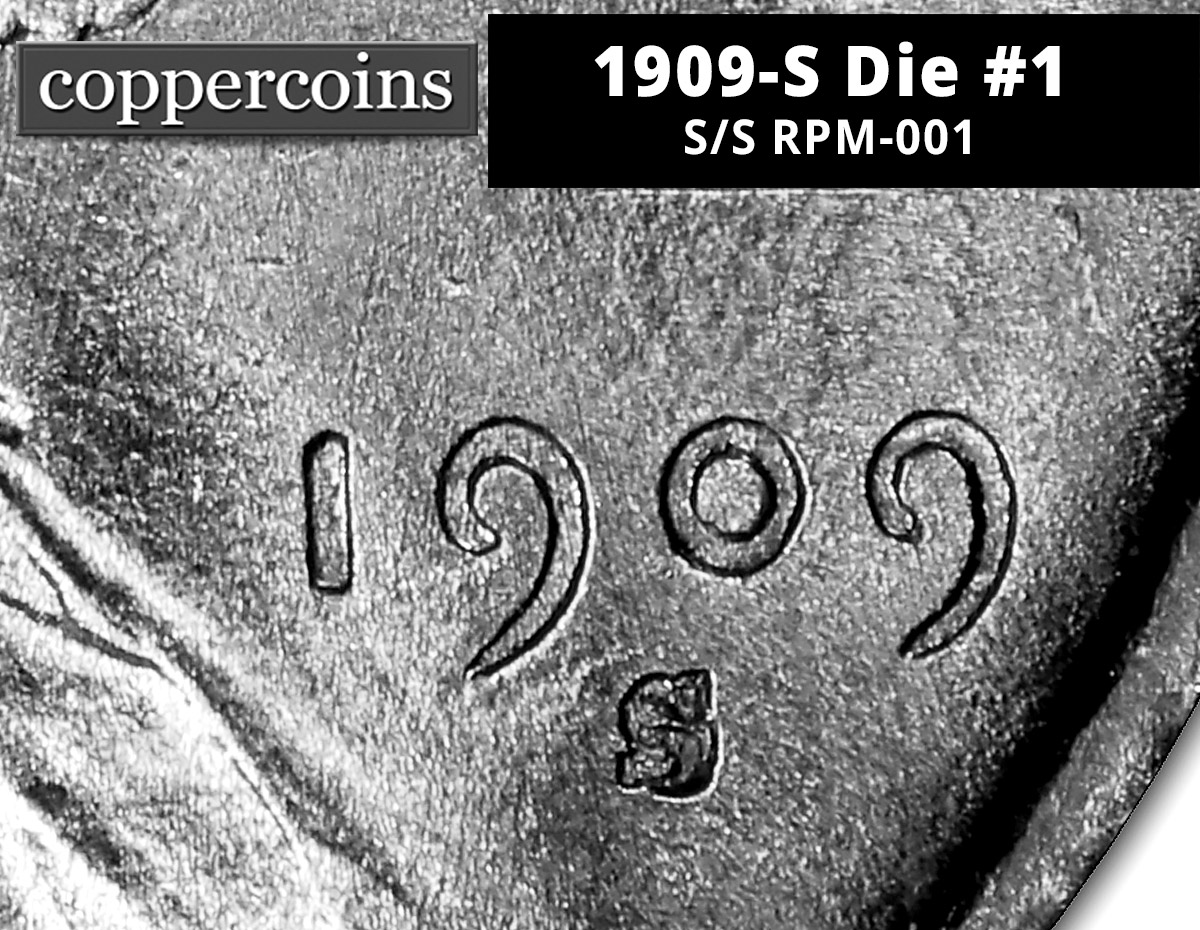
Die #01 Scarce RPM (1909S-1MM-001 / CONECA RPM-001). Nicest known RPM among key/semi-key Lincolns. N–S die scratches through date/mint mark on earlier strikes.

How to recognize: Scarce RPM (1909S-1MM-001 / CONECA RPM-001). Nicest known RPM among key/semi-key Lincolns. N–S die scratches through date/mint mark on earlier strikes.

Relative frequency: Scarce. Study sample: 38 of 428 (8.9%). Assumed die mintage: ~162,425. No markers beyond the RPM are required, though north–south die scratches through the date and mint-mark area appear on earlier strikes and can fade later.

  • 1909-S Die #01 — scarce RPM
    1909-S Die #01 — scarce RPM
  • 1909-S Die #01 — mint-mark detail
    1909-S Die #01 — mint-mark detail
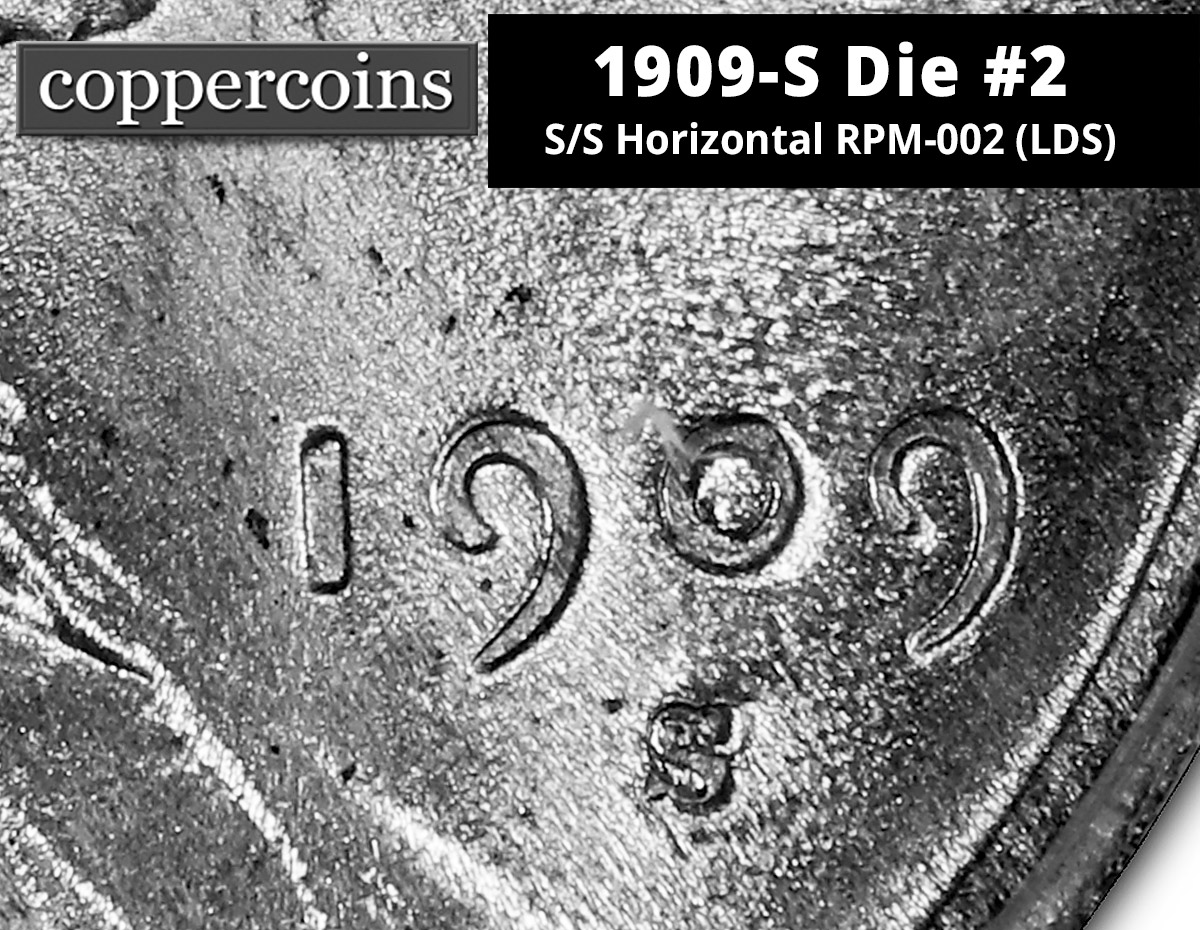
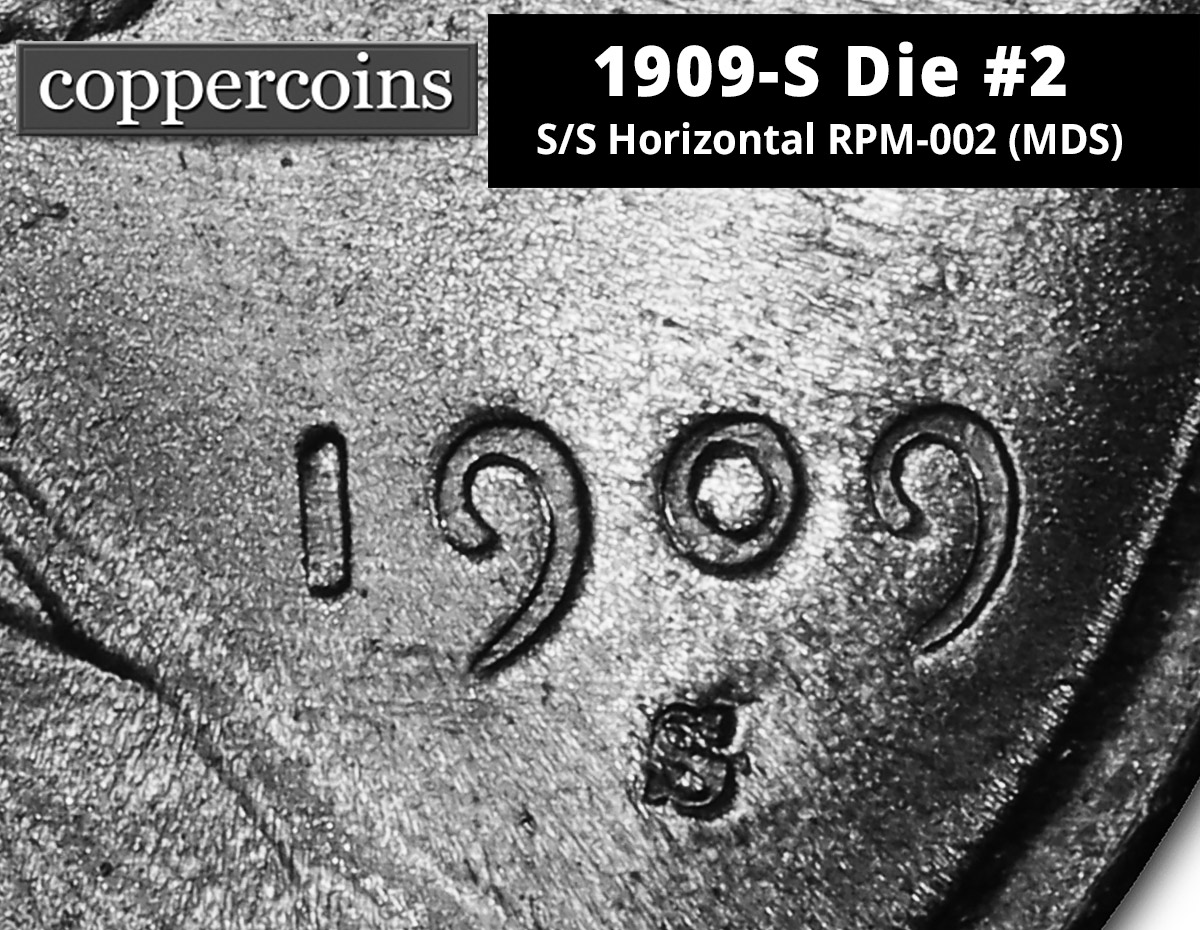
Die #02 Common. S over horizontal S RPM — secondary lower curve and serif rotated ~90° counterclockwise. Most common 1909-S die in the study (~25%).

How to recognize: Common. S over horizontal S RPM — secondary lower curve and serif rotated ~90° counterclockwise. Most common 1909-S die in the study (~25%).

Relative frequency: Common. Study sample: 109 of 428 (25.5%). Assumed die mintage: ~465,375. The only 1909-S RPM listed/recognized across major guides and grading services; often brings a small premium from interest rather than rarity. Secondary mint mark shows through the upper-right section of the primary S.

  • 1909-S Die #02 — S over horizontal S
    1909-S Die #02 — S over horizontal S
  • 1909-S Die #02 — later state with clearer secondary curl
    1909-S Die #02 — later state with clearer secondary curl
Die #03 Common. Mint mark low and far right; nearly upright so its centerline runs near the middle of the zero. Most common non-RPM die.

How to recognize: Common. Mint mark low and far right; nearly upright so its centerline runs near the middle of the zero. Most common non-RPM die.

Relative frequency: Common. Study sample: 91 of 428 (21.3%). Assumed die mintage: ~388,725. If a 1909-S is not one of the two RPMs, this is a frequent match. Distinguish from #04 and #06, which also sit low/right but differ in tilt and how far right the centerline falls.

  • 1909-S Die #03 — low/right mint mark
    1909-S Die #03 — low/right mint mark
Die #04 Uncommon. Low/right of center but farther left than #03; slight right tilt so centerline points to the left inside of the zero.

How to recognize: Uncommon. Low/right of center but farther left than #03; slight right tilt so centerline points to the left inside of the zero.

Relative frequency: Uncommon. Study sample: 55 of 428 (12.8%). Assumed die mintage: ~233,600. One of three low/right dies — closer to the horizontal center of the date (between the middle digits) than Dies #03 and #06.

  • 1909-S Die #04 — low/right, left of Die #03
    1909-S Die #04 — low/right, left of Die #03
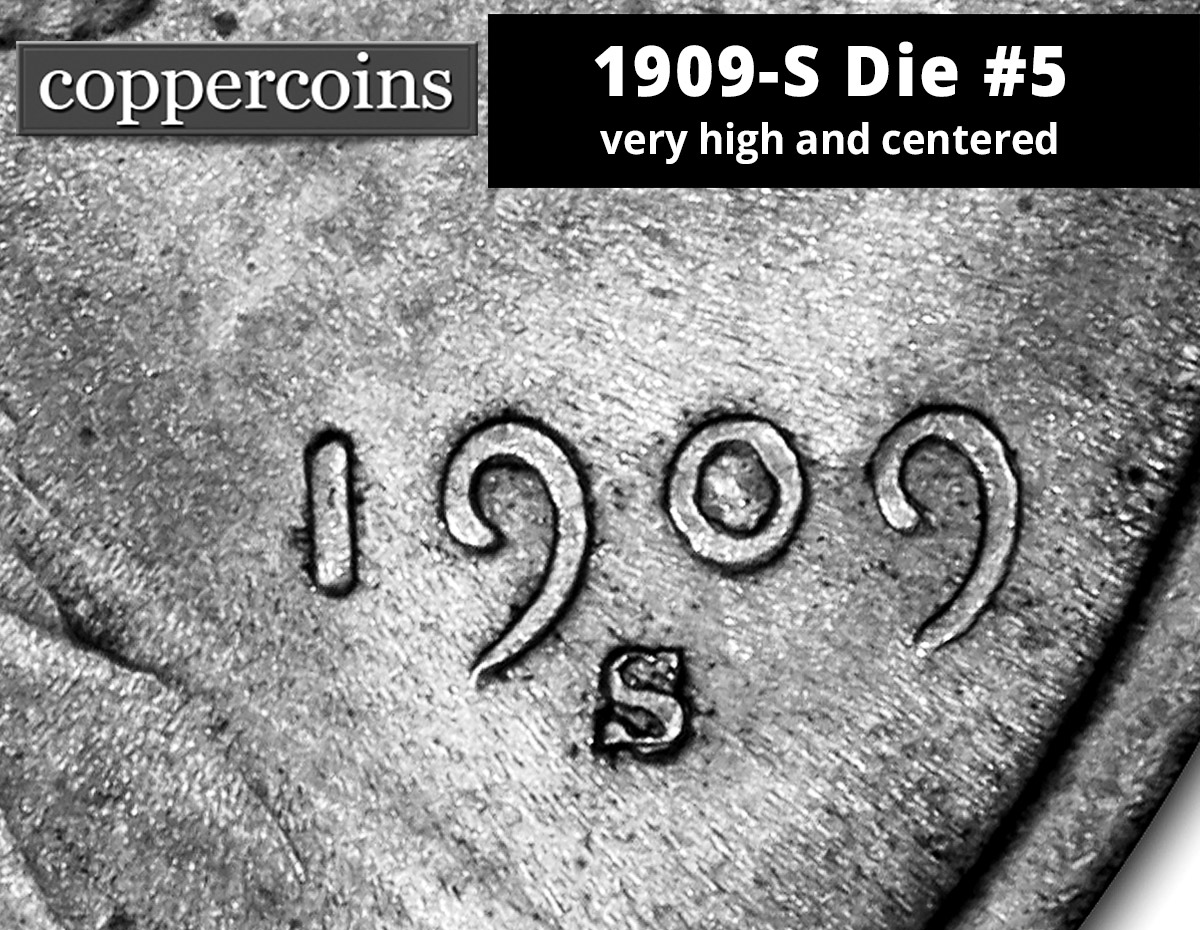
Die #05 Scarce. Highest mint-mark position of the issue (~0.25 mm from the 9). High and left — easiest non-RPM ID by position alone. Not known past mid die state.

How to recognize: Scarce. Highest mint-mark position of the issue (~0.25 mm from the 9). High and left — easiest non-RPM ID by position alone. Not known past mid die state.

Relative frequency: Scarce. Study sample: 37 of 428 (8.7%). Assumed die mintage: ~158,775. Most scarce 1909-S die in the study. Often circulated or lower uncirculated; assumed early retirement.

  • 1909-S Die #05 — high-left mint mark (scarce)
    1909-S Die #05 — high-left mint mark (scarce)
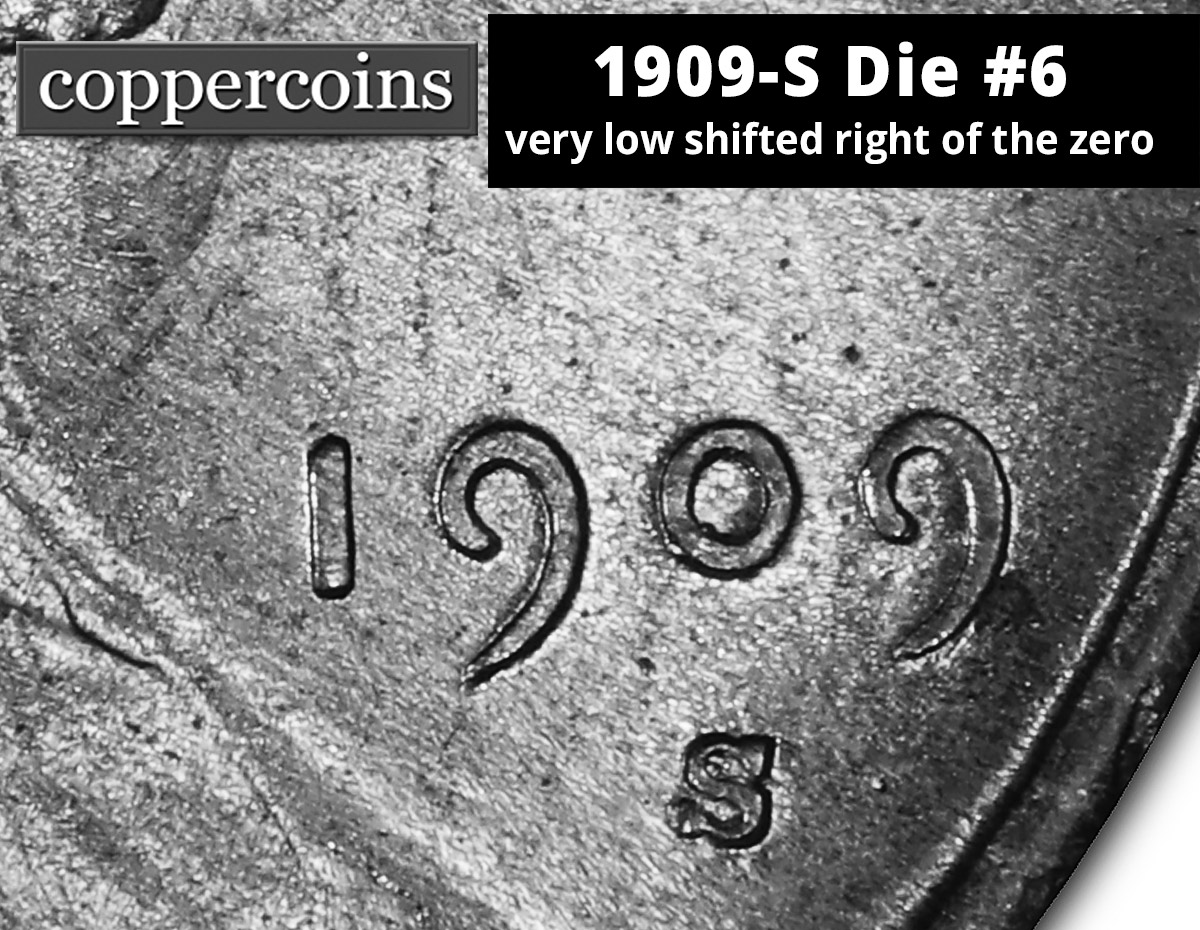
Die #06 Uncommon. Lowest and farthest-right mint mark (~0.9 mm from the 9); right tilt so centerline points to the right inside edge of the zero.

How to recognize: Uncommon. Lowest and farthest-right mint mark (~0.9 mm from the 9); right tilt so centerline points to the right inside edge of the zero.

Relative frequency: Uncommon. Study sample: 53 of 428 (12.3%). Assumed die mintage: ~224,475. Can be confused with Die #03 until the stronger right tilt / extreme right centerline is noticed. Assumed third most populous die overall, but below average per-die mintage so categorized uncommon.

  • 1909-S Die #06 — extreme low/right mint mark
    1909-S Die #06 — extreme low/right mint mark
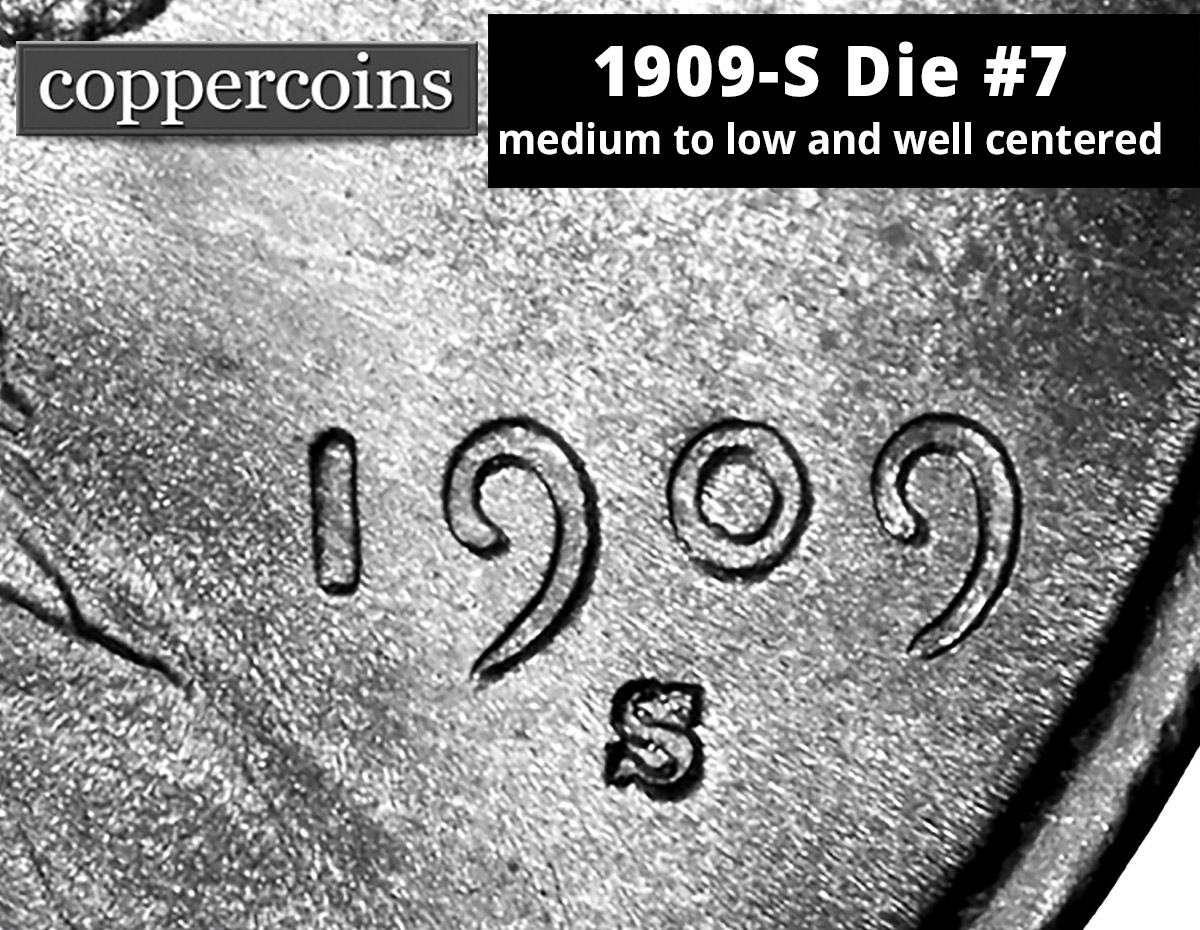
Die #07 Uncommon. Well centered vertically, a bit right horizontally, slight right tilt; centerline touches left side of the zero. Similar position to #01 but without the RPM.

How to recognize: Uncommon. Well centered vertically, a bit right horizontally, slight right tilt; centerline touches left side of the zero. Similar position to #01 but without the RPM.

Relative frequency: Uncommon. Study sample: 45 of 428 (10.5%). Assumed die mintage: ~191,625. Very typical centered appearance. Later states show mottled fields from die wear with a slightly satiny look in better grades.

  • 1909-S Die #07 — centered, slight right tilt (no RPM)
    1909-S Die #07 — centered, slight right tilt (no RPM)
Design types Obverse and reverse engravings in use for 1909

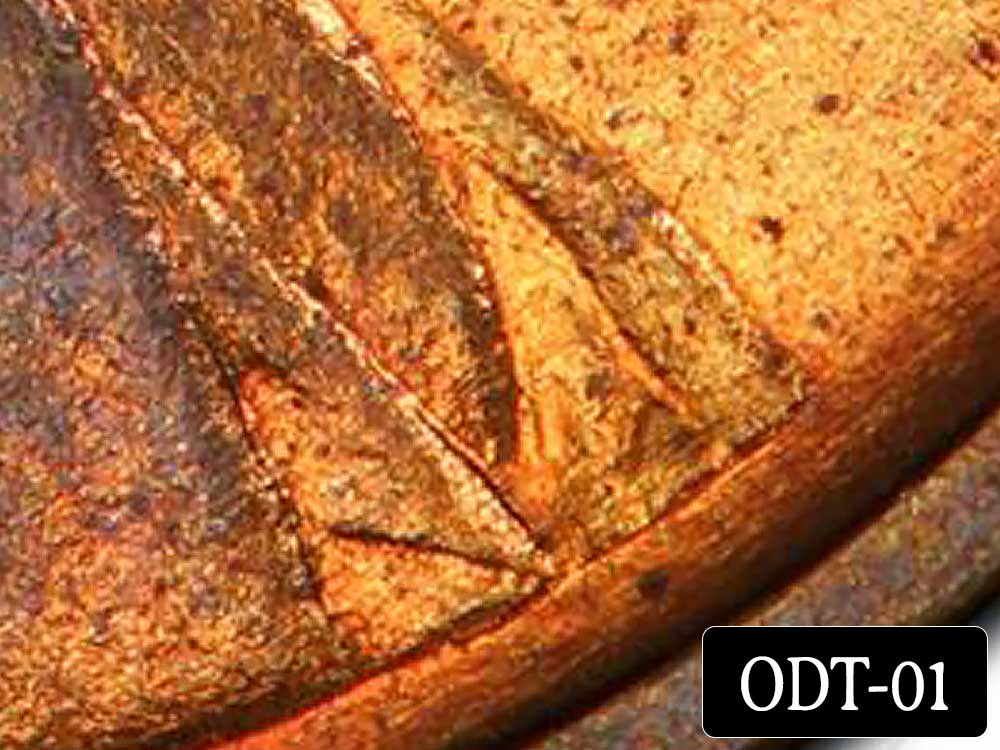
Obverse design types (ODT)

Reverse design types (RDT)

Mint mark types Punch styles used on 1909 Lincoln cents
Typical values Series price guide for regular-issue 1909 cents

1909 Lincoln cents from the CopperCoins series price guide (August/September 2026 edition) — approximate values only, not offers to buy or sell. Business strikes show separate BN, RB, and RD lines where priced.

Business strike

Issue G4 VG8 F12 VF20 EF40 EF45 AU50
1909-P BN 2.35 3.05 4.15 5.90 7 8 10.25
1909-P RB
1909-P RD
1909-P VDB BN 7.90 9.40 11.25 12 13.75 14 15
1909-P VDB RB
1909-P VDB RD
1909-S BN 86 98 114 144 150 170 199
1909-S RB
1909-S RD
1909-S VDB BN 820 920 1,075 1,275 1,350 1,450 1,600
1909-S VDB RB
1909-S VDB RD
Issue G4 VG8 F12 VF20 EF40 EF45 AU50
1909-P BN 2.35 3.05 4.15 5.90 7 8 10.25
1909-P RB
1909-P RD
1909-P VDB BN 7.90 9.40 11.25 12 13.75 14 15
1909-P VDB RB
1909-P VDB RD
1909-S BN 86 98 114 144 150 170 199
1909-S RB
1909-S RD
1909-S VDB BN 820 920 1,075 1,275 1,350 1,450 1,600
1909-S VDB RB
1909-S VDB RD

Proof

Issue PR60 PR61 PR62
1909-P BN 340 300 360
1909-P RB 355 325 390
1909-P RD 810
1909-P VDB BN 5,000 2,950 4,100
1909-P VDB RB 4,200 5,300
1909-P VDB RD 8,400
Issue PR60 PR61 PR62
1909-P BN 340 300 360
1909-P RB 355 325 390
1909-P RD 810
1909-P VDB BN 5,000 2,950 4,100
1909-P VDB RB 4,200 5,300
1909-P VDB RD 8,400
Articles and videos Related reading and watching for 1909
Die varieties in the catalog Attributed 1909 dies by mint and variety type

Our attribution catalog for 1909—doubled dies, repunched mint marks, and related varieties documented by die number. This is specialist research beyond regular issue Lincoln cents.

Search all 1909 dies Variety value guide for 1909

Catalogued dies for 1909

Number of assigned dies in the CopperCoins catalog, by mint and variety type. Click a count to search that group.

Mint DO Doubled Die Obverse DR Doubled Die Reverse MM Repunched Mint Mark Total
Philadelphia (P) N/A 12
San Francisco (S) 0 0 2
All mints 3 9 2 14

(sponsored)